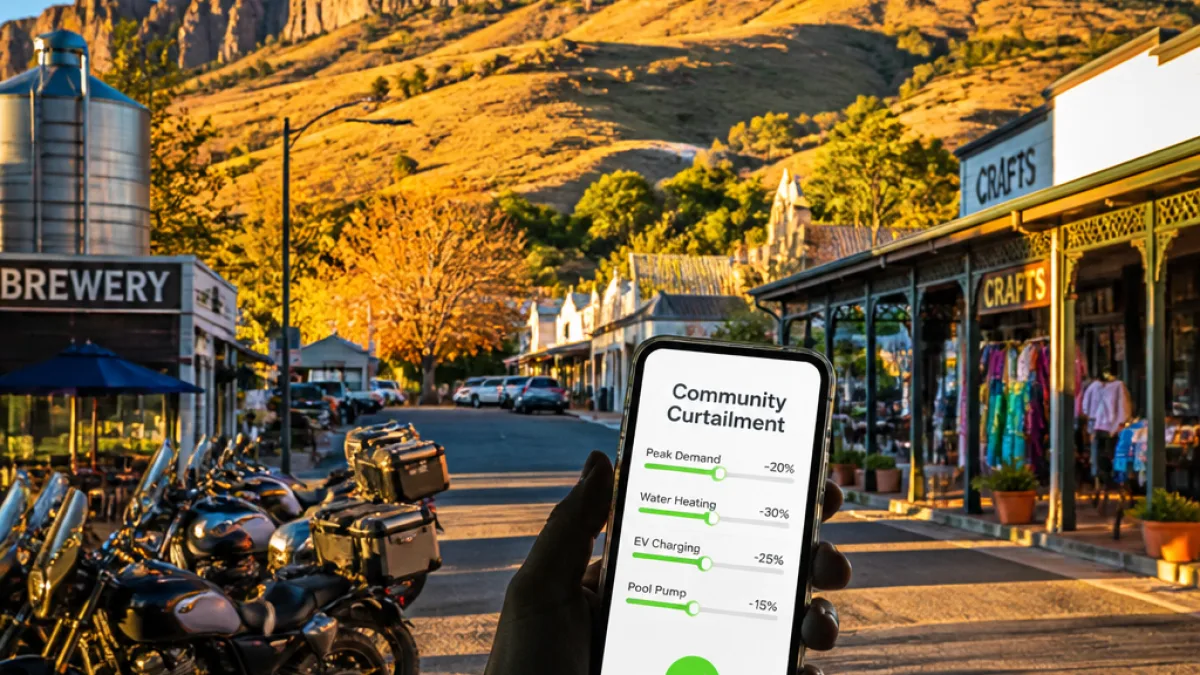
Clarens, a small Free State town known for its brewery and biker culture, has adopted a community-driven approach to protecting its local electricity network by operating a load‑curtailment programme via an app, according to reporting by MyBroadband.
Local action against national disruption
The initiative began during the severe load‑shedding in 2023. Rather than rely solely on Eskom’s rotational power cuts, the Clarens community started using an app to orchestrate reduced consumption across participating properties. The measure aims to lower demand on the municipal distribution network and avoid the need for forced outages.
The model in Clarens is significant because it demonstrates a neighbourhood-level strategy that increases resilience without requiring large capital investments in generation or storage. The town’s approach focuses on behavioural change and coordinated demand reduction across households and businesses.
Why Clarens is suited to a community scheme
Clarens sits beneath the Maluti Mountains and has a history distinct from larger Free State towns. It remained primarily a farming village until the 1940s and later developed into a holiday and tourism destination from the 1950s onward. Attractions such as sandstone cliffs, trout fishing and proximity to Golden Gate Highlands National Park helped build a tourism economy by the 2010s.
The town’s social character — including artists and craftspeople who settled there during the 1980s and 1990s — and a strong local identity tied to hospitality and small businesses appear to have created a basis for cooperative action.
| Year / period | Notable development in Clarens |
|---|---|
| 1910–1912 | Founding farms sold and commission appointed to create the settlement |
| 1940s | Transition from purely agricultural service centre |
| 1950s–1970s | Growth as a holiday and tourism destination |
| 1980s–1990s | Arrival of artists and craftspeople; shift in local economy |
| 2010s | Mature tourism economy |
How a community load‑curtailment programme works
While details of the specific app used in Clarens are not supplied in the report, community curtailment schemes typically rely on a few common elements:
- an opt‑in register of households or businesses willing to reduce consumption;
- a communication platform (in this case an app) to signal when reductions are needed;
- pre‑agreed reduction actions such as turning off non‑essential appliances, reducing heating or shifting loads to off‑peak times;
- local coordination so reductions are staggered and effective for the distribution network.
These measures do not replace longer‑term infrastructure solutions such as new generation, storage or network reinforcement, but they can provide immediate relief and buy time while those investments are made.
Local benefits and limitations
For Clarens, benefits include potentially fewer forced outages, more stable supply for critical businesses (hotels, restaurants, galleries) and reduced economic disruption during high strain on the grid. The approach also builds civic cooperation around a shared problem.
Limitations are practical: voluntary curtailment depends on community buy‑in and cannot substitute for larger scale solutions if demand continues to outstrip supply. It also requires clear, trusted communication and a way to measure compliance or the programme’s effectiveness.
The town’s history — from its early 20th‑century founding through shifts from farming to tourism and an arts community — helps explain why local residents may be willing to adopt mutual measures to protect their economy and way of life.
What Clarens’ experience means for other towns
Clarens’ experiment offers a template for other small towns considering locally driven demand management. Municipalities and communities seeking to reduce the risk of rotational outages could evaluate similar opt‑in, app‑based schemes as a short‑term resilience measure, while continuing to press for longer‑term investments in generation, storage and network upgrades.
MyBroadband reported the Clarens programme; the town’s long civic memory and tourism‑centred economy appear to have underpinned the community response to the 2023 crisis. Whether the model can scale or be formalised by municipalities will depend on detailed monitoring, regulatory clarity and local capacity to coordinate action.
Practical takeaways for residents:
- Opting in to local curtailment programmes can reduce the likelihood of forced outages.
- Small, coordinated reductions across many households can have a measurable effect on a local network.
- Long‑term solutions remain necessary: community action complements but does not replace infrastructure investment.