Argentina has renewed economic pressure on the Falkland Islands, signalling that the territory’s oil and fisheries industries could face fresh constraints as the South Atlantic archipelago again becomes the focus of tense political rhetoric. The move comes amid a domestic political backdrop in Buenos Aires, according to recent reporting.
Small population, outsized stakes
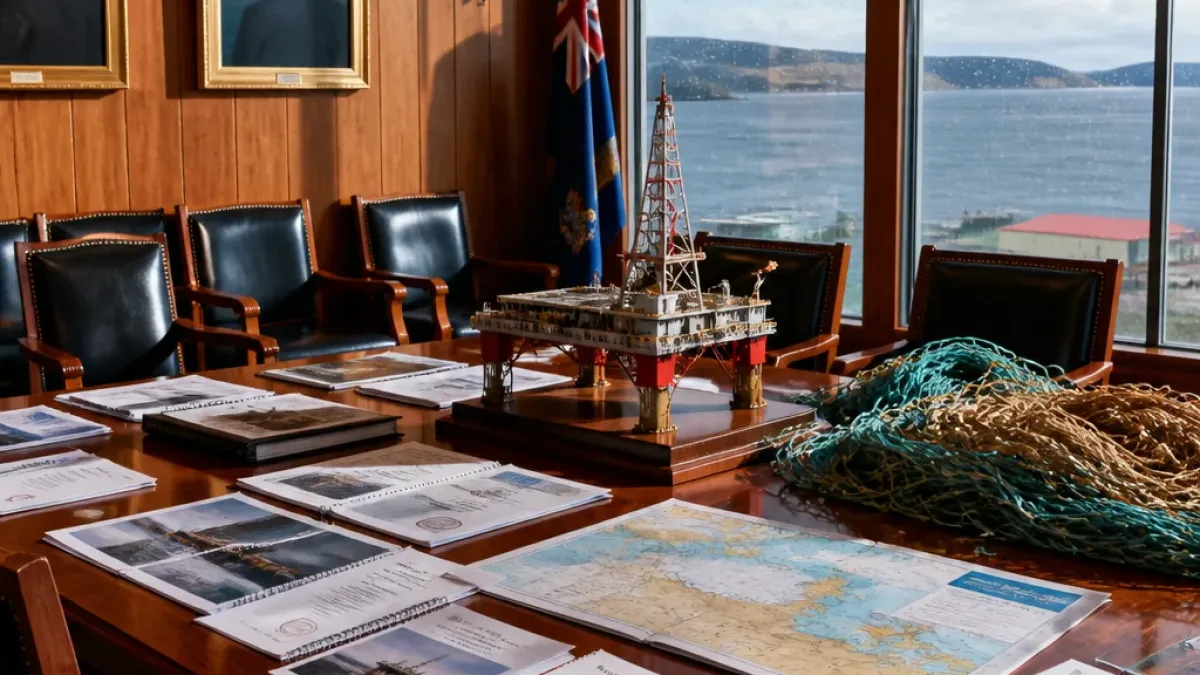
The Falkland Islands are a remote territory of roughly 3,600 residents spread across a 778‑strong archipelago. Local government functions take place in Stanley, the small capital whose assembly meets in a wood‑panelled courtroom decorated with portraits of governors and a portrait of King Charles. Assembly members, including Roger Spink and Stacy Bragger, sit alongside community figures when local issues are debated.
Despite the small population, the islands’ economic profile has been shaped by a handful of high‑value sectors: fisheries and potential offshore hydrocarbons. Those sectors underpin incomes, employment and public revenue for the territory. Renewed political pressure therefore risks hitting the narrow economic base that supports most households.
“There’s no turning back, we can expect them by dawn,” the governor, Rex Hunt, had said then.
What the current rhetoric means for business
Public statements and actions aimed at the islands’ productive sectors can affect several business variables:
- Investment risk: International explorers and service companies price geopolitical and operational risk into project valuations. Elevated political tension can raise the cost of capital and delay investment decisions.
- Insurance and shipping costs: Insurers and underwriters reassess premiums where sovereignty disputes increase the likelihood of disruption, raising costs for companies that rely on maritime access.
- Local livelihoods: Fisheries and oil‑related activities are major employers and revenue sources for the islands; threats to these sectors can have a material impact on household incomes.
For South African businesses and financiers that follow global offshore markets, changes in risk perception in the South Atlantic can influence where capital flows. While no specific South African exposures are identified in the reporting, the broader re‑pricing of frontier oil risk affects marine services, equipment suppliers and insurance markets that operate across jurisdictions.
Governance and community context
Local governance is modest in scale: a dozen or so inhabited islands are served by an assembly of eight members. Proceedings may cover routine matters such as internet contracts and consultations about prospective salmon farms, yet the community remains acutely conscious of the islands’ history. Forty‑four years after the 1982 conflict, references to past invasions remain part of the public memory and inform how security and political pressure are perceived.
| Metric | Figure |
|---|---|
| Resident population | 3,600 |
| Number of islands in archipelago | 778 |
| Years since 1982 conflict (as reported) | 44 |
Small communities such as those on the Falklands are particularly sensitive to any disruption in primary sectors: a single offshore project delayed or a fisheries restriction introduced can ripple through employment, supply chains and public finances.
Regional implications and next steps
Renewed Argentine pressure on the islands’ economic activities will be watched closely by investors, insurers and regional governments. Key near‑term indicators to monitor include any formal measures aimed at the islands’ oil industry or fisheries, changes in shipping or insurance premiums for the area, and statements from companies active or planning activity offshore.
For households on the islands, the immediate question is how political rhetoric will translate into concrete actions that affect jobs and incomes. For investors and commercial operators, the priority is reassessing operational and country risk to determine whether projects remain commercially viable under heightened political uncertainty.
Reporting indicates the current escalation is tied to domestic political dynamics in Argentina. How those dynamics play out will determine whether the pressure remains rhetorical or evolves into measures with tangible economic consequences for the Falklands and for the wider South Atlantic business environment.
WE NEWS does not provide financial advice. Readers with financial interests in offshore projects should consult professional advisers and official notices before making investment decisions.