
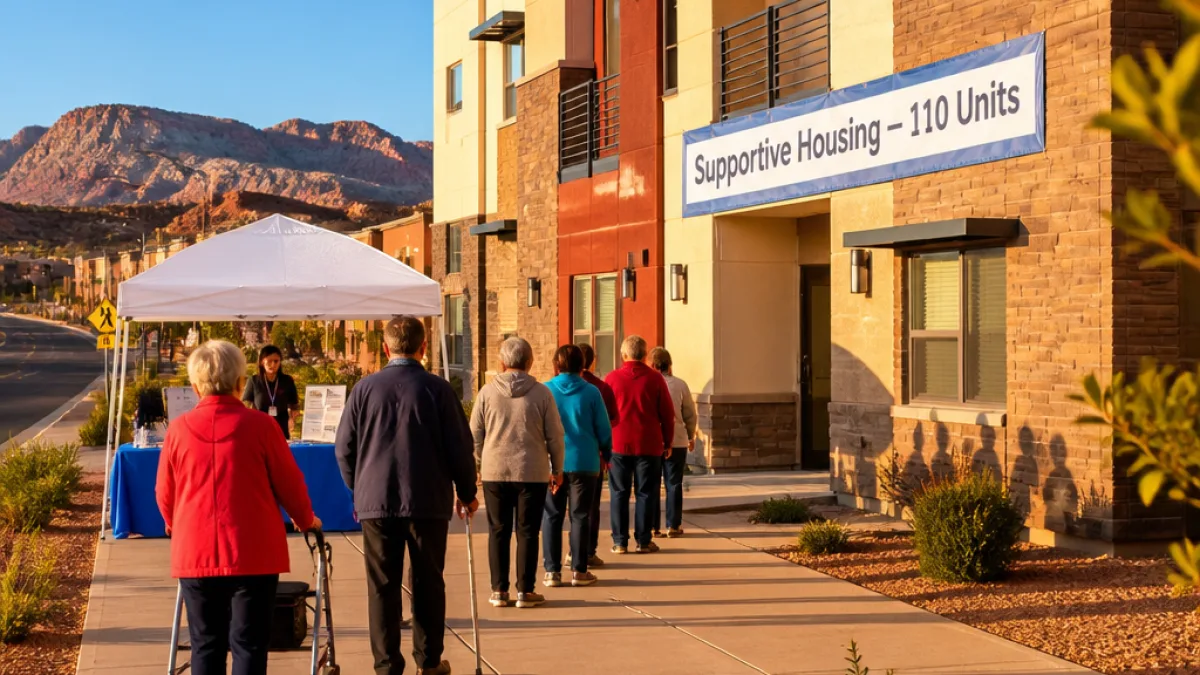
ST. GEORGE, Utah — A newly completed supportive housing complex in St. George has drawn immediate demand from people facing homelessness, particularly older residents, underscoring a widening crisis for seniors across Utah.
Rapid uptake at Switchpoint Red Hills
Switchpoint’s Red Hills campus at 999 E. Red Hills Parkway opened 110 permanent supportive housing units this summer. According to Switchpoint officials, the units were snapped up within a week, and roughly 40% of the apartments went to seniors — a group the nonprofit says is among its highest-demand populations.
Units are reserved for people who have been qualified as homeless and who earn at or below 33% of the area median income, which Switchpoint described as about $24,000 a year. Rents are scaled to income; Switchpoint officials said the highest rent currently charged is under $600 per month.
Why seniors are being pushed into homelessness
Switchpoint Chief Implementation Officer Zachary Almaguer said multiple economic pressures are colliding to increase senior homelessness: rising real estate prices, higher food and fuel costs, unexpected expenses and difficulties finding sustainable employment on fixed incomes.
“It’s a lot of different reasons all colliding together,” Almaguer said. “Sometimes it’s planning for rent to be one thing, and then the massive increases in real estate prices we’ve seen.”
Almaguer and Switchpoint officials emphasize that housing alone will not solve the problem. They called for a combination of affordable and workforce housing, emergency shelters, food support, and case-managed services to help residents maintain stability.
Resident perspective
Among those who moved into the complex is senior resident Bruce Raftery, who said the development offers a crucial safety net.
“If you don’t have places like this, they don’t. This has been a God save for these 110 people,” Raftery said.
Funding and partnerships
Switchpoint financed the Red Hills facility through low-income housing tax credits and a network of partners. Public and private supporters named by Switchpoint include Intermountain Health, the Utah Office of Homeless Services and American Express. The collaborative funding model is typical for permanent supportive housing projects that combine capital subsidies and operating supports to keep rents affordable.
| Item | Detail |
|---|---|
| Total units | 110 |
| Portion for seniors | 40% (about 44 units) |
| Income eligibility | At or below 33% AMI (~$24,000/year) |
| Maximum current rent | Under $600/month |
Services beyond housing
Switchpoint leaders said the site will connect residents to support services intended to reinforce long-term stability. Those services include case management, life-skills coaching and job-readiness supports. Almaguer said matching housing with wraparound services reduces returns to homelessness and increases chances that residents will retain housing and improve financial security.
“It’s not just housing,” Almaguer said. “It’s things like support services with case managers who can meet with individuals to make sure that life skills, job skills, and training are set in place. But it’s also things like emergency shelters and food pantries.”
Broader implications for Utah
Advocates say the speed with which the Red Hills units filled is a sign of unmet need statewide. The development provides a model for how communities can combine public resources, healthcare partners and corporate philanthropy to expand capacity quickly, but Switchpoint officials stressed that many more units and broader policy changes are required to meet rising demand.
- Switchpoint’s Red Hills opened with 110 units, filling within a week.
- 40% of units went to seniors — roughly 44 apartments.
- Eligibility is for households earning at or below 33% AMI (~$24,000/year); rents scale to income, with the highest currently below $600.
For seniors like Raftery, the complex is a lifeline. For local leaders and service providers, it highlights the urgency of expanding affordable housing and strengthening support networks to prevent further displacement of older residents across Utah.
(Spencer Holloway is the state correspondent for WE NEWS.)

















