
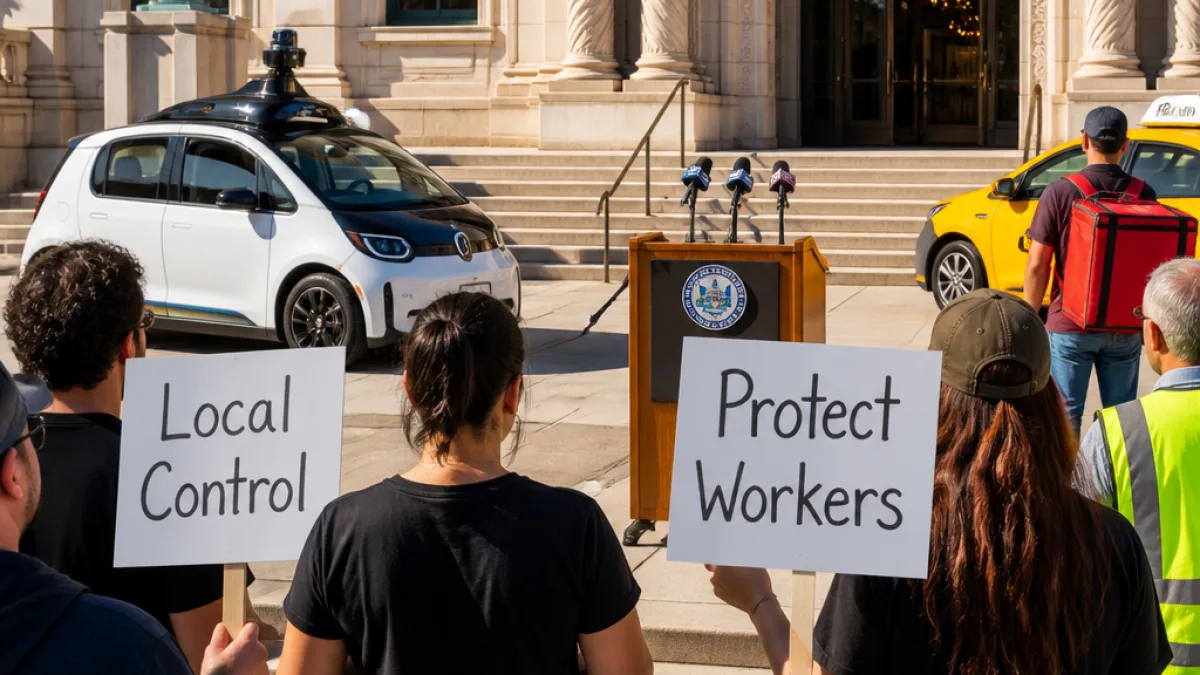
San Diego officials and community allies on Monday called for a slowdown in the rollout of autonomous passenger vehicles and stronger protections for workers, residents and local governments as Alphabet's Waymo, Amazon's Zoox and Tesla's Cybercabs expand services across the region.
Council seeks to restore local decision-making
Councilmembers Sean Elo-Rivera and Marni von Wilpert convened a news conference before a City Council discussion to urge state and federal lawmakers to "restore local control over autonomous vehicle passenger service." The councilmembers were joined by transportation workers, labor leaders and community advocates.
The resolution the City Council is set to discuss asks the state Legislature and Gov. Gavin Newsom to support measures that would give cities more authority over where and how autonomous vehicles (AVs) operate, and to require AV operators to comply with local rules on noise, circulation and loading, as well as protections for data privacy.
"Thousands of San Diegans earn their living as taxi, rideshare, and delivery drivers," the councilmembers' statement read. "As autonomous vehicle and AI technologies continue to expand, city leaders and workers will call for an approach to innovation that includes the voices of impacted workers and communities and ensures technological advancement does not come at their expense."
Specific asks aimed at lawmakers and operators
The council resolution supports House of Representatives Bill 10033, the AV Emergency Response Coordination Act, which would create federal emergency coordination requirements for AV manufacturers and operators. The resolution also urges AV operators to adopt operational and siting practices sensitive to neighborhood concerns.
Key requests outlined in the council's statement include:
- Restoring local authority over AV passenger services;
- Requiring AV operators to comply with local noise and nuisance laws;
- Reducing unnecessary empty-vehicle circulation;
- Limiting loading zones to active passenger and business use;
- Protecting residents' data privacy; and
- Avoiding siting charging hubs and fleet facilities near homes, schools, healthcare institutions and public safety facilities.
What the council will debate
The City Council scheduled discussion of the resolution for 2 p.m. Monday. The news conference by Elo-Rivera and von Wilpert began at 1 p.m., giving councilmembers and the public a chance to hear from labor and community representatives before the formal council session.
The move signals growing municipal concern about how rapidly AV companies are deploying vehicles and infrastructure without local approval of routing, facility siting or workforce impacts. The companies named in the council's announcement — Alphabet/Waymo, Amazon/Zoox and Tesla — are among those expanding services in urban areas nationwide and have drawn scrutiny in other jurisdictions over safety, noise, traffic patterns and job displacement.
Local stakes: jobs, neighborhoods and emergency response
Councilmembers framed their effort as a response to concrete local stakes. Thousands of San Diegans work as taxi, rideshare and delivery drivers whose livelihoods could be affected by AVs. Neighborhoods could see increased traffic from empty vehicles circulating to reposition fleets, or experience new noise and activity related to charging and maintenance facilities.
The resolution also raises emergency coordination as a federal priority. Backers argue unified protocols and reporting requirements would improve public safety response when AVs are involved in incidents or system failures.
| Issue | Requested Action |
|---|---|
| Local control | Restore municipal authority over AV passenger services |
| Worker protections | Support policies to protect taxi, rideshare and delivery workers |
| Neighborhood impacts | Limit empty-vehicle circulation; site facilities away from sensitive locations |
The council's action does not itself create state or federal law, but it aims to influence lawmakers in Sacramento and Washington. If adopted, the resolution would formally request state and federal intervention to shape how AV services expand in San Diego, emphasizing local voices and worker protections as part of any deployment strategy.
As autonomous vehicle companies continue testing and scaling services, San Diego's deliberations reflect broader national debates about balancing technological innovation with community oversight and economic impacts on working people.
















