
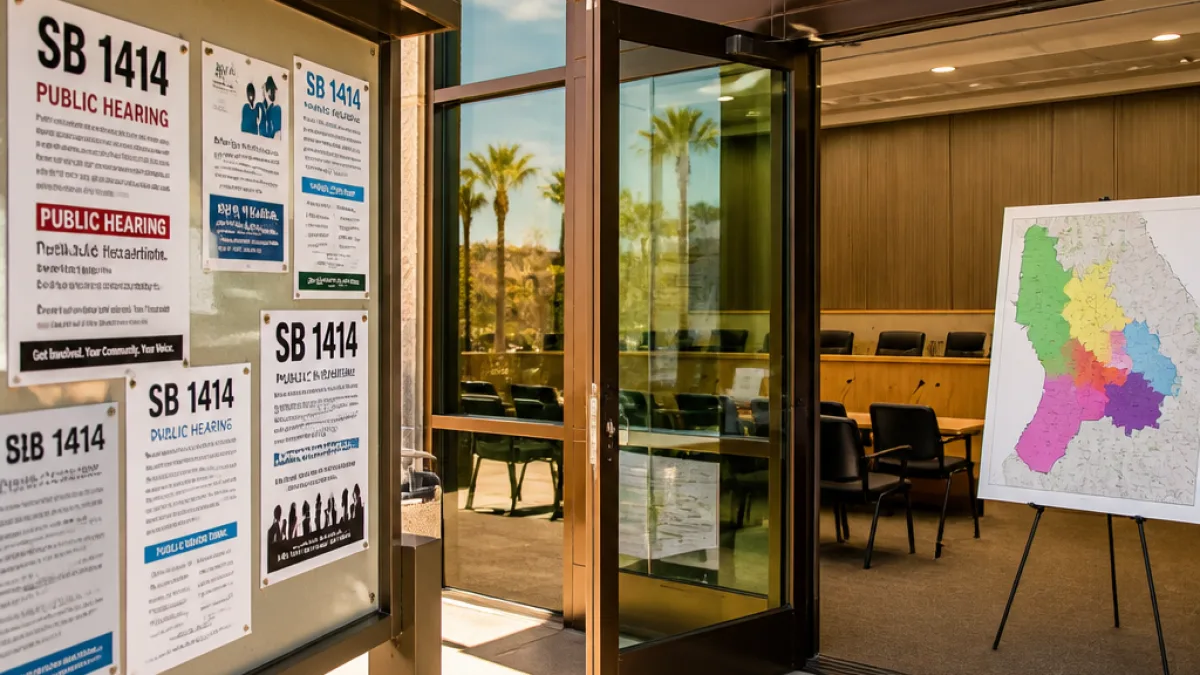
State legislation that would create an independent citizens commission to draw San Bernardino County’s supervisorial districts is being promoted by advocates who say it would strengthen transparency and protect minority voting power after recent shifts in federal law. The bill, SB 1414, authored by Sen. Eloise Gómez Reyes, would remove final map-making authority from county supervisors and place it with a locally based, 14-member panel of residents.
What the bill would change
Under SB 1414, the redistricting process would be managed by a commission whose members must be county residents and would undergo screening to identify conflicts of interest and recent political ties. County supervisors would not appoint the commissioners, a provision supporters say is crucial to preventing incumbent-protecting maps.
- Commission size: 14 San Bernardino County residents
- Conflict screening: Commissioners would be vetted for conflicts of interest and recent political activity
- Public participation: At least seven public hearings, including one in every supervisorial district, plus at least three additional hearings before final adoption
Why advocates say the change is needed
Supporters cite the U.S. Supreme Court’s Callais decision, which they say reduced federal protections against racial vote dilution — the practice of drawing district lines in ways that can weaken the ability of communities of color to elect candidates of their choice. Combined with a national trend of elected officials manipulating boundaries to preserve political power, advocates argue the county needs an independent process patterned on California’s statewide Citizens Redistricting Commission.
"The work created California’s independent Citizens Redistricting Commission and established a national model for a more transparent, independent, and community-driven redistricting process," the advocacy memo states.
San Bernardino County spans a large and demographically diverse area with more than 2.2 million residents. Proponents of SB 1414 contend that a locally based independent commission would better reflect the county’s varied communities and give residents a stronger voice in how supervisorial boundaries are drawn.
Process and public input
The bill lays out a public engagement framework designed to ensure widespread opportunity for input. The commission would be required to hold at least seven hearings prior to drawing maps — specifically including hearings in each supervisorial district — and then hold at least three more hearings before adopting final boundary lines. Advocates say those multiple, geographically distributed hearings are meant to make the process more accessible and transparent than one controlled by sitting supervisors.
| Provision | Requirement |
|---|---|
| Commission membership | 14 county residents |
| Appointment | Not made by county supervisors |
| Public hearings | At least 7 before drawing maps; 3 additional before final adoption |
Backers emphasize safeguards intended to preserve the commission’s independence, including screening for conflicts and recent partisan activity. The proposal mirrors the state-level model, which removed direct line-drawing from lawmakers in Sacramento and placed it with a citizens panel. Advocates point to that reform as a national example for reducing perceived conflicts of interest in map drawing.
Local stakes
For San Bernardino residents, the practical implications hinge on how supervisorial boundaries influence who represents neighborhoods and which communities are grouped together for purposes of elections and county services. Changing the process for drawing those lines could affect electoral competitiveness, minority representation and which interests gain or lose influence in county government.
As SB 1414 advances through the legislative process, county residents and community groups will have opportunities to weigh in. If passed and implemented consistent with its provisions, the measure would mark a significant shift in who decides supervisorial district boundaries and how the public can participate in that decision-making.
















