
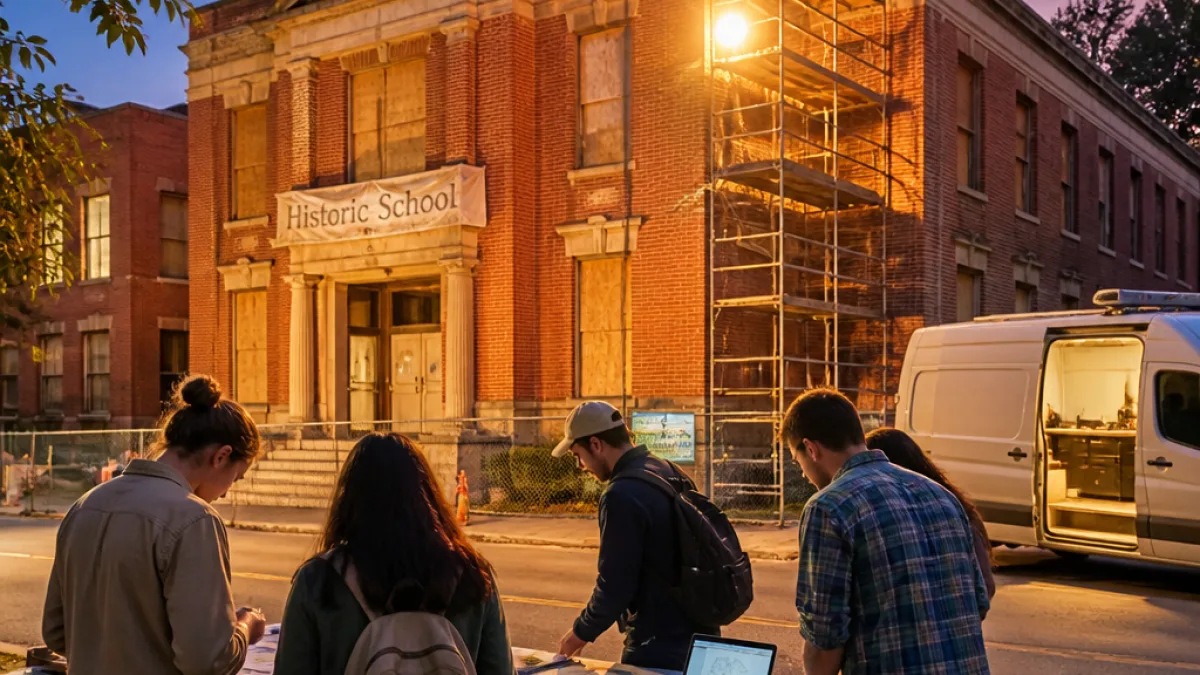
COLUMBIA — A newly formed statewide network is mobilizing community groups, preservationists and academic researchers to protect buildings that once served as schools for Black students across South Carolina.
Partnership seeks to reconnect communities with lost school histories
The South Carolina Historic Black Schools Preservation Network is a collaboration between the Central Carolina Community Foundation and the University of South Carolina’s Center for Civil Rights History and Research. Organizers say the effort is meant to bring together local volunteers and small nonprofits working to preserve former Black school buildings, documenting the institutions’ roles well beyond classroom instruction.
Dr. Bobby Donaldson, director of USC’s civil rights center, said the schools often served as anchors in African American neighborhoods—places where students were educated and community life unfolded. He said it is critical to capture both the physical structures and the memories associated with them before more buildings are lost or altered.
“In every African American community there are schools that were anchors of communities,” Dr. Bobby Donaldson said.
Focus, reach and funding realities
The initiative initially concentrates on the Midlands region but already has drawn interest from groups in other parts of the state. Organizers say the network will function as a hub for sharing expertise, pooling limited funds and coordinating advocacy to stabilize or repurpose historic school properties.
Trimease Carter of the Central Carolina Community Foundation told WE NEWS that nonprofit budgets have tightened in recent years, making cooperative strategies and community donations more essential. Carter said the network will provide a platform for smaller projects that may otherwise struggle to secure grants or technical assistance.
What the network will offer local groups
- Opportunities to connect with other preservation groups across regions
- Access to shared resources and research from USC’s archives and experts
- Help coordinating fundraising and grant applications
- Workshops on documenting oral histories and preparing nominations for historic designation
Those involved emphasize that the effort is about more than bricks and mortar. In many places, former Black school buildings were also meeting halls, voting sites, churches, and cultural centers. Organizers hope that documenting those broader functions will strengthen the case for preservation and community investment.
Community impact and practical next steps
For towns and neighborhoods with aging schoolhouses, the network aims to offer concrete support: how to conduct condition assessments, how to gather alumni testimony, and how to evaluate possible new uses that retain historic character while meeting contemporary community needs. Preservation advocates say adaptive reuse — converting a school into community space, affordable housing or mixed-use facilities — can keep structures relevant.
Local leaders and preservationists also note a timing pressure. As populations and land-use patterns change, historic buildings face demolition or insensitive renovation. The network’s co-sponsors argue that early documentation and community engagement can prevent irreversible loss.
Data points at a glance
| Partner | Initial focus | Services |
|---|---|---|
| Central Carolina Community Foundation | Midlands | Funding coordination, community outreach |
| USC Center for Civil Rights History and Research | Statewide research | Archival support, historical documentation |
Organizers say the network will rely on a combination of foundation grants, individual donors and volunteer labor. They also plan to pursue public funding and historic tax credits where eligible projects meet requirements.
Why preservation matters locally
Preserving former Black schools is about safeguarding tangible reminders of the segregated past and honoring the institutions that fostered leadership and community cohesion. For residents of towns across South Carolina, these buildings are touchstones for family histories and collective memory. By coordinating efforts statewide, the new network seeks to amplify local voices that otherwise may lack technical resources or visibility.
Organizers encourage local groups to reach out to the network to explore membership, technical assistance and opportunities to collaborate on grants or community events. As the initiative expands beyond the Midlands, its leaders say they hope to create a durable infrastructure so that future generations can learn from and benefit from the legacy of these schools.
Reporting for WE NEWS, Adrienne Calhoun.















