
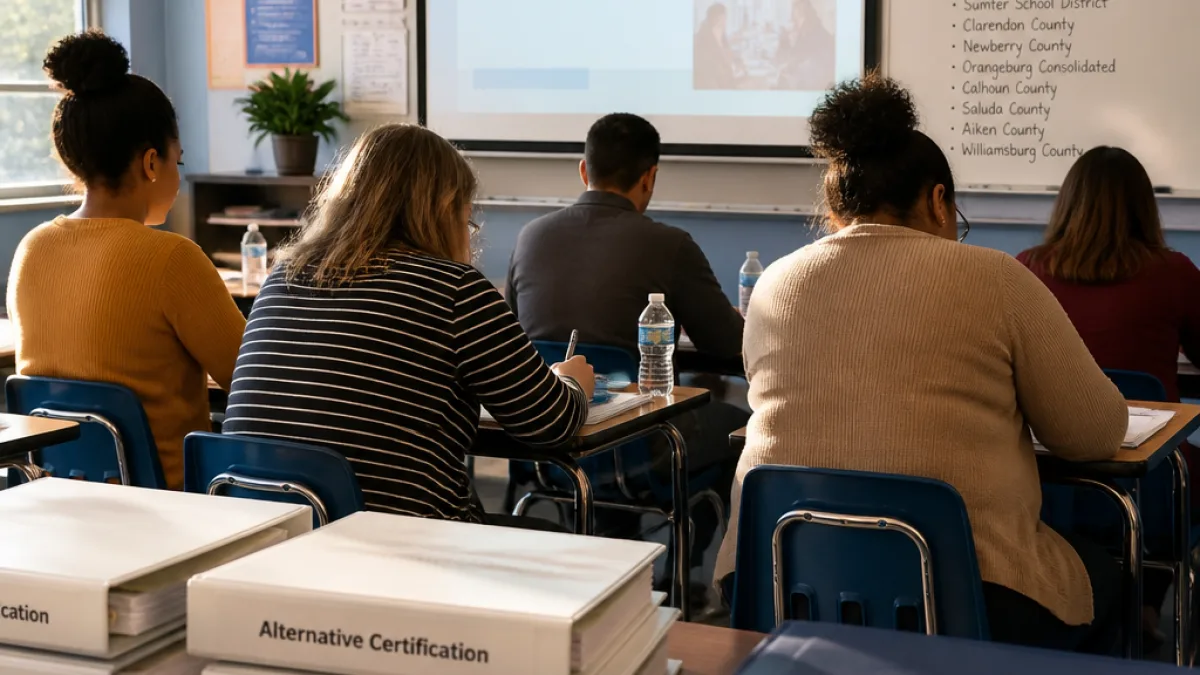
COLUMBIA — South Carolina has made measurable progress filling teacher openings this school year, but hundreds of positions remain vacant and districts continue to rely on nontraditional pipelines to staff classrooms, particularly in special education.
Vacancies decline but needs persist
The latest statewide educator supply and demand data show a drop in reported vacancies from 1,043 to 706 positions, a roughly 32% decrease compared with the previous school year. State education officials say the improvement is welcome, but the remaining vacancies underscore ongoing staffing pressures in many districts.
How alternative certification is stepping in
One organization that has positioned itself as part of the solution is Teachers of Tomorrow, which works with individuals who already hold bachelor’s degrees to help them gain teacher certification while they begin classroom work.
The group reports it has helped place more than 300 teachers in South Carolina classrooms this school year and currently partners with nearly 50 school districts across the state. Many of those placements target roles that school leaders say are hardest to fill.
“You have a vacancy for a special education position, we have a teacher within 25 miles of your school who’s interested and is currently pursuing special education certification, we bring in those career switchers and play matchmaker,”
said Alex Elson, chief growth officer for Teachers of Tomorrow, describing the program’s approach to matching candidates and districts.
Focus on career changers and high-need subjects
Teachers of Tomorrow emphasizes recruiting people entering education as a second career, allowing candidates to complete certification requirements while teaching under mentorship. Supporters argue this model taps into a pool of older candidates who bring prior workplace experience and may not want to complete a traditional teacher-preparation pathway.
“For a long time, second-career individuals, if you want to call it that, that’s really something that’s been overlooked,”
said Ryan Dellinger, director of education policy for the Palmetto Promise Institute. He added that these candidates often have life or work experience that can be valuable in the classroom and that alternative routes can provide a faster path into teaching.
Where the need is greatest
District leaders and program officials say special education remains one of the most difficult areas to staff. Other high-need subjects vary by district but often include math, science and career-technical education. The alternative-certification model is designed to be flexible so candidates can begin teaching while they finish certification coursework and receive mentoring support.
- Teachers placed by program this school year: more than 300
- School districts partnered with program: nearly 50
- Statewide vacancy decline: from 1,043 to 706 positions (about 32%)
Practical implications for districts and candidates
Proponents of alternative certification say the approach benefits both districts and candidates: districts gain access to near-term hires, while candidates receive on-the-job training and support. Critics of fast-track models sometimes caution that accelerated pathways must still ensure classroom readiness and adequate mentoring.
Program officials say mentorship and ongoing support are central to their model, allowing participants to teach while completing certification requirements that lead to full licensure.
| Metric | Number |
|---|---|
| Reported vacancies (previous year) | 1,043 |
| Reported vacancies (current year) | 706 |
| Teachers placed by program | More than 300 |
| District partners | Nearly 50 |
Looking ahead
State education leaders continue to pursue multiple strategies to address staffing shortages, including recruitment efforts, retention incentives and support for alternative pathways. As the new school year continues, districts will likely rely on a mix of traditional teacher-preparation graduates and alternative-certification hires to meet classroom needs.
For candidates interested in alternative certification, programs typically require a bachelor’s degree, background checks and adherence to state licensure steps. Prospective teachers should contact local school districts or program providers for details on eligibility, application timelines and the support available during certification.
While South Carolina has reduced its total number of vacancies, education officials and advocates say the challenge of ensuring consistent, qualified staffing—especially in high-need subjects—remains a priority for the months ahead.















