
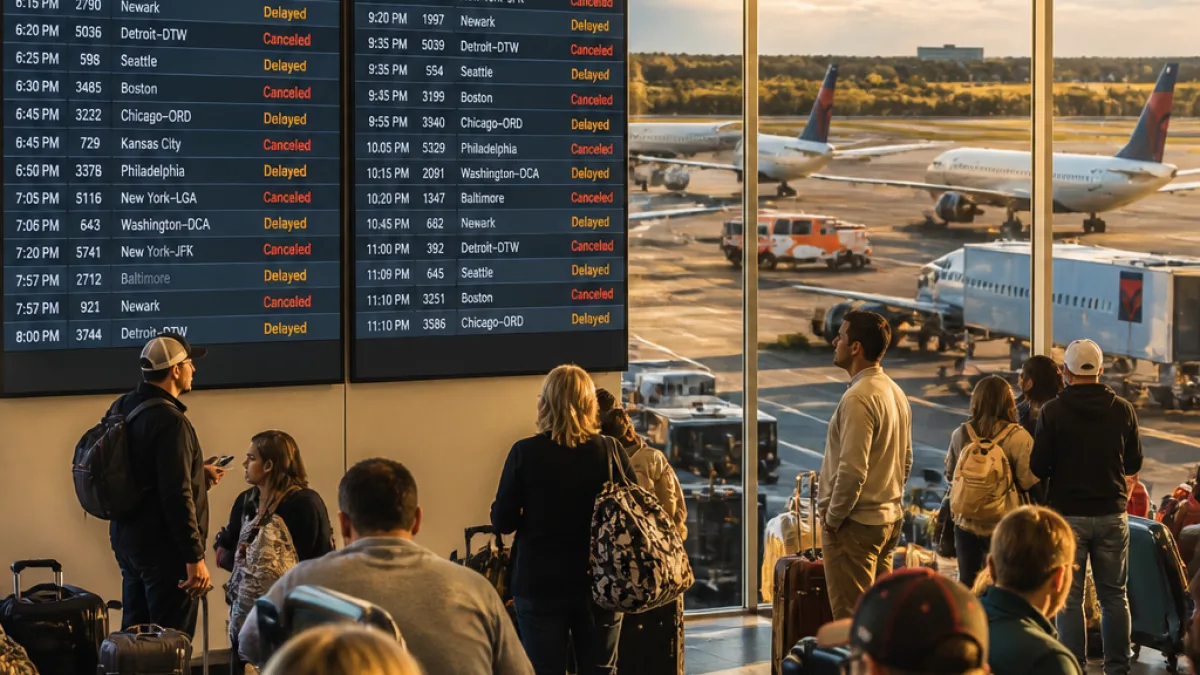
Charleston International Airport experienced travel disruptions Sept. 21 after a telecommunications circuit failure in the Northeast led the Federal Aviation Administration to impose a ground stop at multiple East Coast airports. The interruption, which also involved a backup fiber cable being accidentally severed, produced widespread delays — more than 1,000 flights nationwide — and left local travelers facing cancellations and late arrivals.
What happened and how Charleston was affected
By 3:30 p.m. local time, industry tracker FlightAware showed that Charleston International had more than 30 delayed flights and five cancellations tied to the ground stop. The majority of impacted flights involved routings to and from New York-area airports and Philadelphia, according to the same tracking data.
The Federal Aviation Administration said the loss of communications began with an issue affecting some frequencies at a Philadelphia-area air traffic control facility that manages traffic for several major airports. Officials later determined that a backup fiber line had been accidentally cut by a construction crew in New Jersey, compounding the outage and forcing the halt.
"The FAA will not restart the system for incoming flights at the affected airports until we make sure the airspace is safe," FAA Administrator Bryan Bedford said.
Scope and context
FAA officials reported that the problem temporarily stopped incoming flights at New York’s three major airports, two smaller New York-area fields, Philadelphia and Boston. A company statement and the FAA noted that a replacement circuit also failed early in the outage but traffic to John F. Kennedy International and LaGuardia Airport was later resumed.
The timing of the disruption coincided with the arrival of many world leaders and delegations to New York for the United Nations General Assembly, a factor that increased demand and complexity across the system. The incident underscored concerns about the fragility of some legacy components of the nation's air-traffic infrastructure.
Local consequences and travel tips
Charleston-area travelers with flights to or connections through New York, Newark Liberty International in New Jersey, and Philadelphia International should expect possible residual delays or cancellations as carriers and the FAA worked through the backlog.
- Check your airline’s status before heading to the airport.
- Allow extra time for connections, especially those routed through the Northeast.
- Contact your airline about rebooking or refund options if your flight was canceled.
Airlines and airports typically adjust schedules, add staff and coordinate ground operations to manage surges after large-scale disruptions, but travelers should be prepared for lingering effects as flights are recovered and airspace restrictions are lifted.
Federal response and broader implications
Administrator Bedford acknowledged multiple equipment failures during the outage and the FAA’s decision to withhold resuming inbound operations until it determined the affected airspace was safe. The event highlighted ongoing conversations in Washington about modernizing the nation's air-traffic control systems; Congress approved a $12.5 billion funding package for upgrades last year, a measure intended to reduce vulnerability to such failures.
| Metric | Reported figure |
|---|---|
| U.S. flights delayed/cancelled | More than 1,000 |
| Charleston International delays | More than 30 |
| Charleston International cancellations | 5 |
Local airport officials and carriers are expected to provide updates as operations normalize. Travelers should monitor official Charleston International Airport communications, airline notifications and FlightAware-type trackers for the latest arrival and departure information.


















