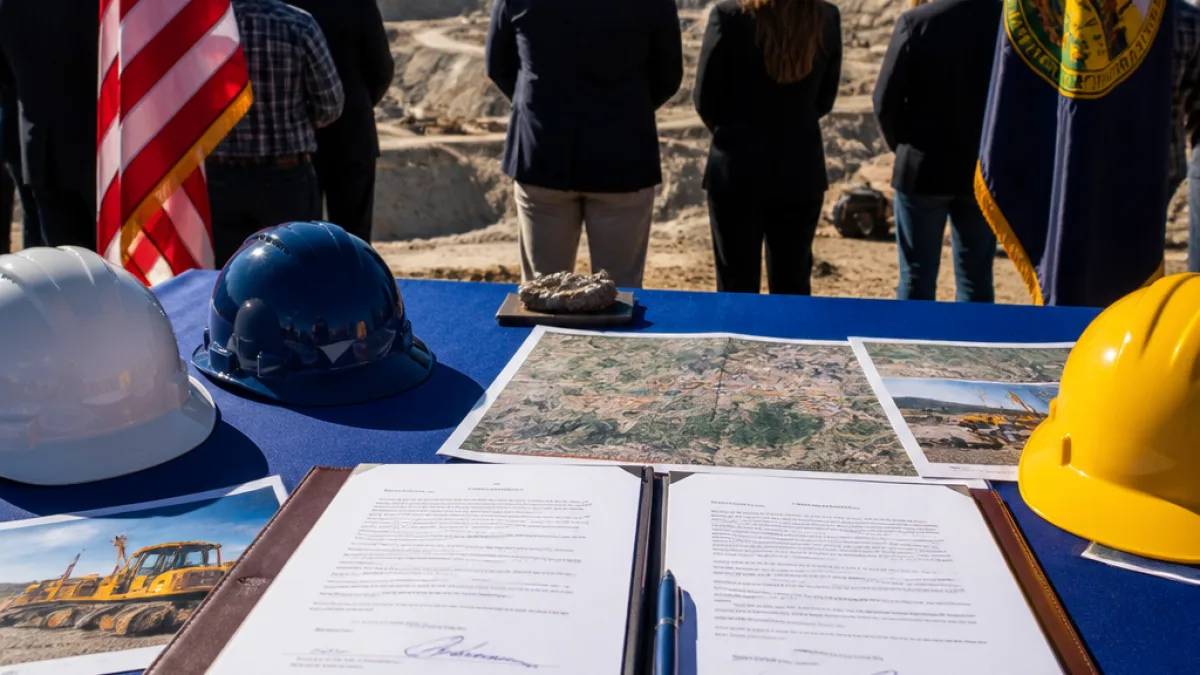
Montana has entered a federal-state agreement designed to coordinate permitting for major infrastructure projects, becoming the 11th state to participate in the FAST-41 process created under federal transportation legislation.
The agreement gives Montana access to support from the Federal Permitting Improvement Steering Council, the federal body responsible for helping agencies and states work through complex permitting matters. Gov. Greg Gianforte and Emily Domenech, the council's executive director, discussed the agreement Wednesday at a press conference in Philipsburg.
A framework for coordinating reviews
FAST-41 was established by Title 41 of the Fixing America's Surface Transportation Act. Its purpose is to create a common federal framework for coordinating environmental reviews and other authorizations required for major infrastructure projects.
For Montana, the memorandum of understanding provides a formal way for state and federal officials to work together on projects that may require reviews from multiple agencies. The process is intended to make those reviews more coordinated and transparent, while reducing the risk that agencies perform overlapping work separately.
| Agreement detail | What the source says |
|---|---|
| Participating state | Montana |
| National position | 11th state to join the process |
| Federal partner | Federal Permitting Improvement Steering Council |
| Primary focus | Coordination, transparency and support for major project reviews |
What federal support could include
Under the agreement, the permitting council can help Montana identify projects that may qualify for FAST-41 treatment. It also can help locate gaps in federal knowledge, create opportunities for state expertise to be shared and bring relevant state and federal agencies together.
That coordination is important because large projects often require several authorizations and environmental reviews. The council's role, as described in the agreement, includes helping agencies pursue a more unified review and avoid duplicative efforts. The arrangement also allows officials to explore ways to improve Montana's own permitting processes.
- Help identify projects that may be eligible for the FAST-41 process.
- Bring state and federal agencies together during project reviews.
- Identify information gaps and share state expertise with federal officials.
- Explore improvements to state permitting procedures.
Montana's resources at the center
State and federal officials framed the agreement around Montana's role in producing resources considered important to the national economy and security. Domenech said the state's natural resources include critical minerals and energy resources, and that the agreement is intended to help related projects advance in an efficient and transparent manner.
“Montana’s natural resources make it a leader in producing the critical minerals and energy our country needs for economic growth and national security,” Emily Domenech, permitting council executive director, said.
The source material does not identify a specific project being placed into the FAST-41 process as a result of the agreement. Instead, the memorandum establishes a framework for determining which future projects may qualify and for coordinating the agencies involved in their reviews.
Efficiency paired with transparency
The agreement is intended to speed coordination, but the stated purpose also includes transparency. That distinction matters for communities, landowners and other members of the public who follow major infrastructure proposals and the environmental reviews connected to them.
FAST-41 does not eliminate environmental reviews or other required authorizations. Rather, the federal framework is described as a way to organize those reviews, improve communication among agencies and make the permitting process easier to track. The agreement also provides a channel for state officials to contribute knowledge and identify problems in the review process.
What happens next
With Montana now participating, the permitting council and state officials can work to identify eligible projects and determine where federal coordination would be useful. They also can convene agencies when a proposal involves overlapping responsibilities or requires information from multiple levels of government.
The agreement therefore represents an administrative step rather than an announcement that a particular mine, energy facility or other infrastructure project has been approved. Its practical effect will depend on which projects are later identified, how agencies use the coordination process and whether the state and federal governments can reduce delays without weakening transparency in environmental review.
For Montana, the arrangement places the state within a federal permitting network while officials seek to support development tied to critical minerals and energy. It also gives state agencies a formal opportunity to work with federal counterparts on improving the way complex projects are reviewed and authorized.