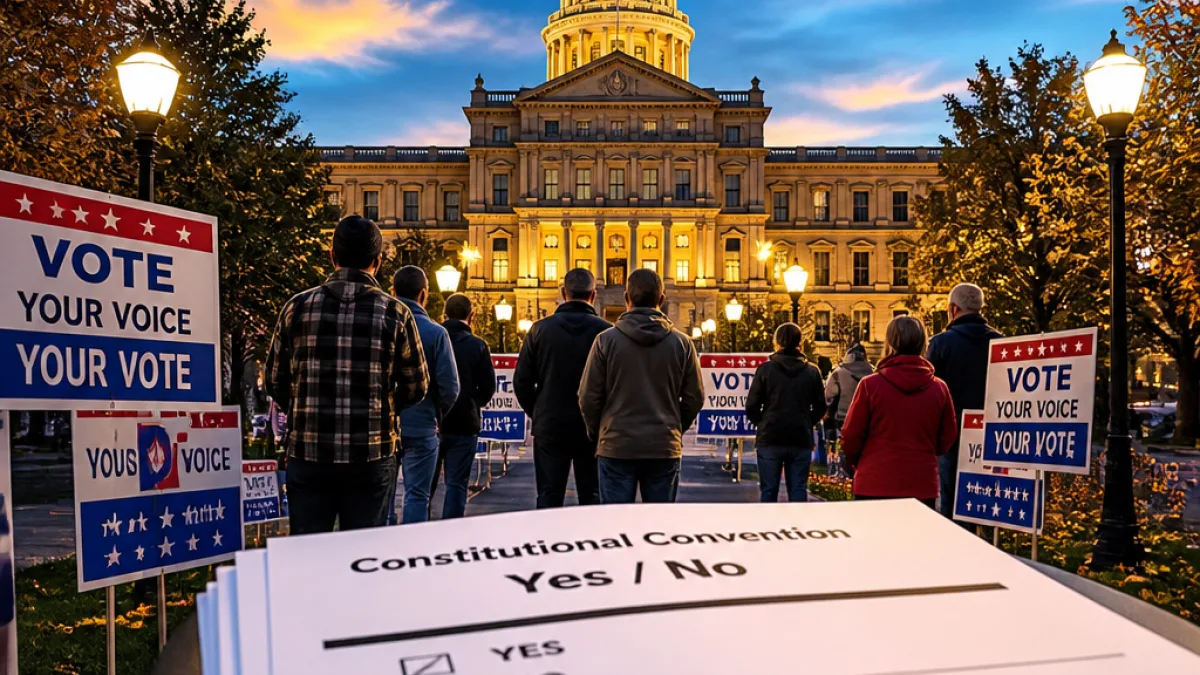
LANSING, Mich. — For the first time in more than six decades, Michigan voters will confront a question this November that could send the state back to the drawing board on its fundamental governing document: should they authorize a constitutional convention?
How the vote works
State law requires that every 16 years voters be asked whether they want a constitutional convention, commonly called a "con-con." A majority "yes" vote would trigger a special election to choose 148 delegates who would meet to draft a new state constitution. If delegates approve a new document, it would typically be submitted to voters for ratification.
The current constitution was adopted in 1963, and the 63 years since its adoption is the longest stretch Michigan has gone without a complete rewrite. Since that time, Michigan voters have approved 39 amendments to the constitution through piecemeal ballot measures, an approach many opponents say should continue.
Arguments from opponents
Opposition to a convention has formed across a wide range of groups, including business associations, religious organizations, civil liberties advocates, labor unions and environmental nonprofits. The coalition, organized under the banner "Protect MI Constitution from Special Interests," urges voters to reject the convention question in November.
"When we start making changes to our state's foundational documents, it starts to bring chaos really into the regulatory environment and how businesses operate on a day-to-day basis,"
Christine Simon, vice president of government affairs for the Grand Rapids Chamber of Commerce, voiced that concern, arguing that opening the constitution creates uncertainty for employers and for the broader economy.
Opponents also warn that a convention could be costly and lengthy. Estimates circulated by critics put a potential price tag for the process at about $80 million. They point to the 1963 convention, which required 10 months for delegates to complete a draft, and note there is no statutory time limit for future conventions.
What opponents fear could be at stake
Citing the broad sweep of issues governed by the constitution, groups opposing a con-con say a new constitution could affect:
- tax policy
- public education and school governance
- local government authority
- voting rules and election administration
- policy areas like marijuana regulation and abortion rights
Those concerns have led traditionally disparate organizations — from the Michigan Catholic Conference and the American Civil Liberties Union to the Michigan AFL-CIO and the Michigan League of Conservation Voters — to align in urging a "no" vote, arguing that targeted amendments remain a safer path to change.
Procedural notes and context
If Michigan voters approve a convention question in November, the next step would be a special election to select the 148 delegates. Delegates would be responsible for drafting a new constitution; the delegate body could be influenced by organized interests and campaigning leading up to and during the special election.
Historically, voters have declined to call a con-con the last three times the question appeared on the ballot, though the margin of opposition has narrowed over time. The debate surrounding the 2026 referendum is unfolding amid what many observers call a "change" election at the statewide and national levels.
| Item | Figure |
|---|---|
| Current constitution adopted | 1963 |
| Years since adoption | 63 |
| Delegates to be elected if approved | 148 |
| Amendments adopted since 1963 | 39 |
| Estimated opposing cost | $80 million |
Supporters of a constitutional convention, who say a wholesale review can address systemic issues and modernize the charter, have emphasized that the convention is a democratic mechanism to allow voters to reconsider and reshape the rules that govern state government. However, details about supporters' arguments and proposals were not provided in the initial reporting.
What voters should know before heading to the polls
Voters considering the question in November should be aware that a "yes" vote does not immediately change the constitution. Instead it starts a process that could culminate in a new constitution subject to final voter approval. A "no" vote keeps the current constitution in place while allowing individual amendments to be proposed and adopted via ballot measures, which is the route advocates of the status quo prefer.
As the campaign for November progresses, Michiganders can expect attention on how delegates would be selected, who funds delegate campaigns, how long the convention might last and what specific issues would be prioritized if a convention convenes.
The question presents voters with a choice between a comprehensive, uncertain rewrite of the state's foundational text and continued incremental change through amendments — a debate that reaches into policy, process and the balance of power in Michigan government.