
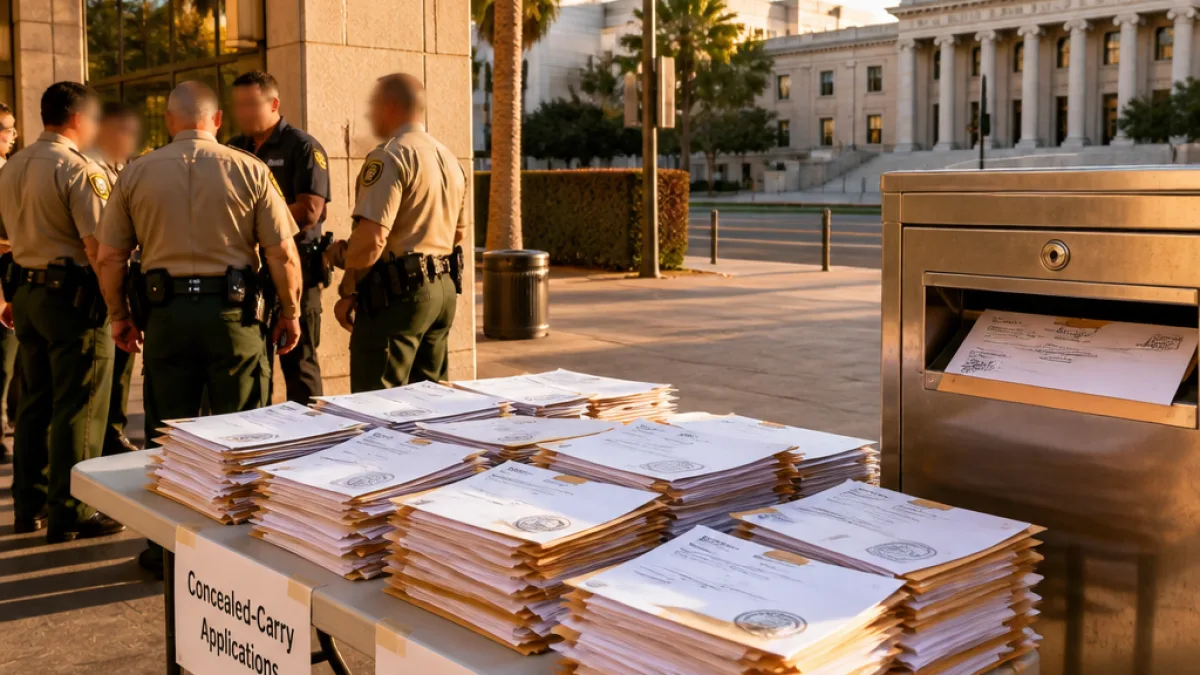
The Los Angeles County Sheriff’s Department has agreed to speed up processing for concealed‑carry license applications as part of a settlement filed Thursday in federal court that resolves a U.S. Justice Department lawsuit alleging the county systematically delayed applicants’ Second Amendment rights.
Settlement terms and legal backdrop
The settlement, which must be approved by a federal judge, does not include an admission of wrongdoing by the sheriff’s office. It requires the department to continue meeting state‑law deadlines and to maintain a licensing regime that complies with the U.S. Supreme Court’s 2022 decision in New York State Rifle & Pistol Association v. Bruen, which held that lengthy delays in processing license applications can be unconstitutional.
According to the Justice Department’s complaint, the sheriff’s department received 3,982 new concealed‑carry license applications between January 2024 and March 2025 but approved just two of them during that period. The complaint said the department typically waited about nine months to review applications and in some cases took more than two years to interview applicants.
"The sheriff acknowledged the problem and devoted substantial additional resources, including new processing software and additional personnel, to cutting waiting times dramatically," said Harmeet Dhillon, who leads the Justice Department’s civil rights division.
What the settlement requires
Under the terms filed in Los Angeles federal court, the county must continue to start application reviews within 90 days and maintain practices aligned with the Bruen standard. The settlement language focuses on procedural and timing issues rather than policy disagreements, according to the Justice Department.Neither the sheriff’s department nor its attorneys immediately responded to requests for comment.
- Applications examined: 3,982 (Jan. 2024–Mar. 2025)
- Approvals during that period: 2
- Required review start time: within 90 days
Local impact and implications
Los Angeles County, home to about 9.7 million residents as of 2025, will now be subject to federally supervised timelines for a high‑profile and politically sensitive permitting process. For applicants, the settlement could mean quicker responses and fewer long delays. For the sheriff’s department, it formalizes the expectation that additional resources — such as staffing and new processing software the department has already deployed, according to the Justice Department — remain in place.
The case highlights how federal civil‑rights enforcement can intersect with county administrative practice. Though the Trump administration and state officials in Democratic‑led California have frequently clashed on policy, the lawsuit concentrated on administrative delays and constitutional protections established by the Supreme Court, rather than on substantive state gun law differences.
Oversight and next steps
The settlement must be approved by a federal judge before it takes full effect. If approved, the county will be required to maintain compliance with the timelines and procedures outlined in the agreement, and the Justice Department will likely monitor adherence. Any failure to meet those obligations could prompt further litigation or enforcement action.
| Item | Detail |
|---|---|
| Complaint period | Jan. 2024 – Mar. 2025 |
| Applications received | 3,982 |
| Approvals during period | 2 |
| Required initial review time | Within 90 days |
For Los Angeles residents, the settlement raises questions about how licensing will be managed going forward and how the sheriff’s department will balance timeliness with thorough vetting. It also underscores the reach of federal civil‑rights enforcement into local administrative operations and the continuing legal consequences of the Supreme Court’s recent Second Amendment rulings.
















