
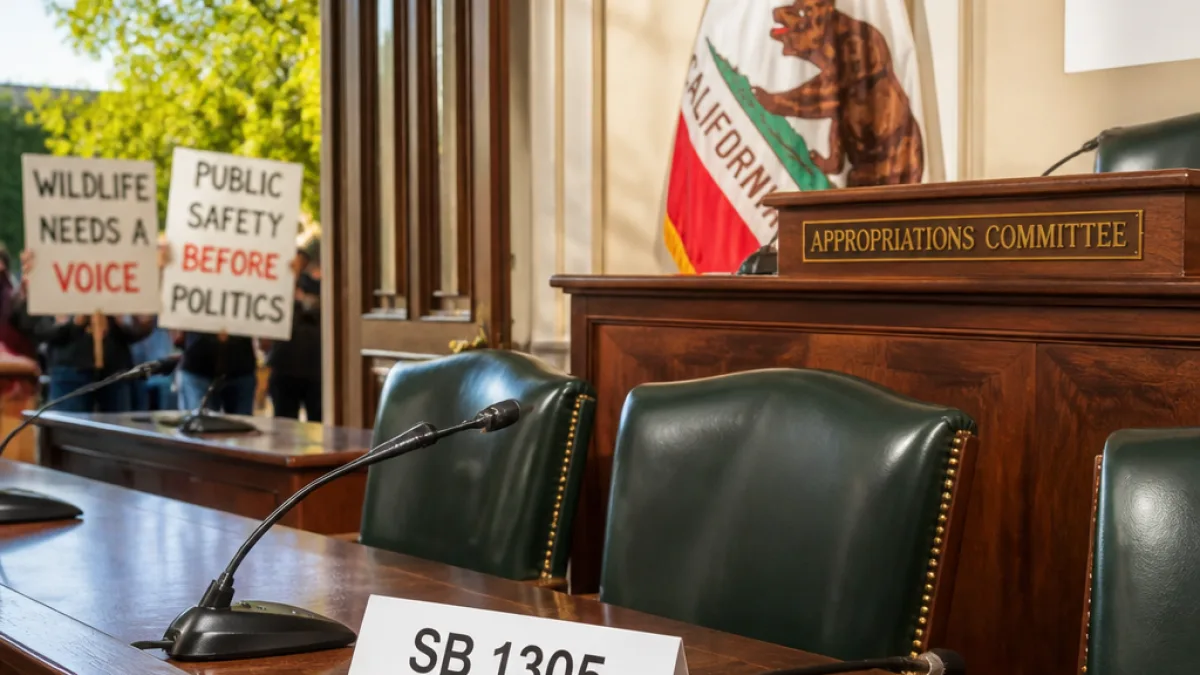
The California Legislature dealt a decisive blow Thursday to a proposal that would have formally examined whether the grizzly bear — long absent from the state but memorialized on its flag — could be reintroduced to California’s landscapes.
Appropriations committee stops SB 1305
The Assembly Appropriations Committee, meeting in Sacramento, voted to reject Senate Bill 1305, sponsored by Democratic Sen. Laura Richardson of Inglewood. The measure would have directed the California Department of Fish and Wildlife to produce a plan assessing whether and under what circumstances grizzly reintroduction would be feasible and advisable.
"a roadmap that evaluates whether, and under what conditions, reintroduction of the grizzly bear is feasible and advisable."
As is common for the Legislature’s fiscal panels, committee members did not hold public testimony before Chairperson, Assemblymember Buffy Wicks, announced the decision to spike the bill.
Historic presence and decades-long absence
Grizzly bears once ranged widely across California. Historical estimates suggest as many as 10,000 grizzlies roamed the state before the Gold Rush era, and the animal became a symbol used by early settlers when they briefly named their proposed state the Bear Flag Republic. Systematic hunting and habitat loss led to the extirpation of the species from California by the 1920s, leaving the smaller black bear as the only native bear species in the state.
| Item | Detail |
|---|---|
| Historic estimated population | ~10,000 |
| Last common presence | By the 1920s |
| Current native bear species | Black bear |
Supporters framed the bill as ecological restoration
Two Native American tribes cosponsored SB 1305, and a coalition of animal welfare and environmental groups backed the effort. Advocates said studying reintroduction would begin to address an ecological imbalance created by the grizzly’s removal nearly a century ago. They argued that bringing back an apex predator could restore certain ecological functions and biodiversity in degraded habitats.
Supporters did not propose immediate reintroduction under the law; the bill would have established a process to analyze the question and identify conditions under which reintroduction might be safe and effective.
Opponents cite safety and economic concerns
Ranchers, hunting organizations and many rural community leaders strongly opposed the measure. They warned that California’s dense human population and widespread conflicts with other predators — including mountain lions, black bears and wolves — make adding a second, much larger predator impractical and potentially dangerous.
- Ranchers expressed fears about livestock attacks and increased management costs.
- Rural residents cited recent conflicts with existing predators as evidence the state is already struggling to balance people and wildlife.
- Some critics argued the bill lacked an appropriation and would have merely redirected the conversation without providing funding for mitigation or compensation.
Legislative and practical implications
The committee’s action halts this particular legislative pathway. SB 1305 contained no funding for an immediate study; it would have tasked the Department of Fish and Wildlife with producing a roadmap, with the possibility that a future Legislature or an outside organization could fund the work.
By blocking the bill in the appropriations committee, lawmakers avoided a floor debate and sidestepped a public hearing on the merits of reopening a far-reaching wildlife restoration question in one of the nation’s most populous states.
Where the debate may go from here
Although SB 1305 is stopped for now, the underlying issues—wildlife restoration, tribal co-sponsorship, rural economic impacts and public safety—are likely to re-emerge. Stakeholders on both sides described the fight as part of a broader conversation over how California balances environmental ambitions with the realities faced by residents in rural and exurban communities.
For now, the state's official posture remains unchanged: the grizzly bear continues as a historic symbol on the California flag, but not as a living part of the state's fauna. Any future effort to revisit reintroduction would require new legislation, funding and broader consensus among state leaders, tribes, environmental groups and rural stakeholders.
Kevin Nakamura is a state correspondent at WE NEWS covering California politics and environmental policy.
















