
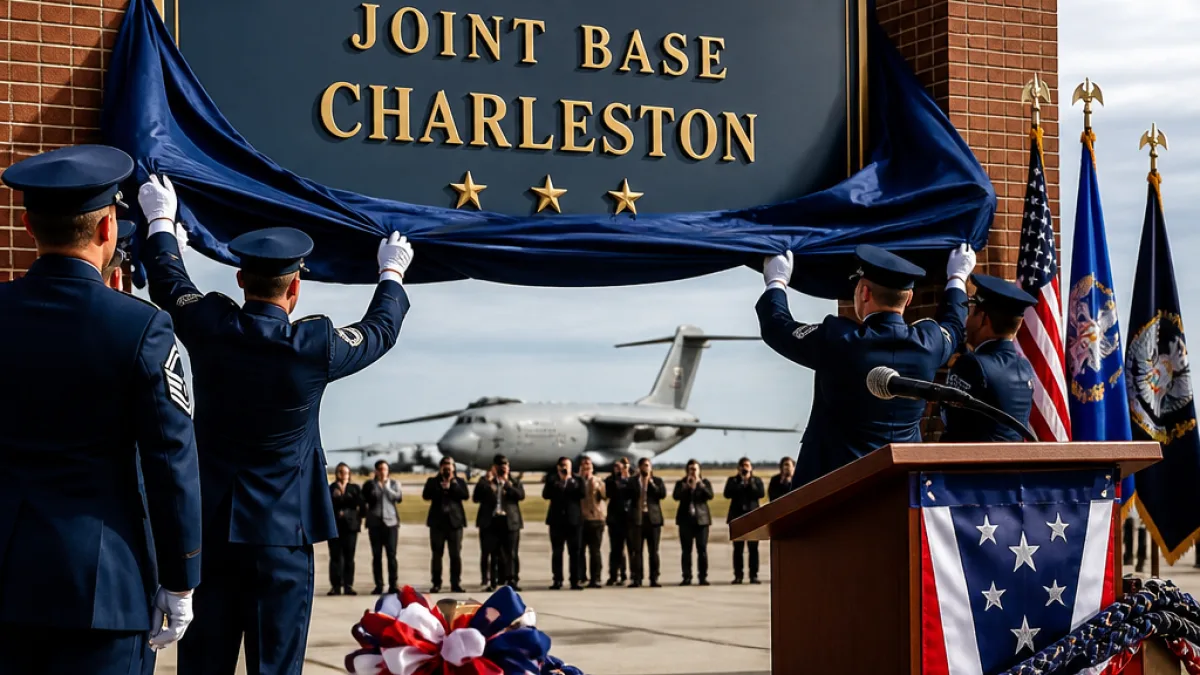
Military base in Charleston formally takes Lindsey Graham’s name
CHARLESTON — In a ceremony Monday at the military installation long known as Joint Base Charleston, state and federal officials joined family members to unveil the base’s new name: Joint Base Lindsey Graham, honoring the late U.S. senator from South Carolina for his years of service in uniform and in elected office.
Secretary of War Pete Hegseth, South Carolina Gov. Henry McMaster and Sen. Graham’s sister, Sen. Darlene Graham, were among those who spoke at the event. Organizers framed the renaming as recognition of Graham’s combined military and public-service career and as a way to preserve his legacy for future generations.
At the ceremony, McMaster said naming public places after notable figures creates learning opportunities for those who follow. He described Graham’s decades of service in three capacities — military, congressional and civilian — and said that each role contributed to a life of public duty.
“Lindsey served it in all three,”
The comment was McMaster’s summation of what he said was Graham’s record of serving South Carolina and the nation.
Hegseth highlighted Graham’s long-standing advocacy for the U.S. military and for increased defense spending during his congressional tenure. During remarks, Hegseth recalled a recent conversation with Graham about defense funding and promoted the idea that the renaming allows Graham’s name to travel with Air Force units based at the installation.
“Those gray tails that say Charleston, now when they land in far-flung places will say Graham,”
Graham’s sister, Darlene Graham, spoke about his bond with the Air Force and how his interest in national security and foreign affairs began with military service. She recounted how he had initially wanted to become a pilot and earned his pilot’s license while in high school, but that hearing issues in one ear led him to pursue law and later a combined career in the military and politics.
Local and national implications for the base and community
The renaming of one of Charleston’s largest military installations carries both symbolic and practical implications. For service members and civilian workers at the base, the new name will be displayed on uniforms, aircraft tail codes and official stationing references, ensuring the attachment of Graham’s name to the base’s operations and personnel movements.
- Symbolic: Preserves the late senator’s legacy in the Lowcountry and within military ranks.
- Operational: Aircraft and personnel signage tied to the base will begin reflecting the new name.
- Community: Local residents may see the new designation used in media, government documents and public signage.
Officials at Monday’s unveiling emphasized continuity of mission rather than any shift in operations. The base remains a hub for joint military activity in the region and will continue to support Air Force and other service components stationed there.
| Speaker | Role |
|---|---|
| Pete Hegseth | Secretary of War |
| Henry McMaster | Governor of South Carolina |
| Darlene Graham | Senator and sister of Lindsey Graham |
For Charleston residents, the change will be visible in public conversations about the base and in how the installation is referenced by local government, business sectors that interact with the military community, and service organizations supporting military families.
The ceremony underscored the ties between the Lowcountry and the nation’s defense establishment. As the new name becomes established in official use, community leaders and base officials told attendees they expect the designation to foster continued recognition of the region’s role in national security.
Details about the formal timeline for updating signage, documentation and other materials to reflect the name change were not provided at the ceremony. Base and state officials are expected to announce implementation steps in the coming weeks.
The dedication event brought together military leaders, elected officials and family members to honor a public figure whose career bridged military service and federal office, marking a high-profile moment for one of Charleston’s major institutions.


















