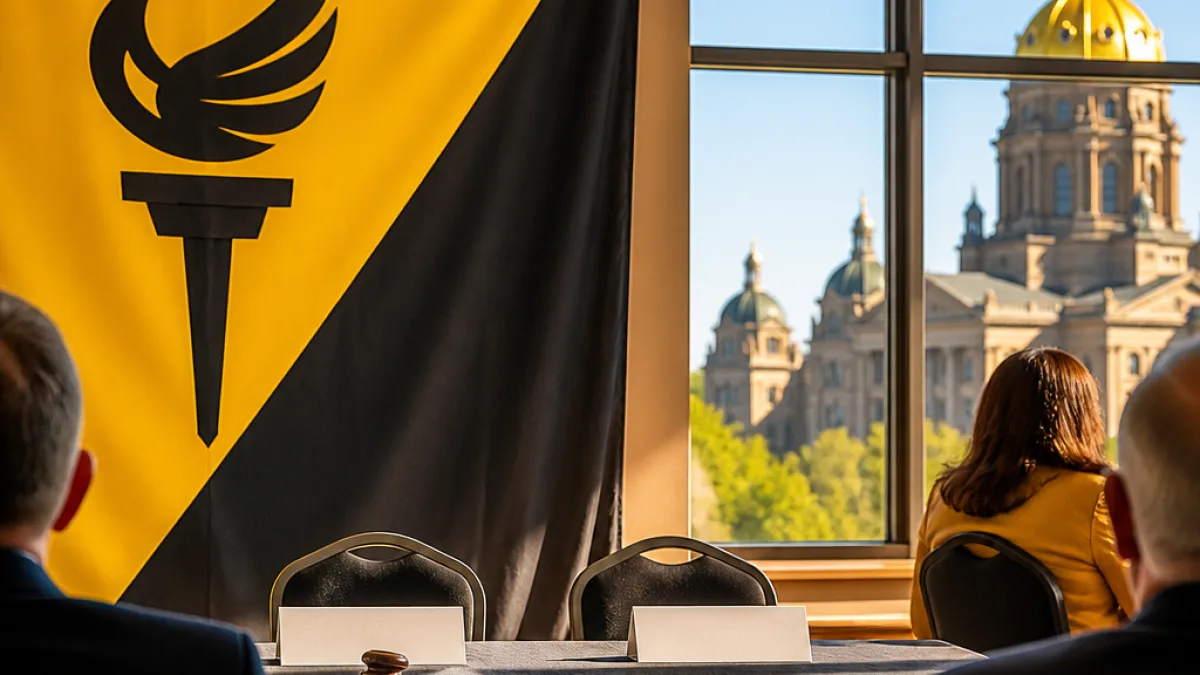
DES MOINES — The Libertarian Party of Iowa’s State Central Committee on Wednesday unanimously nominated two new candidates to appear on the 2026 general election ballot after the party’s earlier nominees were removed by the State Objections Panel and subsequent court action.
Replacements named for two contested races
Charles Aldrich, who ran as a Libertarian in Iowa’s 4th Congressional District in 2024, was selected to replace Jules Cutler as the party’s nominee for lieutenant governor on the ticket with gubernatorial candidate Nicholas Gluba. Jacob Heard, an attorney who previously campaigned for Iowa House District 44, was chosen to be the Libertarian nominee in Iowa’s 3rd Congressional District.
Both nominees were approved with unanimous support at the state central committee meeting, a move the party said was necessary after two earlier candidates ended their campaigns following rulings by the State Objections Panel and a Polk County judge.
How the vacancies arose
The panel’s June decisions removed Marco Battaglia as the 3rd District Libertarian nominee and ruled that Gluba’s original running mate, Jules Cutler, did not qualify for the lieutenant governor slot.
- The panel determined Battaglia’s ballot name — the name he used in the campaign — differed sufficiently from his legal name, listed as Mark T. Anderson, that he did not qualify for the ballot.
- The panel found Cutler had not filed an affidavit of candidacy for lieutenant governor by the June 2 deadline, a requirement to appear on the general election ballot as a running mate.
Both Battaglia and the Gluba–Cutler campaign disputed the objections. Cutler said she had been told by a secretary of state’s office employee that she did not need to submit the separate affidavit. Battaglia argued that he had previously appeared on ballots using the name he presented this cycle.
Those disputes were taken to Polk County District Court, where a judge in July upheld the State Objections Panel’s decisions. After that ruling, Battaglia ended his campaign, citing a medical emergency, and Cutler later announced she was withdrawing from consideration for lieutenant governor.
Party response and next steps
With the vacancies created by the withdrawals, the Libertarian Party of Iowa convened its State Central Committee to name replacements. Aldrich and Heard were the unanimous choices to fill the two open slots on party tickets for the upcoming general election.
The committee’s action ensures the Libertarian ticket remains on the ballot in these races, subject to any further legal or administrative challenges that could arise before the November election.
| Key Date | Event |
|---|---|
| June 2 | Affidavit deadline for lieutenant governor candidates (Cutler found not to have filed) |
| June (State Objections Panel) | Panel ruled Battaglia and Cutler did not qualify for ballot |
| July (Polk County) | Judge upheld panel decisions; Battaglia and Cutler later withdrew |
| Wednesday | State Central Committee unanimously nominated Charles Aldrich and Jacob Heard |
Background and implications for Iowa races
The dispute highlights the procedural and legal hurdles that can affect minor-party access to the ballot in Iowa. Ballot access rules, including filing deadlines and requirements on how a candidate’s name must appear, are frequently at the center of challenges that can alter the choices available to voters in statewide and congressional contests.
For the Libertarian Party, replacing nominees midcycle is disruptive to campaign planning and voter outreach. Aldrich, who has prior experience as a Libertarian congressional candidate, and Heard, with experience in state legislative campaigns, now face the compressed timeline typical of substitute nominees — having less time to fundraise, organize volunteers and present their platforms to voters across constituencies.
State election officials and political operatives say such changes can also affect how other parties and independent campaigns allocate resources, particularly in competitive districts where third-party candidacies can influence turnout or margins.
What voters should know
- Ballot access disputes can be appealed; the Polk County ruling upheld the panel’s decisions in this instance.
- Replacement nominees have been selected and appear to be the official Libertarian choices for the races unless further rulings change their status.
- Voters who follow these races should watch for any additional legal filings or clarifications from the secretary of state’s office as the election approaches.
The State Central Committee did not release additional statements about the candidates’ campaign platforms at the meeting, but the party’s action on Wednesday closes one chapter of the ballot-access dispute and opens another as candidates prepare for the fall election season.
Meredith Kowalski, State Correspondent