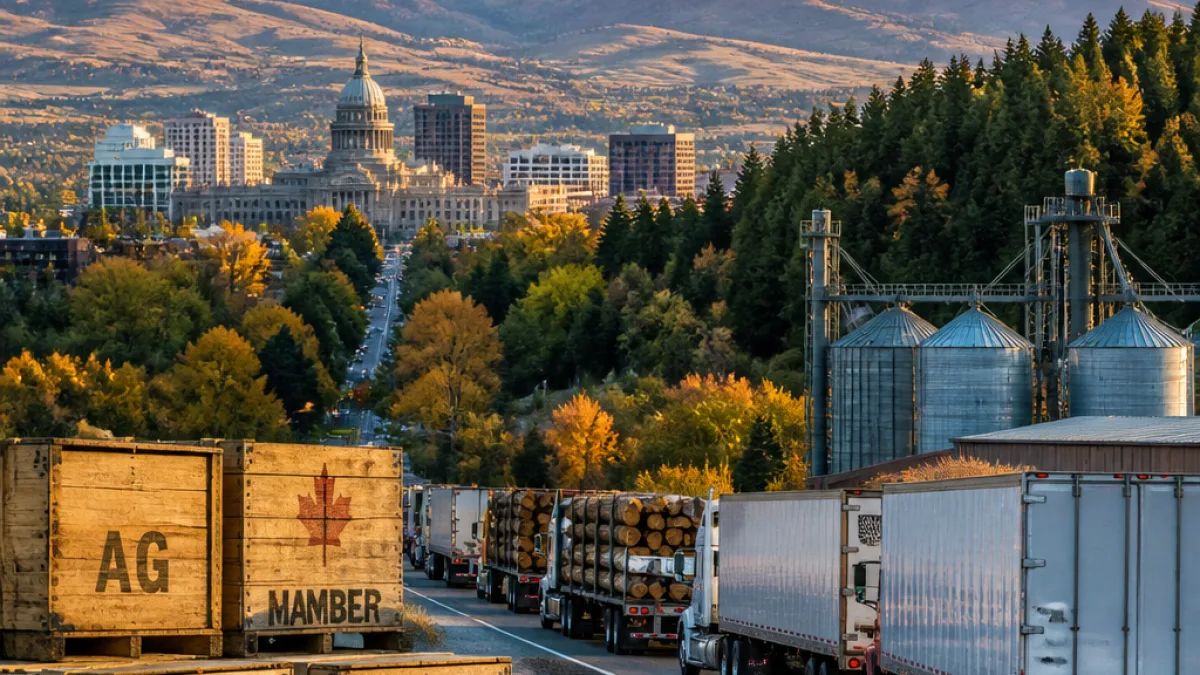
BOISE — Idaho’s trade relationship with Canada, long a steady source of buyers for the Gem State’s agricultural and forest products, has been thrust into uncertainty by a widening tariff dispute between the United States and Canada.
Federal trade figures show Idaho exported $1.8 billion in goods to Canada in 2025 — roughly 39% of the state’s total merchandise exports that year — while importing $1.2 billion in Canadian goods. The dispute centers on U.S.-imposed duties and matching Canadian countermeasures affecting billions in bilateral trade.
Tariffs escalate on billions in goods
After the United States imposed tariffs as high as 50% on about $27.6 billion of Canadian goods, Ottawa announced counter-tariffs between 15% and 50% on an equivalent value of U.S. imports. U.S. tariffs took effect Aug. 22, federal notices show, and corresponding Canadian measures are scheduled to take effect next month unless an agreement is reached.
The measures are broad but could be acutely consequential for Idaho because a large share of the state’s exports are agricultural and forest products that move north of the border.
"We annually export $1.8 billion in goods to Canada," Zions Bank economist Robert Spendlove said. "And then we import $1.2 billion in goods from Canada. It's a really strong trading relationship."
What Idaho sells and buys
Detailed Census Bureau data highlight a mix of items in the bilateral flow. Idaho’s food and agricultural shipments totaled $256 million through June, with live cattle accounting for $119 million of that figure.
- Top Idaho imports from Canada include: animal feed and industry residues ($86 million), softwood lumber ($86 million) and fertilizers ($56 million).
- Agricultural products make up about a quarter of Idaho’s exports to Canada, a share that links rural economies directly to cross-border demand.
| Metric | Value (2025) |
|---|---|
| Exports to Canada | $1.8 billion |
| Imports from Canada | $1.2 billion |
| U.S. tariffs affected | $27.6 billion (up to 50%) |
Local impact and risks
For Idaho producers and processors, higher duties could mean immediate price shocks for buyers in Canada or added costs for businesses that rely on Canadian inputs. Livestock exporters are vulnerable to sudden market disruptions, as are timber operators and fertilizer-dependent growers. The state’s small and medium-sized businesses that serve cross-border customers could face loss of market share if Canadian buyers shift to other suppliers to avoid tariff costs.
Economists and trade officials caution that the ripple effects of tariffs extend beyond direct trade values. Transportation, warehousing and manufacturing services tied to cross-border supply chains can experience reduced activity, which in turn affects rural communities where many of those jobs are located.
What comes next
Federal trade agencies and industry groups are monitoring negotiations closely. The U.S. Office of the Trade Representative and the Canadian Department of Finance have framed their actions as reciprocal measures pending talks. For Idaho stakeholders, outcomes will hinge on whether diplomatic and trade negotiations can de-escalate the tariff measures or whether both sides sustain duties that alter trade flows.
In the near term, Idaho farmers, timber operators and exporters are likely to seek guidance from trade associations and the state’s agricultural extension services on contingency planning, market diversification and documentation required to pursue any available exemptions or mitigation measures.
As the dispute develops, communities dependent on cross-border commerce will be watching how federal diplomacy and market responses shape demand for Idaho goods in Canada — a trading relationship that for now remains large enough to matter across the state’s economy.
— Bethany Lund, State Correspondent