
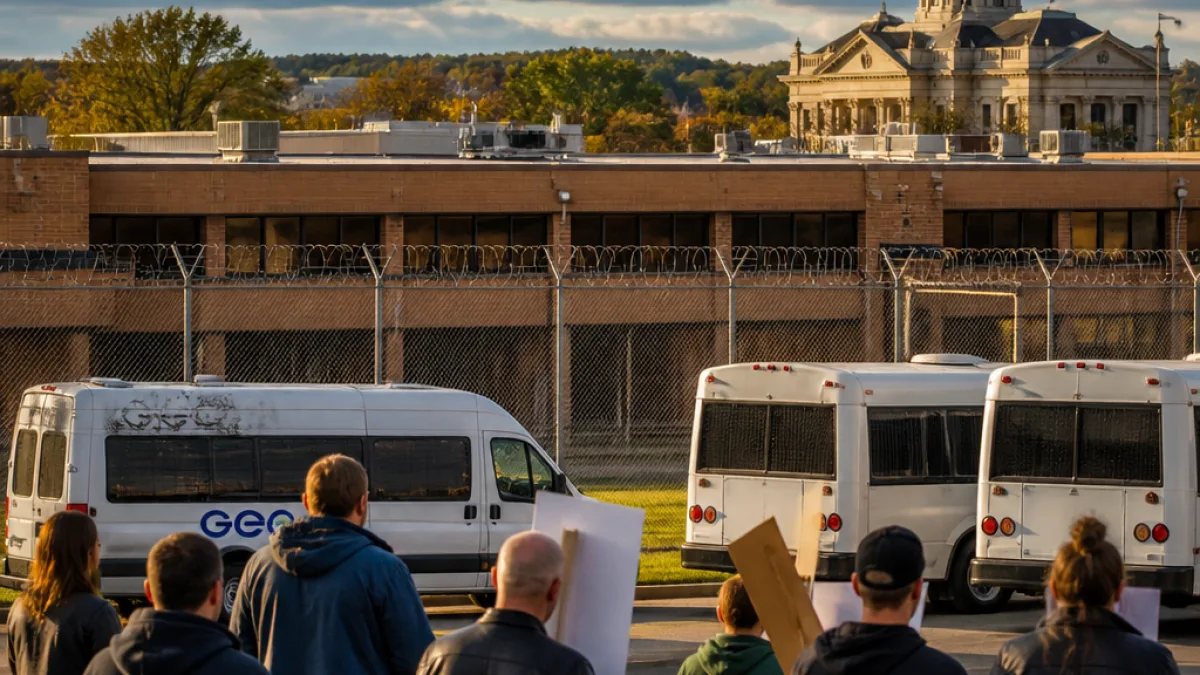
CLEARFIELD — U.S. Immigration and Customs Enforcement has signaled it is evaluating a range of options to maintain detention capacity in central Pennsylvania, including the potential purchase of existing facilities, a move that could reshape local control and oversight of the region’s largest immigration lockup.
What ICE disclosed and why it matters here
In mid-July, ICE published a request for information seeking “turn-key detention services” for several regions, among them central Pennsylvania, home to the Moshannon Valley Processing Center, a privately operated facility long at the center of complaints about conditions and treatment of people in custody.
In an Aug. 10 email to Spotlight PA, an ICE spokesperson said the agency is looking ahead as some detention contracts “approach expiration” and is evaluating options to “ensure continued access to detention capacity.” The statement explicitly listed the potential purchase of turnkey detention facilities as one option.
“ICE has access to over 80,000 beds across its entire detention network in a mixture of dedicated and non-dedicated facilities. As existing detention contracts in certain locations approach expiration, ICE is working to ensure continued access to detention capacity in those areas. As part of this effort, ICE is evaluating options, including the potential purchase of turnkey detention facilities where appropriate, or other contracting solutions to support continuity of operations.”
Local arrangements and the contract timeline
Currently, Clearfield County serves as an intermediary between ICE and GEO Group, the private corporation that owns and operates Moshannon Valley. That arrangement places the county in a limited oversight role; county officials have described that oversight as “minor.”
The county’s five-year contracts with ICE and GEO Group are set to expire in late September. The timing has heightened attention among community activists who fear a direct federal purchase or a labor to renew contract relationships that would change how the facility is run and held accountable.
History that informs today's debate
The way the Moshannon Valley facility came to be structured is tied to federal policy shifts. A 2021 executive order from President Joe Biden that prohibited private federal prisons was later reversed by President Donald Trump in 2025. Local officials and activists say the county’s contract configuration provided a workaround to the earlier federal position by keeping the facility under county contract while GEO Group operated it.
Community reaction and activism
Local advocates have expressed alarm at the RFI and what it could presage. Tim Smith, who says he has opposed immigration detention facilities for more than two decades and who has been active in legal challenges connected to the center, alerted county commissioners to the ICE request on July 13.
Residents and organizers have previously cited complaints of physical and psychological abuse, inadequate medical care and inhumane conditions at the Moshannon Valley facility. Those allegations have been central to past litigation and community campaigns aimed at reform or closure.
What this could mean for oversight and accountability
A federal purchase of Moshannon Valley — or a new direct contract between ICE and GEO Group — would remove the current county intermediary, altering the chain of responsibility and oversight. County leaders who have relied on their role as a contractual intermediary would likely see their influence reduced, while federal management or direct federal contracting would place responsibility with ICE and whatever private entity, if any, ICE retains.
- Immediate issue: Clearfield County contracts with ICE and GEO Group expire in late September.
- Options ICE is evaluating: continued contracting, purchase of turnkey facilities or other contracting solutions.
- Local concerns: advocates fear diminished oversight and have cited long-standing complaints about conditions at Moshannon Valley.
Key dates and context
Community members, commissioners and advocacy groups are watching a narrow window as the contract expiration approaches. The possible outcomes include renewal of existing contracts, new contracts directly between ICE and private operators, or a federal acquisition of the facility. Each path carries different implications for how detainees are treated, how complaints are investigated and how public oversight is exercised.
| Event | Date |
|---|---|
| ICE request for information published (mid-July) | Mid-July 2026 |
| Activist alerted county commissioners | July 13, 2026 |
| ICE statement to Spotlight PA | Aug. 10, 2026 |
| Clearfield County contracts expire | Late September 2026 |
Next steps and what residents can expect
As the contract deadline nears, county officials, advocacy groups and potentially state lawmakers may press ICE for clarity on plans and oversight mechanisms. Public meetings, further legal action or renewed advocacy campaigns could follow depending on ICE’s decisions and any proposals it receives in response to the RFI.
For now, the ICE statement confirms the agency is actively evaluating options for maintaining detainee capacity in the region but does not commit to any specific course of action for Moshannon Valley.
Reporting for this article relied on statements provided to Spotlight PA and public records concerning the existing contractual structure. Additional reporting will track any filings, contract renewals or offers related to the facility as they become available.

















