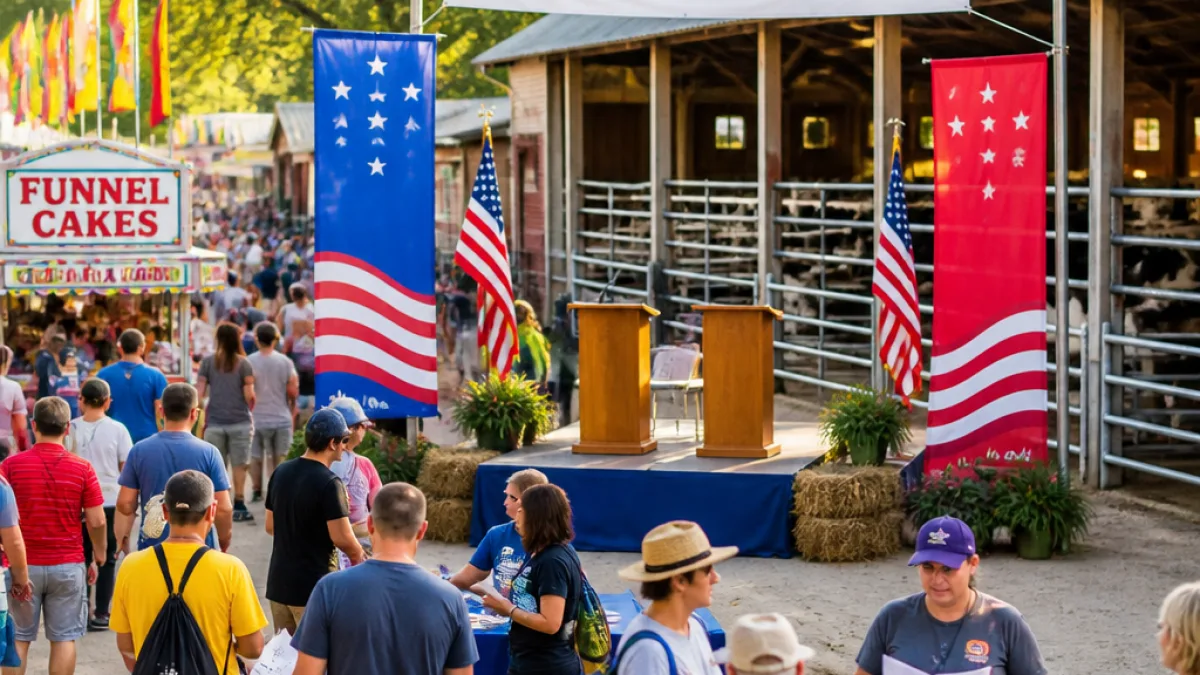
DES MOINES — On the midway outside the animal barns at the Iowa State Fair, Republican Zach Lahn and Democrat Rob Sand each used the Des Moines Register Political Soapbox to press their case for governor, offering competing promises on education, public health and agriculture to listeners who paused between funnel cakes and livestock exhibits.
High-profile appearances, different tones
Lahn spoke Friday under a rain-soaked sky to a large, engaged crowd, emphasizing what he describes as an "Iowa First" agenda aimed at keeping young people in the state and protecting rural livelihoods from consolidation in agriculture. He framed his campaign as a continuation of the themes that carried him through a competitive Republican primary.
“That means we should have good schools. That we should have clean water, a good, fair judicial system. That’s what our campaign’s been about this entire time,”
The candidate pressed concerns about cancer rates in Iowa as a top public-health priority, saying he will "not stop talking about this issue and putting in place real solutions to make it better for the people of Iowa, so they can live long, healthy lives and want to have their kids and grandkids stay here."
Policy highlights from Lahn’s speech
Lahn expressed opposition to large agricultural corporations he said threaten family farms and argued for strengthening public schools and judicial fairness. He also criticized the fundraising behind his opponent’s campaign and renewed a public challenge for one-on-one debates.
- Protect family farms — oppose consolidation by large agribusiness firms, according to Lahn’s remarks.
- Education — emphasize quality public schools to retain young residents.
- Public health — address Iowa’s high cancer rates with targeted solutions.
- Judicial system — seek what he called a "good, fair" system.
| Topic | Lahn’s emphasis |
|---|---|
| Farming | Protect family farms from large companies |
| Education | Improve quality to retain youth |
| Health | Focus on lowering cancer rates |
Campaign dynamics on the midway
Lahn used the fair appearance to draw contrasts with Democrat Rob Sand, including a jab about the source of campaign signs in the crowd. He singled out outside financial backing for Sand’s campaign — saying Sand has received "millions from family members" — and again called for a long-form debate format without a moderator.
Sand also drew a significant audience at the soapbox, part of a long-standing State Fair tradition that gives candidates a platform to reach a broad cross-section of voters. Both candidates sought to tap into the fair’s large, diverse foot traffic to present accessible, tactile arguments on issues that affect every county in Iowa.
What the Soapbox means in the campaign
The Des Moines Register Political Soapbox remains an important venue in Iowa politics because it places candidates directly before voters in an informal setting, allowing for unscripted exchanges and immediate response. For many Iowans, it’s a chance to weigh personal impressions alongside policy positions — and it gives campaigns material to carry into the final months before the election.
Campaign appearances at the fair typically focus on pocketbook and place-based issues: schools, health care, water quality and farm policy. Those themes were prominent in Lahn’s remarks and are likely to animate further debates as the race continues.
Looking ahead
Both campaigns will continue traveling across the state in the coming weeks. The fair appearance is one of several high-visibility moments that can shift momentum, energize volunteers and shape media narratives as Election Day approaches. Iowa voters who saw the candidates at the Soapbox will carry those impressions into town halls, precinct meetings and later debates — especially if the candidates accept or formalize the debate formats they referenced on the midway.
Meredith Kowalski contributed reporting from the Iowa State Fair.