
Fullerton officials to respond to grand jury on housing targets
The Fullerton City Council plans to formally tell an Orange County Grand Jury that state-mandated housing targets are out of reach and that some forms of student housing should be counted when assigning the city's housing requirement.
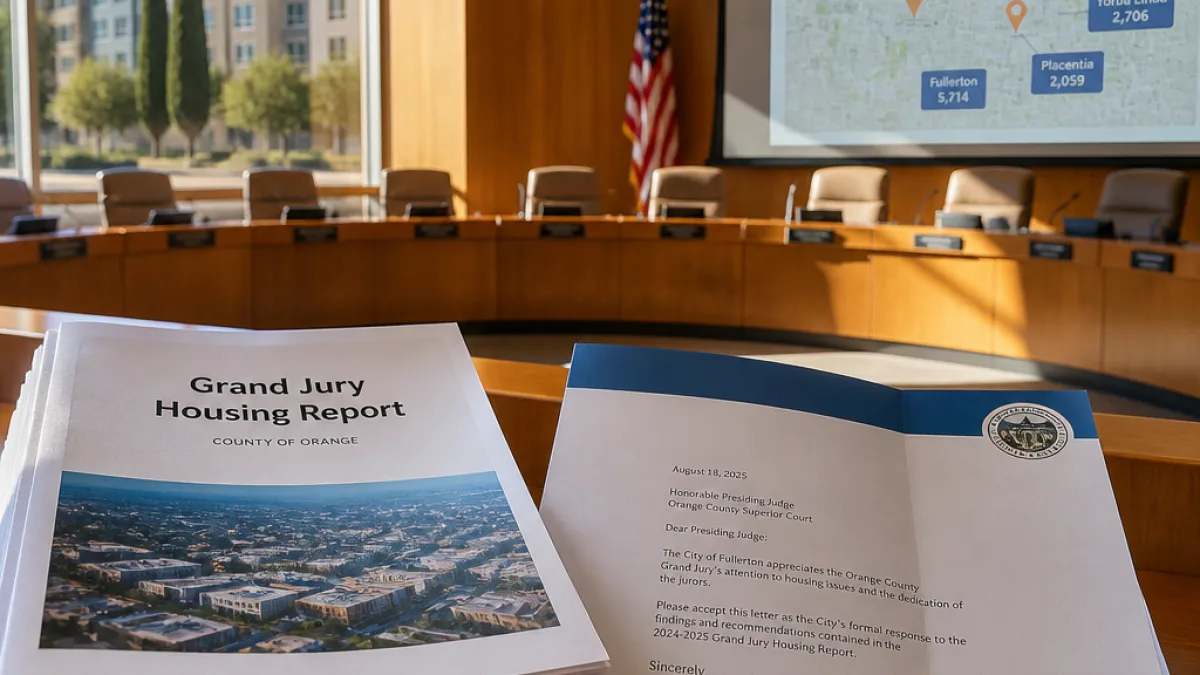
The council placed a response to the grand jury report, titled “California Housing Mandates: The Unintended Reshaping of Orange County Neighborhoods,” on the consent calendar for its Aug. 18 meeting. State law requires cities to file a formal reply to grand jury findings; the county report was released to the public May 27, and the city’s response is due Aug. 27.
In a letter dated Aug. 7 and signed by Mayor Fred Jung, Fullerton officials acknowledged most of the grand jury’s conclusions, including the assessment that the state’s housing goals are difficult to attain. The city’s response notes the scope of the challenge: Fullerton was assigned a target of 13,209 new housing units for the 2021–2029 period as part of Orange County’s broader allocation of 183,861 units.
Officials point to recent construction trends to underscore the gap between targets and production. According to U.S. Census Bureau data cited by the city, Orange County has averaged roughly 5,000 new housing units per year over the past five years — a pace the city says is insufficient to meet the current allocations.
Student housing classification at center of dispute
A central element of Fullerton’s response is its argument that housing developed for students at California State University, Fullerton, and similar projects should be eligible to count toward the city’s overall housing need. Under current state classifications, many student residences are treated as group housing and excluded from the city’s quota.
In the response letter the city argues that the group housing label is too broad and can exclude developments that, in form and function, resemble conventional apartments. Fullerton’s position is that when university enrollment and staff levels contribute to a community’s housing demand, housing built specifically for students and campus employees should be recognized as part of the supply addressing that demand.
“California Housing Mandates: The Unintended Reshaping of Orange County Neighborhoods.”
City officials also urged state and county policymakers to consider allowing land owned by universities and nonprofits to be used for more affordable housing, noting that such land can reduce development costs and potentially accelerate delivery of units.
- Assigned target: Fullerton — 13,209 units (2021–2029)
- County target: Orange County — 183,861 units
- Recent production: ~5,000 units built per year in Orange County (past five years)
While the city endorsed much of the grand jury’s analysis, Fullerton did not fully support two key recommendations contained in the report. One recommendation urged jurisdictions to join regional planning groups; the city said mere attendance in those forums is not sufficient to guarantee local control or outcomes.
| Item | Figure |
|---|---|
| Fullerton housing allocation (2021–2029) | 13,209 |
| Orange County allocation (2021–2029) | 183,861 |
| Recent annual housing production (Orange County) | ~5,000 |
Fullerton’s reply frames the housing mandate debate as both a technical and policy dispute: technically, how units are classified for counting purposes; and in policy terms, how cities, universities and regional authorities should collaborate to deliver affordable units without upending established neighborhoods.
For Fullerton residents, the practical consequences could be immediate. If student-style residences are counted, developers and university partners may pursue more on-campus or near-campus projects that would contribute to the city’s counted supply. Conversely, if the current classifications remain, the city faces pressure to find sites for thousands of units, a prospect that raises questions about zoning changes, infrastructure capacity and neighborhood impacts.
The city will consider the response on Aug. 18 as part of its consent calendar, a procedural step that precedes the formal filing of the letter to the grand jury and to county and state officials. The discussion and the final language of Fullerton’s response will be watched by neighboring jurisdictions and housing advocates as the debate over how to meet California’s housing goals continues.
















