
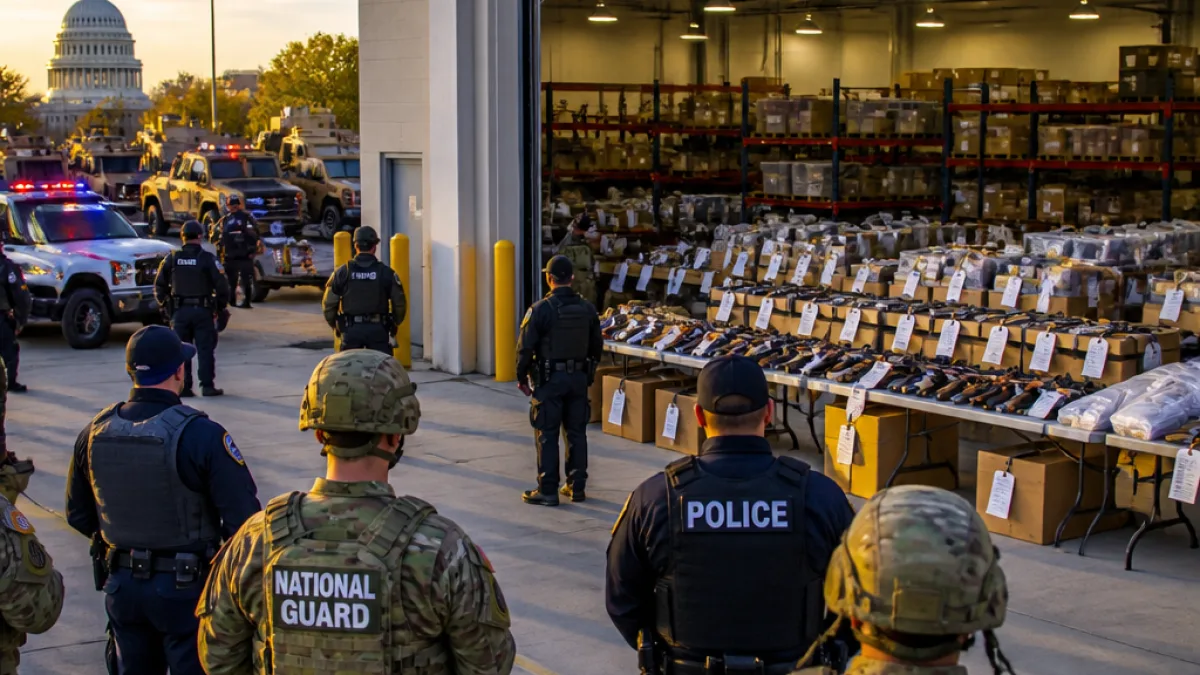
WASHINGTON — One year after federal authorities and the National Guard began a concentrated effort to curb violent crime in Washington, D.C., the operation’s leaders say it has produced more than 16,000 arrests and multiple high-profile outcomes across the city.
Scope and stated results
The initiative, launched Aug. 11, 2025, as the Make D.C. Safe and Beautiful Task Force, combined federal, state and local law enforcement resources with National Guard personnel to target violent offenders, gangs and illegal firearms. The U.S. Marshals Service provided the aggregate arrest figures released this week.
Officials reported that the task force’s first year included:
- More than 16,000 arrests across the District;
- 35 homicide suspects taken into custody;
- Arrests of more than 100 known gang members;
- Over 3,200 arrests tied to narcotics offenses;
- Seizure of nearly 2,000 illegal firearms;
- Location and return of 25 missing children to their families.
| Category | Reported Total |
|---|---|
| Total arrests | 16,000+ |
| Homicide suspects arrested | 35 |
| Narcotics-related arrests | 3,200+ |
| Illegal firearms seized | ~2,000 |
Officials highlight specific cases
Law enforcement leaders pointed to several arrests tied to notable violent incidents last year. Among them were the apprehension of three suspects in the June 2025 killing of congressional intern Eric Tarpinian, who was struck and killed while caught in a Northwest D.C. shootout. Authorities also said two people were arrested in connection with an August 2025 attempted carjacking, robbery and assault involving a former city government staffer.
In a separate operation in January, members of the task force arrested three alleged MS-13 members wanted on first-degree murder warrants in a 2025 shooting that killed a 14-year-old in neighboring Prince George’s County, Maryland.
“We will not relent until every community in Washington, D.C., is safe,” Attorney General Todd Blanche said in a statement.
Guard presence and community response
National Guard troops remained visibly deployed in the capital as the anniversary approached. Related reporting indicated roughly 4,600 Guard personnel were still stationed in the District as the operation neared its one-year mark.
The extended federal presence and the scale of arrests have drawn both support and scrutiny from D.C. residents and public officials. Proponents point to the arrest totals and firearms seizures as evidence of progress on public safety. Civil liberties advocates and some local leaders have expressed concerns about militarized policing, the long-term role of federal forces in city policing, and the transparency of arrests and prosecutions emerging from the initiative.
What the numbers do and don’t show
While the raw arrest and seizure data are substantial, they do not, on their own, measure long-term reductions in crime or systemic changes in public safety. Arrest totals can reflect both targeted enforcement of violent actors and broader sweeps that may include low-level offenses. Tracking how many arrests lead to convictions, whether prosecutions target major offenders, and how community-level violence trends evolve will be essential to assessing the initiative’s lasting impact.
City officials have said they will continue coordinating with federal partners while also emphasizing local priorities such as community policing and social services. The task force’s future operations and the timeline for scaling back federal and Guard involvement remain key questions for policymakers and residents.
As the task force begins its second year, Washingtonians will be watching for detailed breakdowns of prosecutions, recidivism among those arrested and changes in neighborhood crime statistics to better understand whether the first year’s activity translates into sustained public-safety gains.
Reporting for this story relied on statements and figures released by the U.S. Marshals Service and federal officials describing the task force’s operations during its initial year.
















