
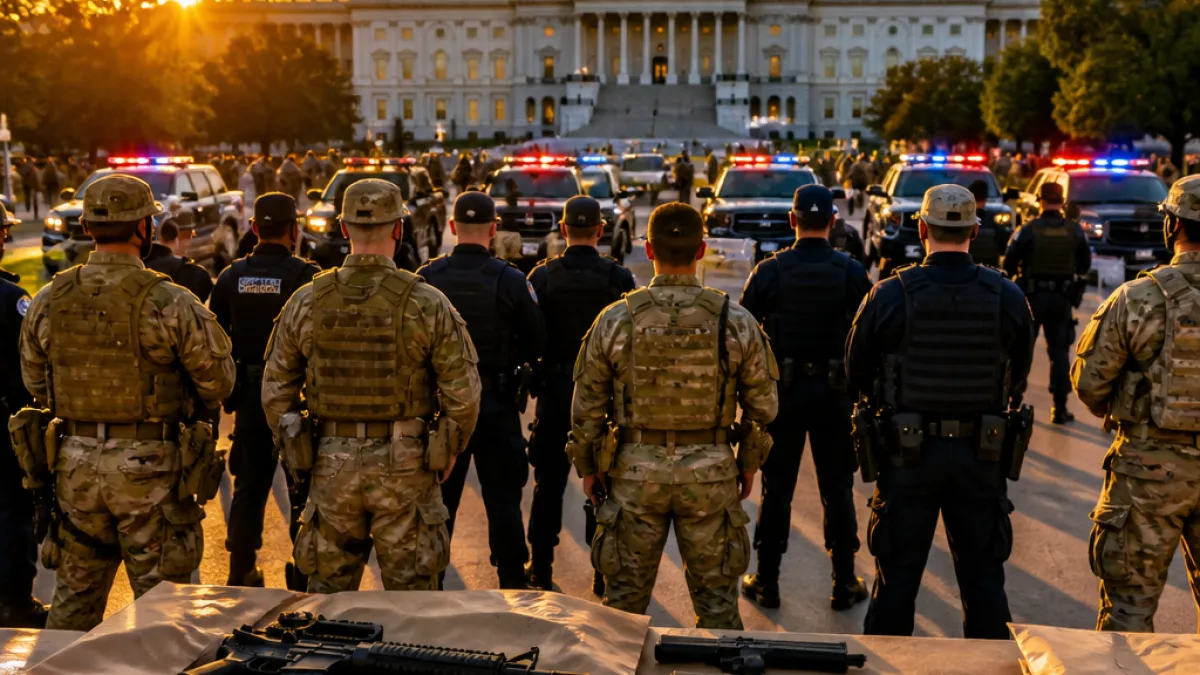
One year after President Donald Trump announced a sweeping federal operation to tackle violent crime in the nation’s capital, officials say the effort has resulted in more than 16,000 arrests and the seizure of nearly 2,000 illegal firearms.
Scope and reported outcomes
Since Aug. 11, 2025, the Make D.C. Safe and Beautiful Task Force has combined federal, state and local law enforcement resources with the National Guard to pursue violent offenders across the District. The U.S. Marshals Service reported the task force’s totals after its first year of operations.
Officials said the arrests include:
- 35 homicide suspects,
- more than 100 known gang members, and
- over 3,200 people on narcotics charges.
Authorities also reported recovering 25 missing children and highlighted the return of those youngsters to their families as part of the operation’s stated mission to protect communities.
“We will not relent until every community in Washington, D.C., is safe,” Attorney General Todd Blanche said in a statement.
High-profile cases spotlighted by the task force
Officials pointed to several arrests tied to incidents that drew national attention. The task force arrested three suspects in connection with the June 2025 shooting death of 21-year-old congressional intern Eric Tarpinian, who was killed in Northwest D.C. after being caught in a crossfire. The operation also apprehended two people accused in an August 2025 attempted carjacking, robbery and beating of a former Department of Government Efficiency staffer.
In January, members of the task force arrested three alleged MS-13 gang members who were wanted on first-degree murder warrants in the shooting death of a 14-year-old boy in Prince George’s County, Maryland. Officials have used those and other arrests to demonstrate cross-jurisdictional coordination, saying the task force can pursue suspects tied to violent crimes that straddle local and regional boundaries.
Persistent National Guard presence and local impact
Nearly a year after the task force’s deployment, thousands of National Guard troops have remained stationed in the District at various points during the operation. Related reporting noted about 4,600 National Guard troops remained in D.C. as the mission approached its one-year mark.
The continued presence of federal forces and Guard members has been a subject of debate among residents and local officials. Supporters say the surge disrupted violent networks and removed dangerous weapons from the streets. Critics have raised concerns about federal intervention in local policing and the long-term implications for civil liberties and municipal control.
Numbers, questions and next steps
The task force’s numbers—arrests, weapons seized and recovered children—offer quantifiable measures of activity. Yet many questions remain about broader trends in crime, prosecution outcomes and community relations. Arrest totals do not directly translate into convictions, and officials have not released comprehensive data tying the operation to sustained decreases in violent crime across every neighborhood.
As the task force enters its second year, residents and policymakers will be watching for evidence that the strategy reduces violence without eroding trust between communities and law enforcement. City leaders, federal officials and advocacy groups are likely to continue negotiating how to balance aggressive enforcement with oversight and accountability.
| Metric | Reported Figure |
|---|---|
| Total arrests | 16,000+ |
| Weapons seized | Nearly 2,000 |
| Homicide suspects arrested | 35 |
| Narcotics charges | 3,200+ |
| Missing children recovered | 25 |
Officials emphasized that the operation remains ongoing and framed the reported figures as part of an aggressive approach to public safety. Local community groups and civil liberties advocates have called for transparent reporting on arrests, the disposition of cases and the effect on residents, particularly in neighborhoods where enforcement activity has been concentrated.
As the city marks the anniversary, Washingtonians will be assessing both the immediate results and the longer-term consequences of a high-profile federal intervention in local public safety.
















