
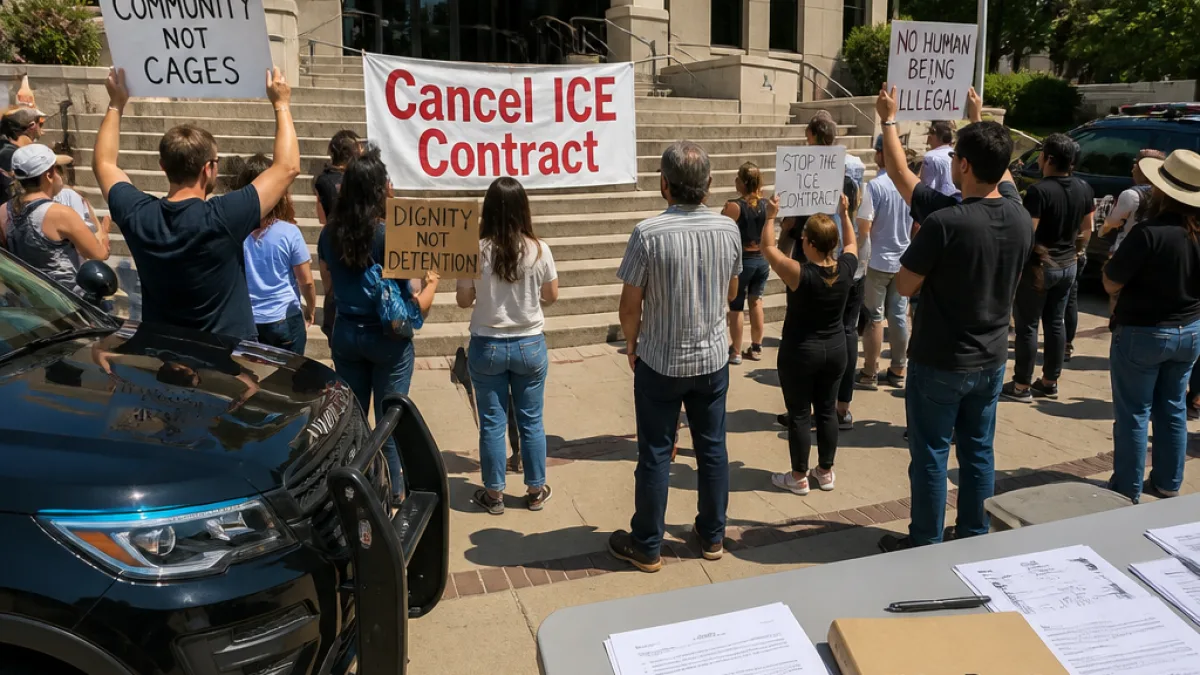
Protesters returned to Escondido City Hall Thursday to demand that city leaders cancel a contract that allows U.S. Immigration and Customs Enforcement to use a municipal firing range, citing public-records revelations that agents who train at the facility were later deployed to other cities.
Contract details and community reaction
The contract, disclosed earlier this year, shows ICE pays the city $22,500 per year to use the range off Valley Center Road. It took effect in January and includes two one-year renewal options that would bring the total value to $67,500 if exercised. The agreement has been in place in some form for more than a decade, but its most recent iteration became publicly known after media reports in January.
After the contract surfaced, opponents packed a City Council meeting in February requesting the city cancel the arrangement. At that meeting, the council declined to terminate the contract, citing a need for training, according to attendees and records.
“It means that the resources here in Escondido are enabling the abuses, the violence that we’re seeing on TV happening in cities across the country,”
The comment was made by Salvador G. Sarmiento, an attorney with the National Day Laborer Organizing Network, who has participated in the protests and public-records efforts. Community groups that sought additional documents reported emails showing ICE agents who trained at the Escondido facility were deployed to Los Angeles during unrest in June 2025 and to Minneapolis in January — deployments protesters say connect local resources to national operations.
Local concerns and public officials' response
Residents at Thursday's demonstration expressed fear and frustration about the contract and its timing. The records show the Escondido police chief signed the agreement on Jan. 14 — one week after agents in Minneapolis shot and killed Renee Good, an incident that sparked protests. Maria Wallace, an Escondido resident of 30 years, told reporters she was ashamed the city had the agreement and raised concerns about racial profiling in a city that is roughly 52% Hispanic.
“I feel outrage. I feel embarrassed. I feel sad,”
Protesters said Mayor Dane White, city staff and Escondido Police Chief Ken Plunkett did not respond to requests for comment Thursday.
Next steps and public participation
The contract is not listed on the immediate City Council agenda, but organizers said they plan to attend the next council meeting on Sept. 30 to address council members during public comment. Demonstrators indicated they will continue pressing elected officials to cancel the agreement and to release additional communications related to the arrangement.
- Contract cost: $22,500 per year
- Renewal options: Two one-year options, total potential $67,500
- Signature date: Police chief signed on Jan. 14
- Deployments noted: Agents trained in Escondido later sent to Los Angeles (June 2025) and Minneapolis (January)
| Item | Detail |
|---|---|
| Annual fee | $22,500 |
| Possible total | $67,500 (with renewals) |
| Facility | City-owned firing range, Valley Center Road |
| Contract signed | Jan. 14 (police chief) |
Organizers and protesters pursuing records say they will continue to press for transparency about how the facility is used and who deploys personnel trained there. Some residents said they worry the association with national enforcement actions could put immigrant neighborhoods at risk or undermine trust in local institutions.
The city faces competing pressures: public safety officials who emphasize the need for training facilities and community members who view the agreement as a political and moral issue tied to immigration enforcement. The debate in Escondido mirrors conversations happening in other California cities that have grappled with partnerships between municipal agencies and federal immigration authorities.
For Escondido residents, the issue has practical and symbolic stakes. Beyond the dollar amounts and contract language, opponents say the arrangement raises questions about local control, municipal priorities and the role of city assets in federal operations.
Protesters said they will return to the Sept. 30 council meeting to make their case to elected officials and to seek a formal city response to the newly released records.
















