
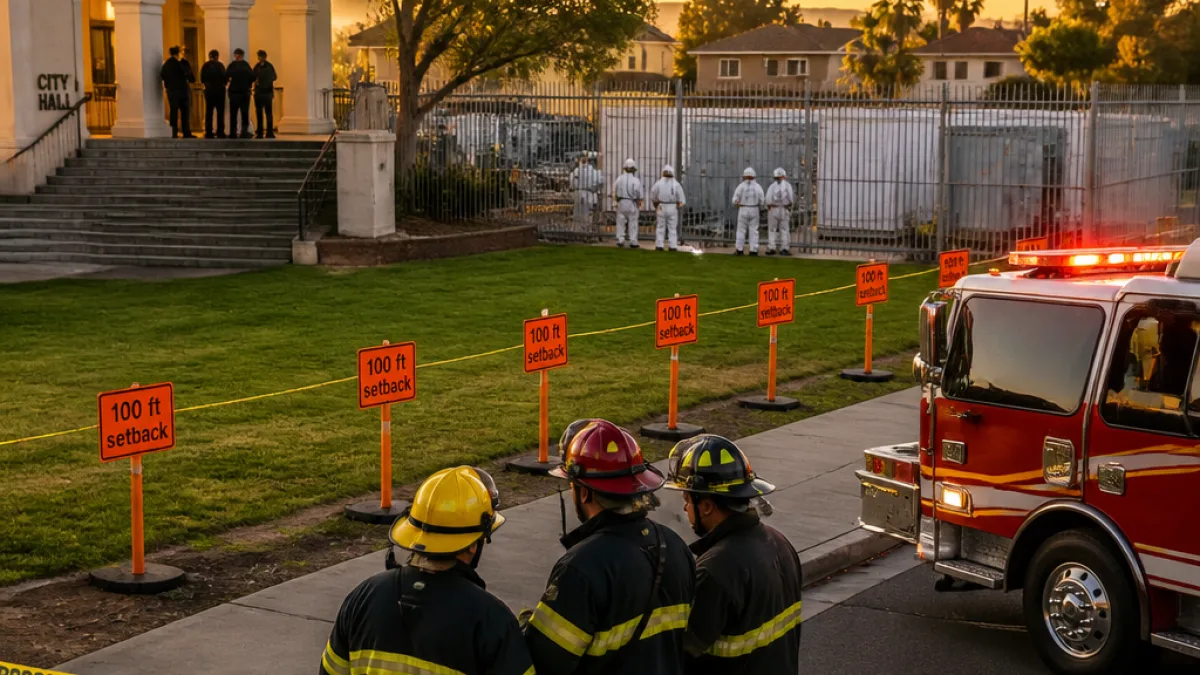
ESCONDIDO — The City Council unanimously voted July 29 to integrate San Diego County’s safety guidelines for battery energy storage systems into Escondido’s fire code, enacting new requirements intended to reduce risks from large-scale battery facilities and to clarify who pays for emergency response and investigations.
New rules and what they require
The ordinance adds several specific provisions to the fire code. Key measures include a 100-foot setback for battery energy storage systems, or BESS, when facilities are adjacent to residential, educational or institutional uses. The city also will require facility owners to reimburse the Escondido Fire Department for costs tied to emergency responses, and to pay for a cause-and-origin investigation following any fire at a BESS site, conducted either by the fire chief or an approved third party.
City officials framed the update as a response to nearly two years of concern and review. That period included a council resolution in August 2024 opposing large-scale BESS projects within or near Escondido and an interim moratorium on new commercial battery installations after a nearby fire.
Timeline and local context
The council first moved in 2024 to express opposition to major battery projects in the city, specifically in reaction to plans from AES Corporation for a proposed project in Eden Valley that was later withdrawn. In the weeks that followed, a fire at a San Diego Gas & Electric BESS facility in Escondido heightened public concern and prompted the council to adopt an interim urgency ordinance that banned new commercial BESS projects inside the city for 45 days. The moratorium was extended while staff conducted further study.
In May 2025, council members directed staff to incorporate San Diego County’s recommended best practices into the city’s fire code and to prepare minimum workforce safety standards for battery projects. The workforce proposals under discussion included requiring electrical work to be performed by electricians holding a C-10 license and a proposal that at least 15% of certified electricians on-site hold such credentials.
Implications for development and emergency response
Adopting the county guidelines formalizes safety expectations for potential developers and operators of battery facilities in Escondido. The setback provision is designed to keep large-scale battery systems at a greater distance from sensitive uses, while the cost-recovery and investigation clauses place financial responsibility for emergency incidents on facility owners.
- Setback: 100-foot buffer from residential, educational and institutional property lines
- Emergency costs: Facility owners must reimburse Escondido Fire Department response expenses
- Post-fire investigation: Cause-and-origin review required, paid for by facility owner
Supporters say the measures provide clearer rules for public safety and accountability. Critics of large-scale storage projects have cited the destructive potential of thermal runaway events and the challenges firefighters face when tackling battery fires; the city’s action seeks to address those concerns with concrete regulatory tools.
What remains unresolved
While the ordinance adopts the county’s safety guidelines, the city had also been weighing workforce standards that would affect who can perform electrical and installation work on BESS projects. The council in May 2025 directed staff to develop minimum workforce safety standards that included licensing and certification elements, but at the July 29 vote the full scope and final adoption of those workforce rules remained separate from the fire-code update.
| Item | Requirement |
|---|---|
| Setback | 100 feet from residential, educational, institutional uses |
| Emergency response costs | Reimbursement by facility owners to Escondido Fire Department |
| Post-fire investigation | Cause-and-origin review by fire chief or approved third party, paid by owner |
City officials emphasized that the ordinance is a step toward managing local risks associated with an emerging industry, even as debates continue about the appropriate size, location and oversight of battery storage projects. For residents, the changes establish clearer safety standards and financial accountability should incidents occur at battery facilities near the community.
















