
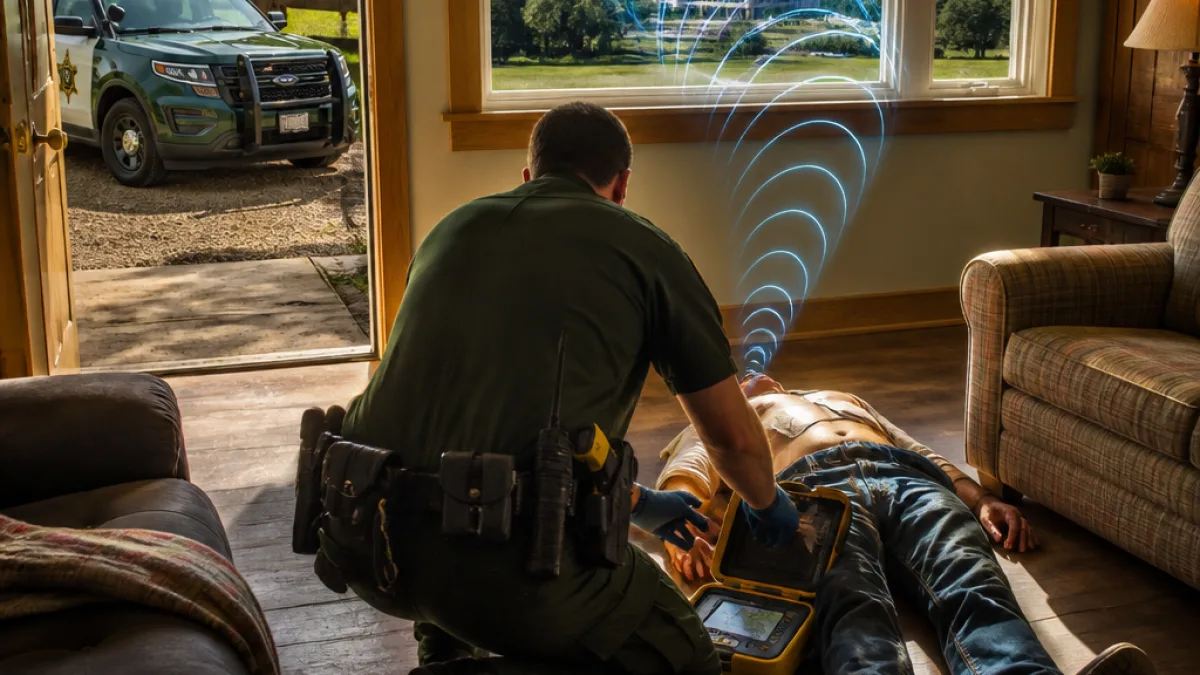
Clay County’s investment in connected automated external defibrillators paid off almost immediately after the devices were deployed across the sheriff’s office earlier this year, county and company officials said.
New devices in patrol cars, sheriff facilities
In January 2026, the Clay County Sheriff’s Office placed 63 Avive Connect AEDs into service, distributing units among every patrol vehicle and across several sheriff-run sites, officials said. The rollout reached locations that include the county’s justice and public safety facilities and other sheriff-operated buildings.
The county’s largely rural footprint can yield longer ambulance travel times; officials noted that emergency medical services response in some corridors can extend to 30 to 40 minutes. Sheriff’s deputies often are first on scene, particularly in outlying areas, and equipping patrol units with defibrillators was intended to close that gap, the sheriff’s office said.
Life saved within 48 hours
Two days after the devices were distributed, deputies used one of the Avive units during a home collapse emergency. A 61-year-old man, identified in company materials as Donlee McIntyre, suffered a cardiac arrest at his residence shortly after finishing a treadmill session. Family members performed CPR while dispatch and responding deputies converged on the home.
Deputy Vicente Vargas retrieved an Avive Connect AED from his patrol vehicle, followed the device’s visual and audible prompts through two shocks and continued compressions until paramedics arrived. The device’s guidance and the deputy’s actions were credited with restoring a pulse and helping secure what officials describe as a complete neurological and physical recovery for McIntyre.
According to the account released by the AED manufacturer and the sheriff’s office, the deputy scanned the AED’s incident data QR code at the scene and transmitted the full cardiac record to the receiving hospital before the ambulance left. That transfer, the company said, provided clinicians with critical information on treatment and timing during transport.
Training and technology
Deputy Vargas had completed training on the Avive device just days before the incident and had handled the AED only once previously, the materials state. Avive Solutions, the California-based manufacturer of the Avive Connect AED, emphasizes the device’s connected features: real-time guidance, incident data capture and rapid transmission to hospitals.
Company and county materials say those capabilities can shorten the time from collapse to defibrillation and improve the continuity of care between first responders and hospital teams. The county’s decision to place the systems in both vehicles and fixed locations was framed as a move to cover 410 square miles of mixed urban and rural terrain.
- Number of AEDs deployed: 63
- Reported ambulance delays in some areas: up to 30–40 minutes
- Patient outcome reported: full neurological and physical recovery
| Deployment sites | Examples listed |
|---|---|
| Patrol vehicles | Every patrol car in the sheriff’s fleet |
| Sheriff facilities | Rooney Justice Center, Children’s Justice Center, Public Safety Building, Law Enforcement Resource Center, Transition Housing |
Public-health implications
Outcomes in cardiac arrest rely on a chain of survival that includes immediate recognition, prompt CPR, rapid defibrillation when appropriate and advanced care. In areas where ambulances face extended travel times, equipping law enforcement with AEDs can shorten the interval to defibrillation, officials say.
County leaders will likely monitor long-term outcomes and response metrics to evaluate whether the deployment reduces mortality in out-of-hospital cardiac arrests. The sheriff’s office framed the program as a public-safety improvement that complements emergency medical services rather than replacing them.
For residents, the episode underscores the value of bystander CPR training and quick access to automated external defibrillators — both wired or fixed-location units and those carried by first responders. Local agencies may use the Clay County case as an example when considering broader AED programs.
Information about public AED locations, CPR classes and how to respond to suspected cardiac arrest remains available through local public health offices and emergency medical agencies.

















