
By Gabriela Montez
State Correspondent, WE NEWS
What voters will decide this fall
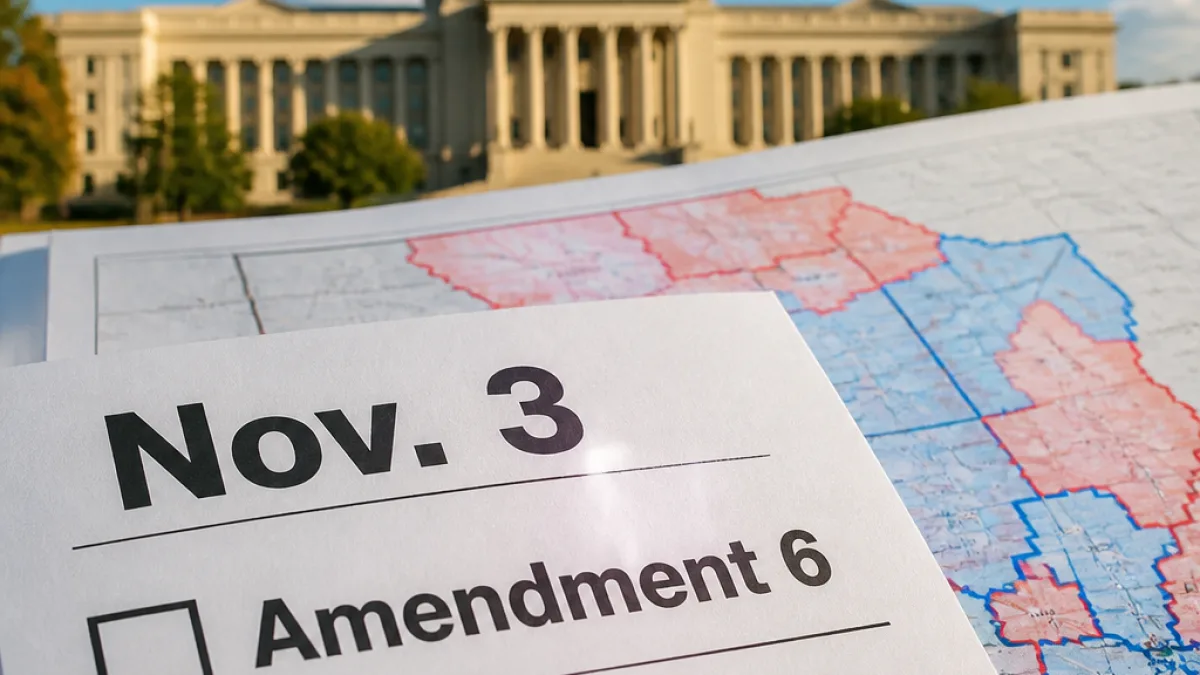
Two ballot measures on Nov. 3 — Amendment 6 and Proposition A — could combine to make another mid-decade congressional redistricting in Missouri difficult if not politically fraught. The measures follow a string of court rulings this month that pulled the state into a legal fight over which map will govern upcoming federal elections.
Under the scenario advocates describe, if voters reject Proposition A and approve Amendment 6, lawmakers would face an unusually high bar — an 80% supermajority in both legislative chambers plus another statewide referendum — before they could change the congressional map again prior to the 2030 census.
How the measures interact
The unusual intersection of the two items is the product of recent Missouri Supreme Court actions. The court ruled that opponents of a proposed 2025 congressional map had gathered enough signatures to force a referendum, and separately ordered Amendment 6 onto the ballot. That has created a condition where the public could simultaneously accept a limitation mechanism while voting on whether to keep or reject the new map.
Legal scholars say the combination could have practical effects beyond the next few election cycles. Travis Crum, a Washington University law professor who specializes in election law and redistricting, told reporters that Amendment 6 would likely apply the 80% requirement to any subsequent mid-decade redraws aimed at replacing a map that voters had recently rejected.
“A new map would be viewed as similar in effect to the map that was rejected, and so therefore the 80% requirement would apply,”
That interpretation would make it extremely difficult for lawmakers who wish to pursue a new congressional plan for the 2028 or 2030 election cycles without overwhelming legislative support or another statewide approval.
Political response and proposals
Some Republican lawmakers have already telegraphed plans to revisit redistricting. Minutes after the Missouri Supreme Court struck down a partisan map, GOP state Sen. Nick Schroer posted the message “8-0 2027” on social media and indicated his caucus would discuss “implementing an eight-zero map” in coming years. Secretary of State Denny Hoskins also said in a radio interview he could “most certainly” see lawmakers attempting another congressional redraw during the 2027 legislative session.
But if voters approve Amendment 6, those proposals could face a substantial procedural barrier. Professor Crum said even alternative redraws—such as a different 7-1 plan targeting a different metropolitan area—would likely fall under the amendment’s high-threshold rule.
What the ballot measures would do
- Proposition A: If rejected by voters, the congressional boundaries enacted in 2022 would remain in place for upcoming elections.
- Amendment 6: Would impose an 80% approval threshold in both the Missouri House and Senate and require another statewide vote to change congressional maps before the next decennial census.
The combined effect could freeze a map in place unless a very broad bipartisan consensus emerges in the legislature or voters reverse course via another statewide referendum.
Practical implications for upcoming elections
The timing matters. Courts and federal appeals judges have already weighed in on which maps are legally in effect for November. The 8th U.S. Circuit Court of Appeals ruled that Missouri must use the 2025 map, but that decision has been stayed pending further action. The legal uncertainty, paired with the potential for a new voter-imposed hurdle, means campaigns and voters are operating with competing possibilities for which lines will apply.
That uncertainty affects candidates' decisions about where to run, how to allocate resources and how parties plan for competitive races. If Amendment 6 passes and Proposition A fails, lawmakers hoping to redraw districts mid-decade would face a steep climb to secure the supermajority and another statewide referendum.
Quick reference: thresholds and effects
| Measure | Immediate effect if passed |
|---|---|
| Proposition A | Approves new 2025 map; if rejected, 2022 map stays in effect. |
| Amendment 6 | Requires 80% legislative approval in both chambers and another statewide vote before changing congressional boundaries prior to 2030. |
What voters should consider
Voters deciding on Nov. 3 are being asked not only to weigh which map they prefer for the near term but also whether to constrain future lawmakers’ ability to redraw districts without extraordinary legislative consensus. Legal experts caution that the interaction of the two measures creates complexity that could shape Missouri’s redistricting battles for the remainder of the decade.
As the state moves toward Election Day, the choices on the ballot will determine whether the immediate legal fight over maps ends with the 2025 plan, the 2022 plan, or a new set of procedural obstacles that shape remapping efforts for years to come.

















