
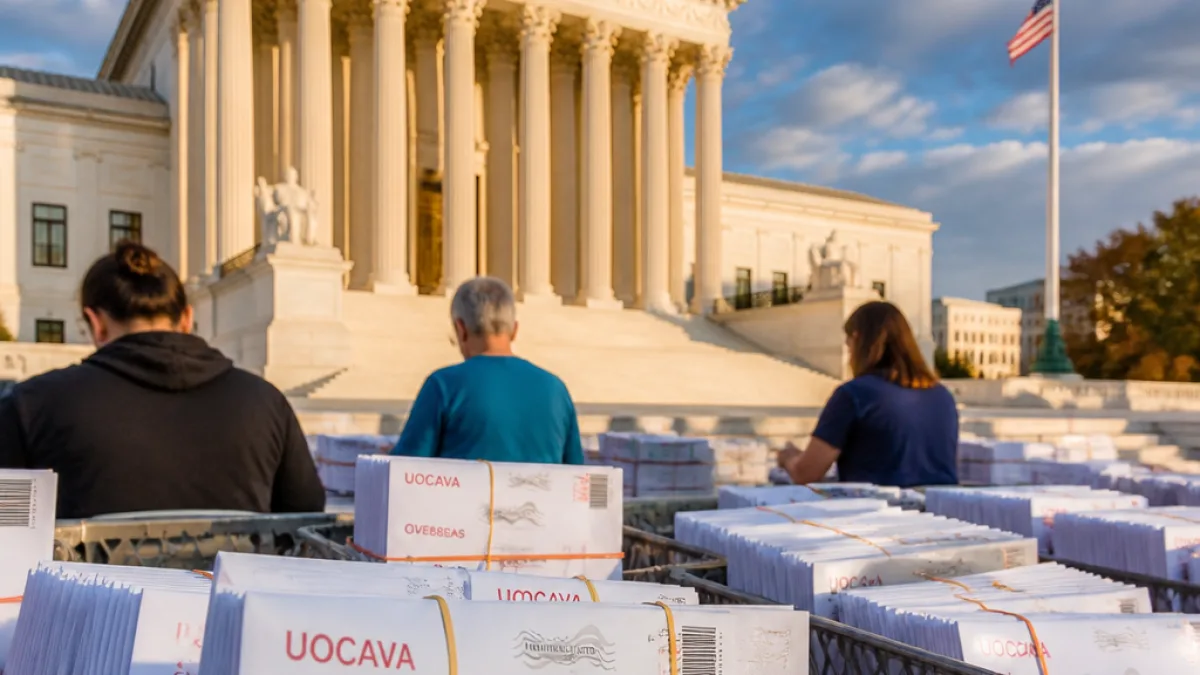
WASHINGTON — The U.S. Supreme Court on Friday prevented Missouri Republicans from switching to a new congressional map in the middle of the state's midterm election, reinforcing earlier rulings and leaving the state to proceed under the existing 2022 map as votes are already being cast.
Court cites risk of electoral disruption
In a brief, unanimous order, the justices blocked an appeals court decision that had sought to reinstate the proposed 2025 map. The high court said that changing the district boundaries now would create unacceptable uncertainty because Missouri has already started mailing ballots to military and overseas voters and some absentee voting has begun.
“At this late date, ordering reversion to the 2025 map in the midst of an ongoing election would usher in electoral chaos.”
The order granted emergency relief to People Not Politicians, the group that challenged the 2025 map. The group's executive director, Richard von Glahn, said in a statement that the decision affirmed the organization's position that maps imposed outside the constitutionally prescribed process would not stand.
What remains in place for November
With the Supreme Court’s action, Missouri will use the congressional map adopted in 2022 for the upcoming midterms. Under that map, six U.S. House seats are held by Republicans and two by Democrats. The proposed 2025 map would have removed one of the Democratic-held seats, including that of Representative Emanuel Cleaver.
| Map | Republican-held seats | Democratic-held seats |
|---|---|---|
| 2022 map (in use) | 6 | 2 |
| Proposed 2025 map | Would have eliminated one Democratic seat |
Representative Cleaver told reporters he was "very happy" with the ruling and relieved the matter was resolved ahead of November, saying the dispute had continued for too long.
Legal battle and political stakes
This is the third time the nation’s highest court has intervened to block the change. The issue has also been addressed by the Missouri Supreme Court, which previously ruled against the Republican-led effort to implement the 2025 plan. The proposed redistricting in Missouri was part of a broader, nationwide push by Republican lawmakers, encouraged by President Donald Trump, to redraw congressional districts in ways that could advantage their party.
The dispute in Missouri drew parallel mapping changes in other states as both parties sought maps favorable to their interests. Courts across the country have been adjudicating a series of redistricting fights as the 2024 and 2026 election cycles have prompted new map proposals.
Practical impact for voters and election administrators
Election officials across Missouri now must continue administering the midterm cycle under the 2022 lines. That decision has practical implications:
- Ballots already mailed to military and overseas voters remain valid and need not be reissued.
- Absentee voting that has begun will continue under the current districts.
- Candidates and campaigns will proceed with the certainty of existing boundaries as they finalize outreach, get-out-the-vote plans and ballot access preparations.
In explaining its decision, the Supreme Court relied on precedent cautioning lower federal courts against altering election rules on the eve of or during an election. The order stressed that the election was not just forthcoming but had in fact begun, heightening the court’s concern about potential disruption.
What to watch next
The legal fight over Missouri’s map is likely to continue in various forums, but Friday’s decision removes immediate uncertainty for the November elections. Observers will be watching whether there are further filings seeking reconsideration and how Missouri election officials manage the final weeks of voting.
For Missouri voters, the ruling means ballots, candidate lists and district representation will remain as they were under the 2022 map for this election cycle. Campaigns and local election boards now have a clear directive from the highest court to maintain the status quo while the broader constitutional and procedural questions underlying the dispute are litigated or resolved through the political process.
Voters with questions about their districts, sample ballots or absentee and military voting procedures should consult their county election authorities for the most current information.

















