
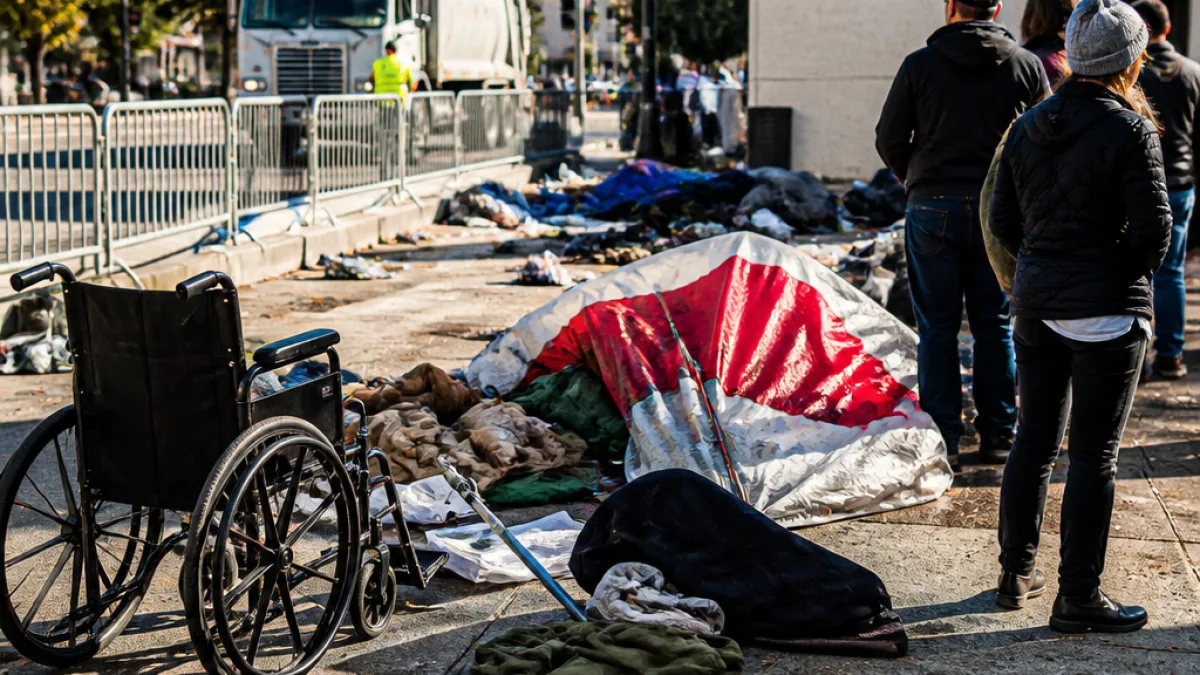
A federal judge has certified a class of unhoused people with disabilities in a 2023 lawsuit challenging the City of Berkeley’s encampment sweep policies, saying the record shows widespread risk that city enforcement results in the loss of essential belongings.
Court action and scope of the class
The U.S. District Court for the Northern District of California granted class certification in the case brought by Disability Rights Advocates and the East Bay Community Law Center on behalf of five individual plaintiffs and the advocacy group Where Do We Go. The action alleges that the city discriminates against unhoused people with disabilities by failing to provide reasonable accommodations and engages in the unlawful destruction of survival gear and personal property—items the complaint lists as tents, medical equipment and identification documents.
The court approved a broad class definition covering all unhoused people with disabilities who have experienced or face the risk of the city’s encampment sweep policies and practices. It also certified a subclass of disabled people who live in their vehicles and cannot comply with the city’s 72‑hour vehicle-move requirement because of their disabilities.
What the judge found
In its order, the court said the evidentiary record contains “abundant — and troubling — anecdotal evidence of an enforcement framework weighted in favor of property disposal,” and that those facts demonstrate both the scope of the risk to the class and the severity of harms resulting from the city’s property seizure and destruction procedures.
“This case is bigger than Berkeley. It is about whether any city can treat disabled unhoused people as disposable,”
said lead plaintiff Yesica Prado in a statement accompanying the certification. Prado added that the certification sends a message to cities that assume unhoused people will disappear.
“Being unhoused and disabled is hard enough without the city you live in actively working to keep”
said class representative and named plaintiff Amber Whitson, in remarks excerpted in the court filing.
Practical implications for Berkeley
The certification moves the lawsuit into a phase where the named plaintiffs will litigate claims on behalf of a larger group. Potential outcomes could include injunctions, policy changes, or other remedies addressing how the city handles possessions of unhoused residents and how it provides accommodations to people with disabilities. The court’s findings on property disposal suggest the judge sees a systemic issue rather than isolated incidents.
- Certified class: All unhoused people with disabilities affected by Berkeley’s encampment policies.
- Subclass: Disabled individuals living in vehicles who cannot meet the 72‑hour vehicle-move rule.
- Allegations: Failure to provide reasonable accommodations and unlawful destruction of essential belongings.
| Party | Role |
|---|---|
| Disability Rights Advocates | Lead counsel |
| East Bay Community Law Center | Co-counsel |
| Where Do We Go | Advocacy plaintiff |
Local context and next steps
Berkeley, like many Bay Area cities, has wrestled for years with visible homelessness and how to balance public space enforcement with legal obligations to people with disabilities. The court’s decision to certify a class underscores that this dispute will be resolved not only through individual claims but on a classwide basis that could shape municipal practice.
The certification does not decide the merits of the claims. It allows the plaintiffs to pursue relief for the whole certified group. The litigation will proceed through class discovery and motions that could culminate in a trial or a settlement addressing city policies, storage and notice procedures, and accommodation protocols.
City officials did not appear in the court excerpts released with the certification to dispute the plaintiffs’ allegations; the order and plaintiffs’ statements form the basis of the public account filed with the court. The case remains active in the federal court docket for the Northern District of California.
The certification marks a consequential development for Berkeley residents and city policymakers: a federal court has found sufficient uniformity and risk to allow classwide litigation over whether enforcement practices unlawfully impinge on the rights of disabled unhoused people.
















