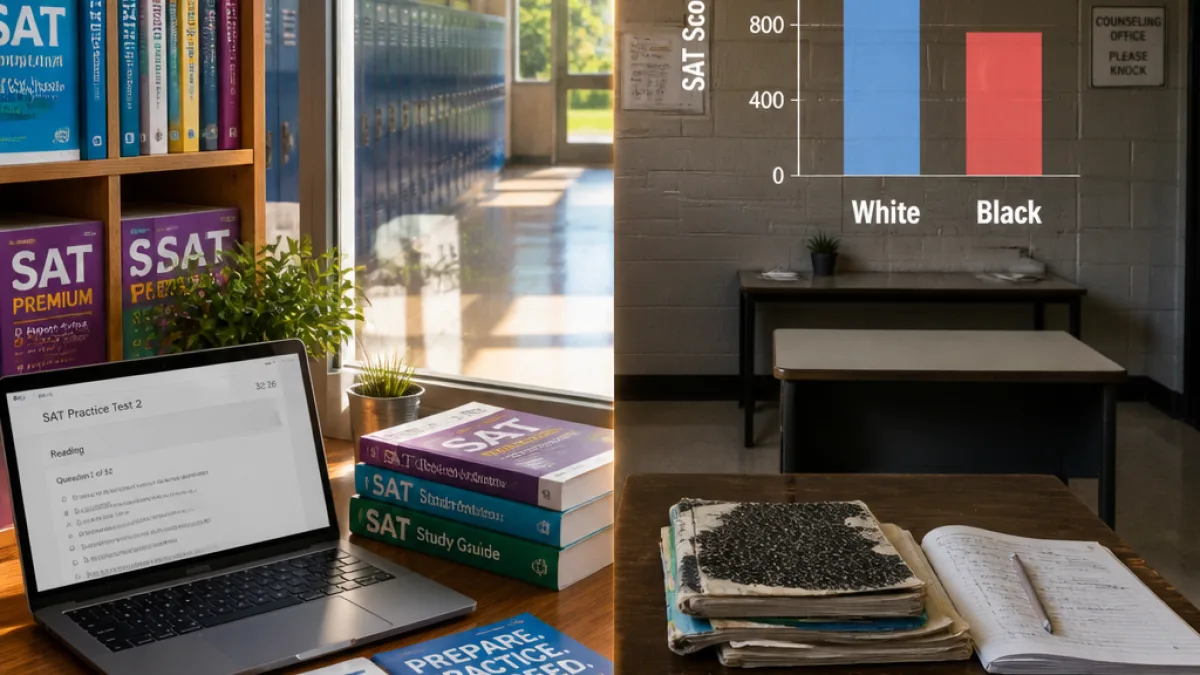
Data show sharp White–Black gap across Ann Arbor high schools
The latest state testing figures show the Ann Arbor school district posted the widest gap in SAT scores between White and Black students of any district in Michigan, with an average difference of about 308 points, according to an analysis of Michigan Department of Education results published Sept. 14.
The data, released by the state on Sept. 4 and analyzed by the Detroit News, indicate that while Black students in Ann Arbor scored roughly 38 points higher than Black students statewide, White students in the district scored about 189 points higher than the statewide average for White students. Those relative gains for both groups still leave a substantial disparity between White and Black test-takers within Ann Arbor.
| Measure | Ann Arbor vs. State |
|---|---|
| Average White–Black SAT gap (Ann Arbor) | ~308 points |
| Black students vs. statewide Black average | +38 points |
| White students vs. statewide White average | +189 points |
Local context: high averages, persistent inequality
Ann Arbor schools continue to register relatively high overall performance. Data from the Educational Opportunity Project at Stanford University cited in the analysis characterize the district as providing "higher than average" educational opportunities, and the average test scores are noted as nearly two grade levels above the national average.
Still, education researchers and local advocates caution that strong average performance can mask deep differences between student groups. University of Michigan education professor Matthew Diemer, cited in the report, noted that the SAT tends to reflect broader social and economic inequalities rather than serving as a pure measure of in-class learning.
"The SAT essentially functions as a mirror, reflecting existing inequalities," the report quoted Diemer as saying.
Why the gap matters for Ann Arbor families and schools
Experts attribute much of the gap to differences in access to out-of-school resources that support SAT preparation, including private tutoring, test-prep programs and access to practice tests. Because those resources often track with family income and wealth, decades-long racial income disparities can result in systematic advantages for some students.
For Ann Arbor families and educators, the numbers underscore a dual reality: the district's high overall performance and the need to address uneven access to supports that influence college-admissions testing. College Board commentary referenced in the analysis noted that the SAT was designed as "an objective and standardized way" to compare students, but long-standing research continues to document racial gaps on the exam.
- Three Ann Arbor high schools had the largest White–Black score gap in Michigan.
- The district's average SAT results remain well above state and national benchmarks.
- Researchers link gaps to out-of-school resources and broader economic inequality.
Implications for policy and practice
Addressing the gap will likely require coordinated action among district leaders, schools and community organizations. Potential approaches discussed by scholars and advocates in similar districts include expanded free or low-cost test preparation offered through high schools, targeted academic supports, and efforts to reduce economic barriers to college counseling and application resources.
Ann Arbor Public Schools did not provide an immediate comment for this report. Local stakeholders — including parents, community groups and higher-education partners — will face questions about how to preserve the district’s overall strengths while narrowing disparities that may affect college opportunities for Black students.
The recent state release of SAT data provides a focal point for those discussions in Ann Arbor. As leaders consider next steps, the numbers make clear that strong average achievement does not eliminate the need for work to ensure equitable outcomes across student groups.