
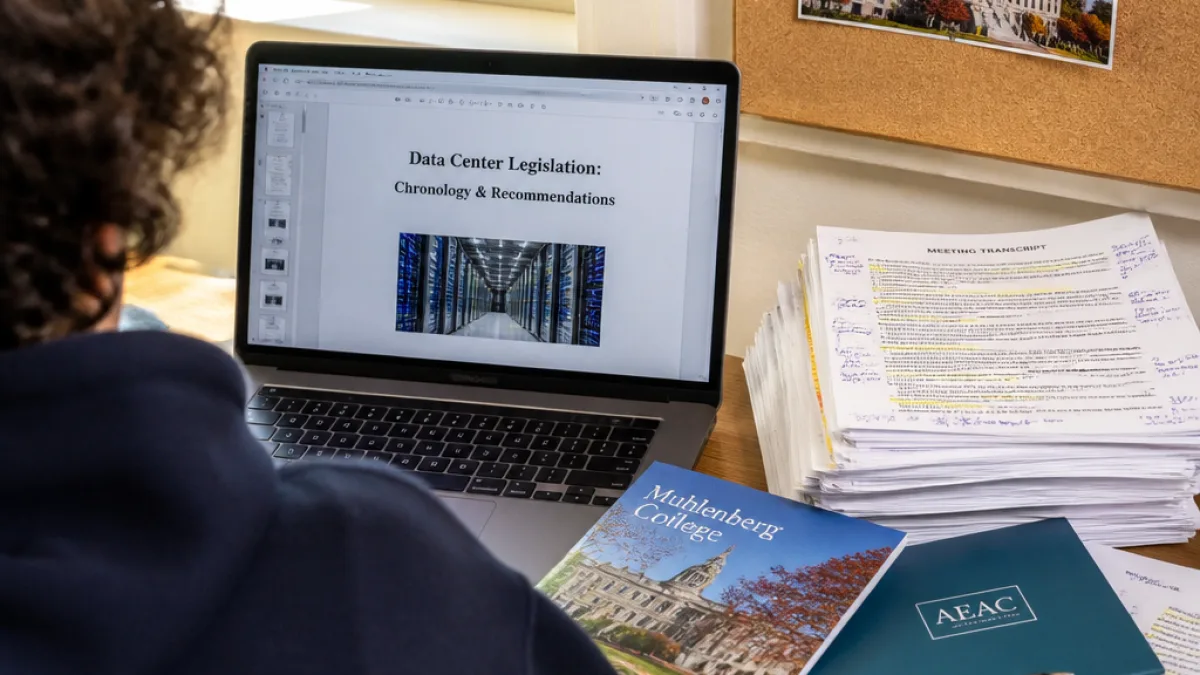
This summer, a Muhlenberg College student interning with the Allentown Environmental Advisory Council spent weeks monitoring municipal meetings and preparing a detailed account of the city's handling of proposed data center legislation, producing a report intended to inform future amendments and improve public communication.
From campus to city hall
Noah Rosenfeld, a 2028 student at Muhlenberg College and a double major in statistics and psychology from Dallas, said he connected with the work after exploring research and public policy opportunities through his college’s Career Center and the Institute of Public Opinion. His internship is part of the college Office of Community Engagement’s Community Internship Program, which provides grant-funded stipends to students working with community organizations.
Rosenfeld’s responsibilities this summer ranged from watching city meetings to reviewing meeting materials and preparing written analyses for the AEAC.
Documenting the city’s process
Early in the internship, Rosenfeld said he created an unofficial summary of public commentary surrounding a controversial bill related to data centers. He presented that information to the AEAC to help the council and other stakeholders understand public sentiment as officials considered amendments.
“When I read that the AEAC wanted an intern to conduct a research report on a topic relevant to sustainability and/or the environment in Allentown that could potentially influence city legislation, I knew the internship would be perfect for me.”
Later in the summer, Rosenfeld compiled a more comprehensive report that provides a chronological account of the city’s actions on data center legislation through Aug. 5. According to Rosenfeld, the report also includes recommendations for potential amendments and strategies to bolster the city’s transparency and communications regarding the issue.
Why it matters locally
Allentown has been reviewing policy options that affect land use, environmental impact and municipal oversight related to data centers. The work of local advisory groups such as the AEAC — supported in this instance by student researchers — can feed directly into the policy debate by highlighting procedural steps, public concerns and gaps in communication.
- Monitoring: Rosenfeld watched city meetings and examined materials to capture the flow of discussion and decision-making.
- Public comment analysis: He produced an unofficial summary of public input on the controversial data center bill to inform council deliberations.
- Formal report: A chronological report through Aug. 5 outlines the city’s actions and recommends improvements to transparency and amendment language.
Report highlights and next steps
Rosenfeld’s description of the report shows a focus on documenting the legislative process and proposing ways to improve how the city communicates with residents and stakeholders during policy changes. The document, shared with the AEAC, lays out the sequence of city activity related to the data center topic and proposes recommendations for future amendments.
City officials decide which recommendations from advisory reports are taken up in the formal drafting and amendment process. Advisory council findings and community-sourced analyses often inform that process but do not set policy on their own.
| Item | Detail |
|---|---|
| Intern | Noah Rosenfeld, Muhlenberg College Class of 2028 |
| Host | Allentown Environmental Advisory Council (AEAC) |
| Program | Muhlenberg Office of Community Engagement — Community Internship Program |
| Focus | Chronological report on data center legislation and recommendations (through Aug. 5) |
For Allentown residents, the work underscores how students and advisory groups can contribute to municipal policy discussions — collecting public comment, analyzing procedural steps and recommending clearer communication practices. The AEAC may use Rosenfeld’s findings as it continues to advise the city on environmental and sustainability implications tied to land-use decisions and regulatory language.
As the council and city officials consider potential amendments, residents interested in data center policy and related environmental impacts should monitor upcoming council agendas and AEAC meetings for responses to the recommendations outlined in the report.

















