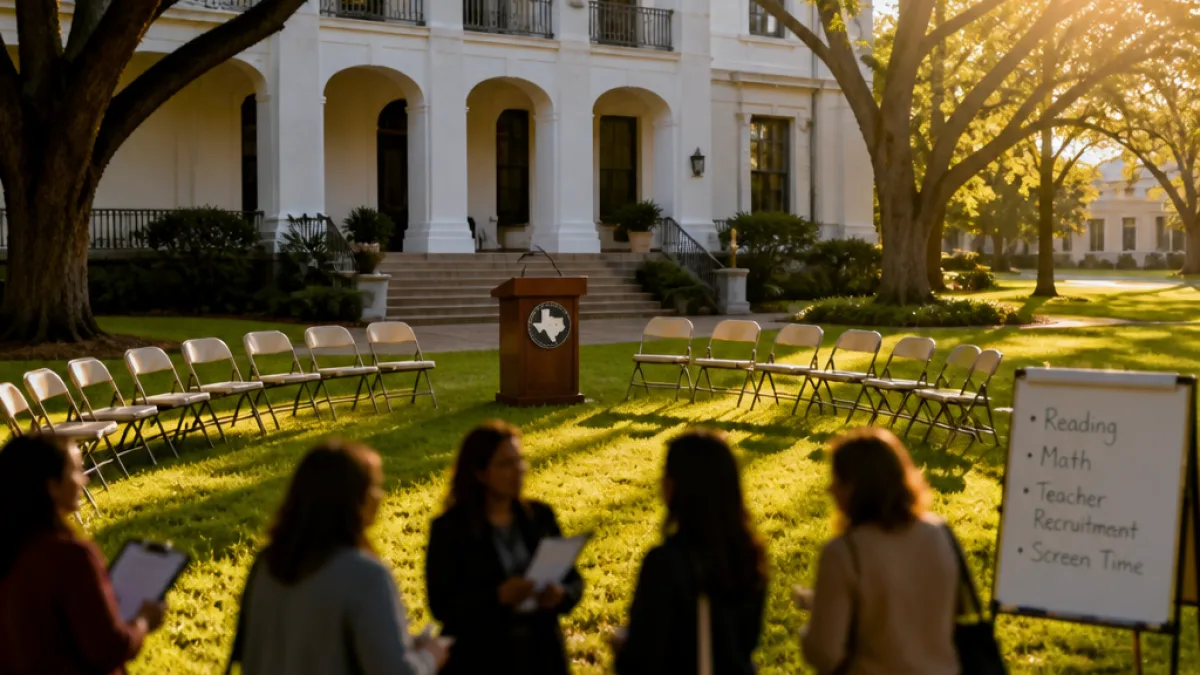
AUSTIN — Gov. Greg Abbott on Monday convened the first meeting of the newly formed Texas Classroom Commission at the Governor’s Mansion, unveiling a 21-member panel of current and former public school educators charged with producing recommendations to improve classroom instruction, teacher recruitment and student outcomes.
Commission focused on classroom-tested solutions
The commission, made up exclusively of past and present public school teachers and administrators, will advise the governor, the Texas Legislature and the Texas Education Agency on steps intended to bolster instruction, support educators and raise student proficiency in core subjects.
Abbott told the group their work should center on practical, classroom-level solutions and set a clear target for the state: making sustained progress toward “ranking number one in America for educating our kids.”
"The goal now among this commission, the goal for the state of Texas, is to ensure enduring progress toward our goal of ranking number one in America for educating our kids," Gov. Abbott said.
Priority areas: math, reading, teachers and screen time
Abbott outlined specific priorities for the panel, emphasizing improvements in math and reading proficiency, strategies to attract and retain teachers, and efforts to reduce screen time in classrooms. He pointed to a 2025 state law that banned cellphones in classrooms as an example of reducing distractions to strengthen learning.
"The law that banned cell phones in classrooms proved very effective," the governor said. "Too much screen time hinders, as opposed to helping, educating a child."
The commission is expected to craft recommendations that are informed by teachers’ experience in day-to-day classrooms rather than high-level policy alone, Abbott said. He made clear the timeline: the panel should deliver proposals in advance of the state’s 90th legislative session, which opens Jan. 12, 2027.
Structure, timeline and intended audience
The membership totals 21 educators, all with public school backgrounds. The commission’s findings will be targeted to three recipients: the governor, the Texas Legislature and the Texas Education Agency. Abbott expressed hope the panel’s work will provide lawmakers with actionable items to consider during the 2027 session.
| Item | Detail |
|---|---|
| Members | 21 past and present public school educators |
| Key priorities | Math & reading proficiency, teacher recruitment/retention, reducing screen time |
| Deliverables due | Before the 90th legislative session (begins Jan. 12, 2027) |
What the commission could influence
By focusing on classroom practices, the commission could shape legislative proposals, TEA guidance, and district-level policies on curriculum, teacher pay and professional development. Abbott emphasized the perspective of teachers as central to moving the needle on performance metrics in reading and math.
He framed the commission’s work as a necessary step toward equipping lawmakers and education officials with recommendations that arise from those who lead classrooms. "The most important perspective we can have in ensuring that we will put our students on the pathway to ranking number one in education...is the perspective of teachers," Abbott said.
Local impact and practical considerations
School districts across Texas already contend with varying academic performance levels, differing teacher retention challenges and debates over classroom technology use. If the commission recommends statewide policy changes — for example, additional limits on devices during class time, expanded tutoring or new teacher incentives — districts would need to consider implementation costs, professional development needs and local community input.
Parents and educators will be watching to see whether the commission’s proposals favor classroom-level interventions, statewide standards adjustments, or increased funding for teacher salaries and supports. The group’s emphasis on teacher experience suggests recommendations may prioritize classroom-tested methods and supports rather than solely structural changes.
- Who is on the panel: 21 current and former public school educators.
- Primary goals: Improve math and reading proficiency; recruit and retain teachers; reduce screen time in classrooms.
- Timeline: Recommendations due before Jan. 12, 2027, when the Legislature convenes.
As the commission begins meetings and forms working groups, districts, parent groups and education advocates will likely seek opportunities to submit evidence and examples of successful classroom practices. The coming months will reveal whether the commission’s recommendations translate into legislative proposals or administrative actions from the TEA that would affect classrooms statewide.
Reporting from the Governor’s Mansion, the commission’s formation marks a high-profile step by state leaders to respond to academic concerns; the practical effects will become clearer as the panel outlines specific policy options in the run-up to the next legislative session.