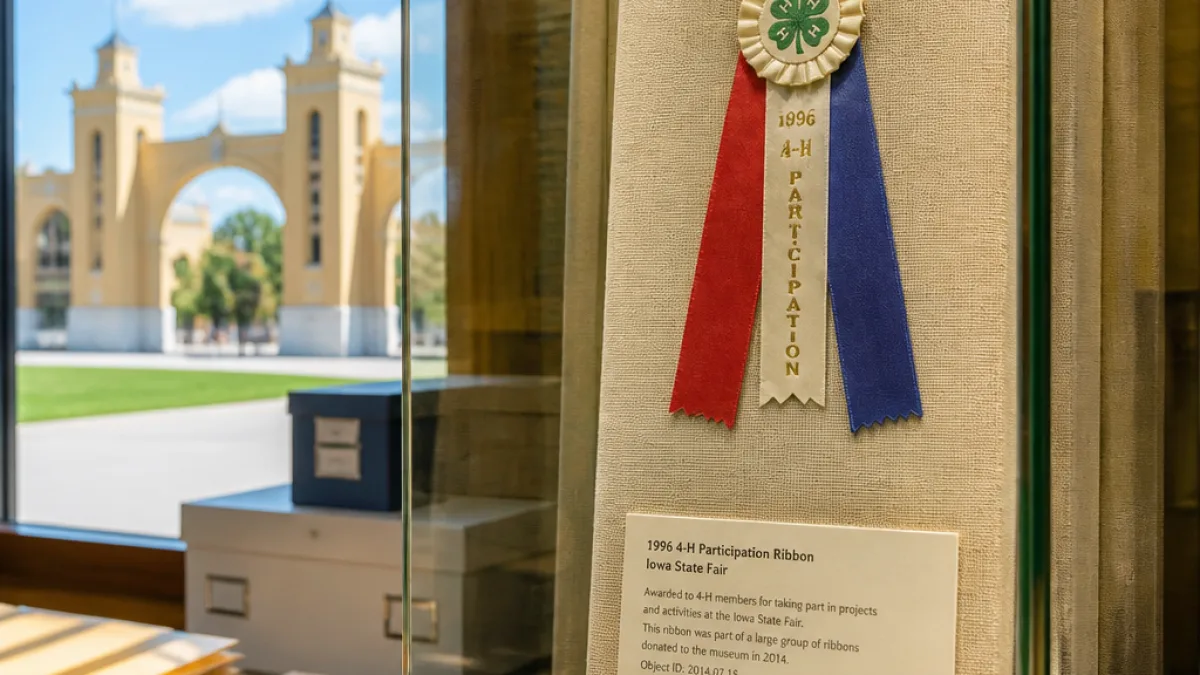
When a 4‑H ribbon from 1996 arrived at the Iowa State Fair office this summer, it carried more than the cloth and print of a participation award. It represented a moment that reshaped conversations about competition, values and education inside one of Iowa’s most enduring institutions.
What the ribbon represents
In 1996 the Iowa State Fair 4‑H Advisory Committee launched a three‑year pilot program under which every 4‑H project at the fair received an identical tricolor participation ribbon, on the principle that “the learning experience is more important than the color of the ribbon.” The experiment touched nearly 3,893 exhibitors that year and became one of the most remembered controversies in recent fair history.
After communicating with museum director Ellen Hammond, the donor stopped by the fair office this week and donated a ribbon from family history, ensuring the piece will be preserved in the fair’s collection and displayed as part of Iowa State Fair memory.
Immediate backlash and political attention
The policy drew public criticism almost immediately. Opposition appeared not just from competitors and families attached to traditional judging but also within the political arena. The state Republican Party platform that year included a passage in its education section that directly criticized directions taken in 4‑H programming.
“If Karl Marx were our state 4‑H chairman, he might say, ‘We must take from each 4‑H’er according to his ability and give to each 4‑H’er according to his need,’”
The quotation, attributed to Linda Mohning of Remsen — one of a pair of 4‑H leaders who said they had been dismissed after refusing to sign new extension pledges — captured how heated the debate became. The Mohnings expressed concern that the move away from competitive awards was symptomatic of broader ideological shifts.
Defending the program
State and program leaders defended the change as reflecting educational aims. Joe Kurth, the state 4‑H director at the time, told national outlets that extension pledges and program goals emphasized teaching citizenship, leadership and positive self‑concept, and that the initiative sought to embrace values such as diversity and voluntarism.
Despite those defenses, the tricolor ribbons lasted only one year at the Iowa State Fair. The outcry from exhibitors, families and political actors was strong enough to end the pilot after 1996, returning the fair to the familiar system of judged awards.
Why the artifact matters now
Objects like a single ribbon do more than recall a dispute. They document how educational policy, community values and politics intersected on fairgrounds now filled with thousands of yearly visitors. For 4‑H families, the ribbon is a reminder of a formative event in youth programming; for the fair museum, it is a record of how public reaction shaped the institution’s direction.
- 1996: All 4‑H projects received identical tricolor participation ribbons.
- Exhibitors affected: 3,893 projects that year.
- Outcome: Policy lasted one year and was discontinued after public backlash.
| Item | Detail |
|---|---|
| Ribbon type | Tricolor participation ribbon |
| Year | 1996 |
| Number of exhibitors | 3,893 |
Local resonance and memory
For those who grew up in 4‑H, or whose families have long attended the Iowa State Fair, the ribbon donation is a small but meaningful act of preservation. Fair museum director Ellen Hammond and staff now steward not only trophies and blue ribbons but also artifacts that tell a fuller story of the fair’s evolution — including controversies that prompted debate about the role of competition in youth development.
The ribbon’s presence in the museum invites reflection on how public institutions balance educational goals with community expectations. It also underscores the State Fair’s role as a mirror of Iowa civic life: a place where agricultural achievement, youth education and political sentiment have long intersected.
As the State Fair continues to collect and preserve items from its past, a 1996 tricolor ribbon will remain a tangible record of a single year that produced outsized conversation — and a reminder that artifacts can carry arguments as much as memories.
Meredith Kowalski is the state correspondent for WE NEWS.