RJM International, an emissions‑reduction specialist based in Winchester, has been named among 185 organisations to receive a King’s Award for Enterprise for outstanding international trade after what judges said was a sustained period of export growth over the past three years.
Export success and its wider significance
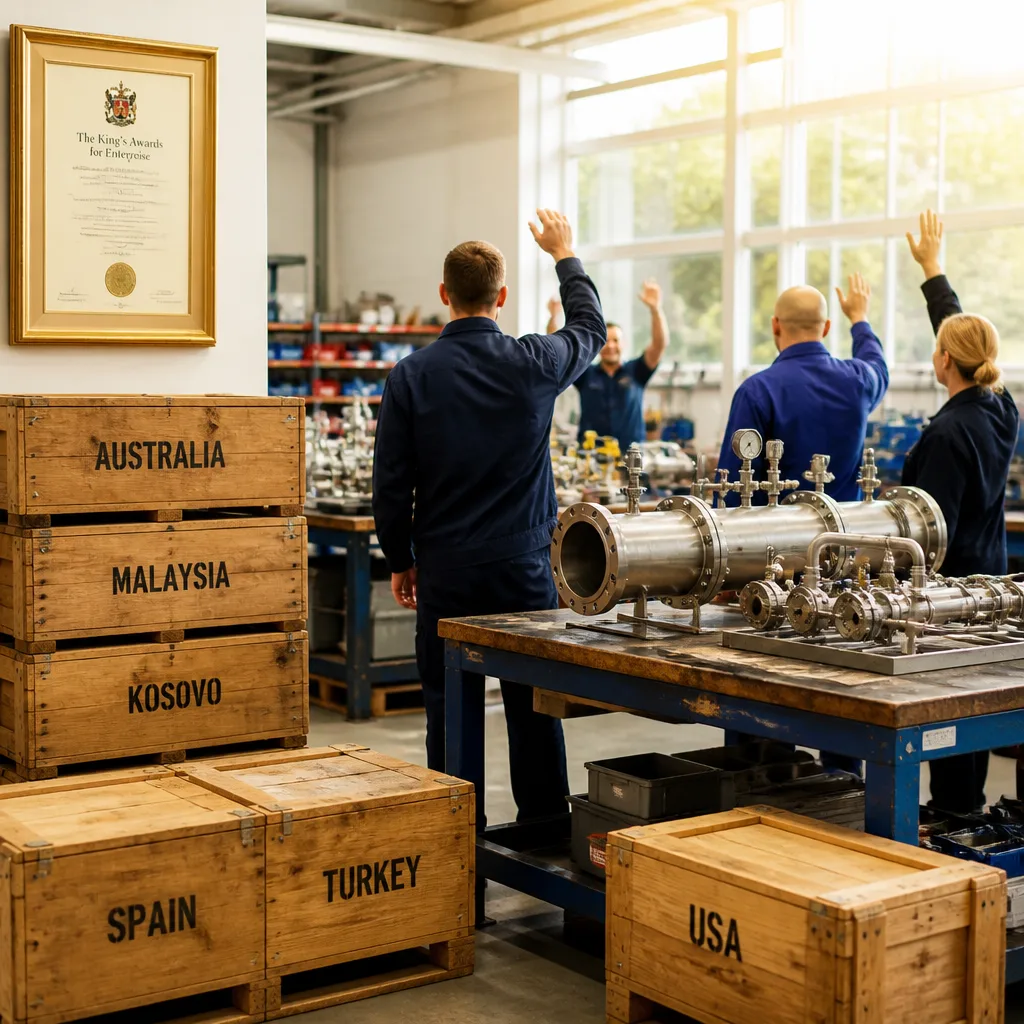
The accolade, presented on Thursday by the Lord Lieutenant of Hampshire, Nigel Atkinson, recognises companies that have demonstrably increased overseas sales. RJM’s managing director said the award was evidence of the team’s technical skill and its contribution to reducing CO2 emissions across a global client base that includes Australia, Malaysia, Kosovo, Spain, Turkey and the United States.
"I couldn't be more delighted and pleased to be honoured with His Majesty's Award," said John Goldring, managing director of RJM International.
King’s Awards are the UK’s most prestigious business honours and are intended to showcase firms that expand the country’s export footprint. That matters because, in simple terms, exports bring foreign earnings into the economy — a point Mr Goldring emphasised.
What the award means for jobs, wages and prices
On paper, export rising is a positive signal: overseas orders can stabilise revenue streams, support higher skilled employment and enable investment in plant and research. For a specialist engineering firm, winning large contracts abroad can secure well‑paid technical roles and apprenticeships that would otherwise be vulnerable.
But the link between export awards and broad gains for wages or consumer prices is not automatic. Smaller export successes often concentrate value in intellectual property and high‑skilled labour rather than across the wider workforce. Whether customers here see lower prices or higher staff pay depends on how firms deploy additional revenue — investment, dividend payouts or cost absorption against rising inputs such as energy and materials.
Context: UK export performance and corporate reality
This recognition comes as the UK economy remains sensitive to external demand and global supply pressures. For niche exporters, foreign markets can offer higher margins, but they also expose firms to shipping costs, currency swings and geopolitical shocks. RJM has previously won business awards — a Queen’s Award for Innovation in 2017 and industry innovation awards in 2015 — which suggests a track record of developing technically differentiated products that can travel internationally.
- 185 organisations received King’s Awards for Enterprise in 2026.
- RJM’s international footprint includes at least six countries named by the company.
- The firm has prior national recognition for innovation in 2017 and industry awards in 2015.
| Metric | Detail |
|---|---|
| Awards in 2026 | 185 organisations awarded |
| Notable prior awards | Queen’s Award for Innovation (2017); EI Award for Innovation (2015) |
| Export markets mentioned | Australia, Malaysia, Kosovo, Spain, Turkey, US |
That history of recognition strengthens the narrative that RJM’s products have competitive advantage. Yet companies winning such honours are often small parts of larger supply chains. The prize is a marketing boon and can help open doors overseas, but it does not insulate firms from rising input costs or a weaker domestic market.
Why policymakers should take note
At a macro level, the government wants to boost exports to improve the balance of payments and create higher value employment. Stories such as RJM’s demonstrate that advanced engineering and environmental technologies remain exportable strengths. However, to convert such successes into broad‑based gains, policy must address factors that shape whether export revenues translate into sustained pay growth and investment — from skills and capital allowances to energy costs and trade facilitation.
Local celebrations are understandable — the Lord Lieutenant described the awards as "the UK's most prestigious business awards" — but the economic benefit will only be realised if firms like RJM are supported through the full cycle of exporting: scaling production, managing supply‑chain costs and turning foreign earnings into domestic employment and investment.
For RJM, the King’s Award offers a platform to build on its international momentum. For the wider economy, it is a reminder that export champions exist across the country; the challenge for policymakers is to ensure more of them thrive and that their success feeds through to wages and jobs across the regions.