
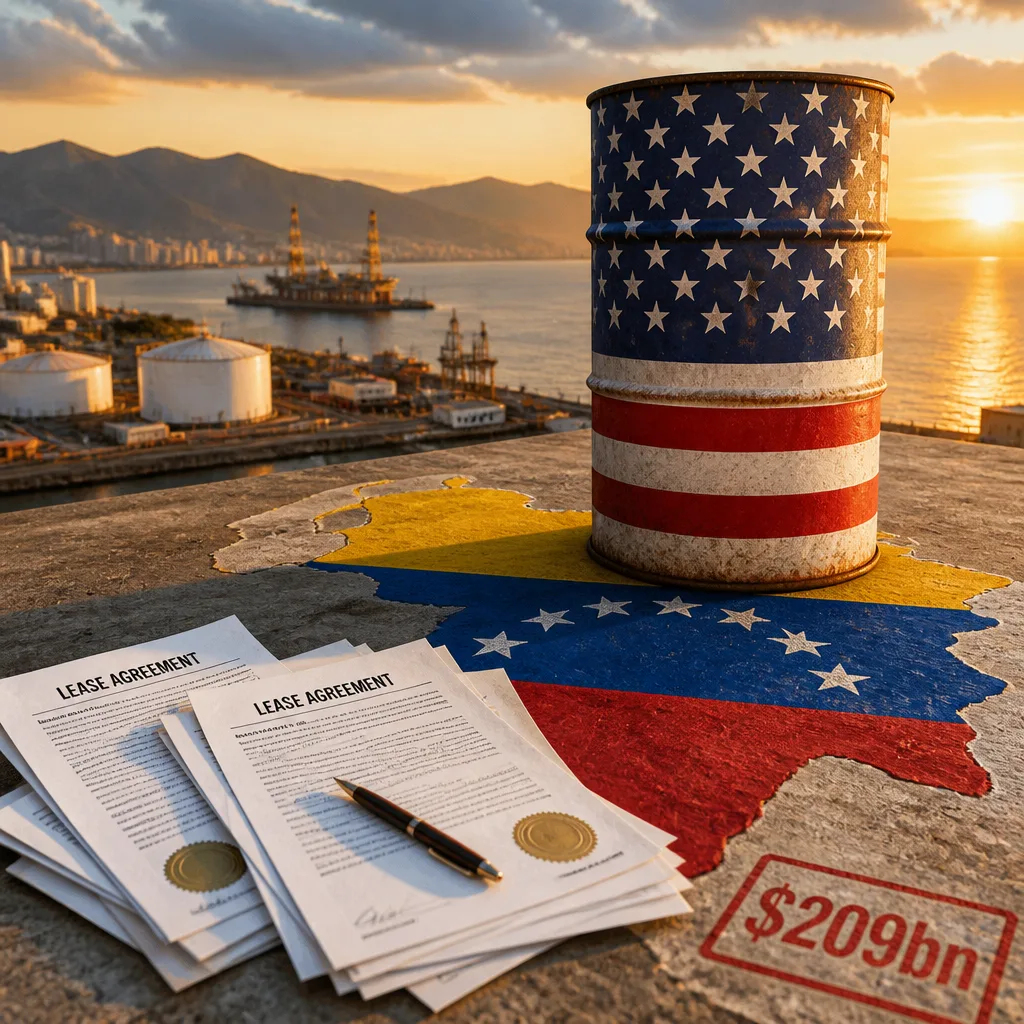
President Donald Trump has announced what he called a historic energy agreement with Venezuela that he said will give the United States majority control of more than 65 billion barrels of the South American country’s proven oil reserves and bring significant revenue to Caracas.
Deal announced via Truth Social
In a post on his social platform, Truth Social, the president described the arrangement as a transaction that “more than doubles American oil reserves” and said it would “substantially lower gas prices for all Americans”. He named senior officials as leading the negotiations, saying:
“At my direction, Secretary of State Marco Rubio, and Secretary of War Pete Hegseth, working closely with Highly Respected Interim President of Venezuela, Delcy Rodriguez, and, through a partnership with private business, have secured majority US control of more than 65 BILLION BARRELS of proven Oil Reserves in Venezuela, at no cost to the American Taxpayer.”
What the announcement says and what follows
Venezuelan authorities welcomed the deal, which the announcement said is expected to deliver around $209bn to the state’s treasury. According to the account of events released alongside the announcement, the agreement follows weeks of negotiation and would grant US companies long-term access to a group of Venezuelan oilfields, with arrangements to guarantee crude supplies to the United States.
Venezuelan officials are reported to be preparing to sign contracts next week that will grant new exploration and production rights to a number of companies, with particular emphasis on US firms. The structure under consideration has been described in media reporting as a potential lease model, with fields possibly auctioned to American producers.
- Reserves involved: more than 65 billion barrels (proven).
- Projected revenue: about $209bn to Venezuela’s state treasury, per the announcement.
- Next steps: reported signing of exploration and production agreements next week; possible lease/auction model under consideration.
| Key figure | Value |
|---|---|
| Proven oil reserves cited | 65 billion barrels |
| Expected state revenue | $209bn |
Legal and political questions
Media reporting cited by the announcement and earlier coverage warns the arrangement could face significant legal and constitutional obstacles inside Venezuela, where the state has traditionally retained control over core activities in the oil sector. Observers have also noted that any transfer of rights or long-term leases to foreign firms would need to navigate Venezuelan law and political structures.
Separately, Reuters and other outlets have reported that a lease model was under consideration and that fields could be auctioned to US producers; those accounts were referenced in the material released alongside the White House-style announcement. The statement, however, provides limited detail on the contractual form of US control, governance arrangements, oversight mechanisms, or the measures by which revenues will be delivered and monitored.
Implications for energy markets and geopolitics
If implemented as described, the deal would represent a dramatic expansion of Washington’s role in Venezuelan oil production and could reshape crude supply dynamics between South America and the United States. The announcement frames the agreement as a means of bolstering US oil reserves and reducing fuel prices domestically.
Yet questions remain about implementation: how control will be exercised in practice, the legal pathways for transferring rights, the role of private companies, and the reactions of other international actors. The prospect of large revenue flows to Caracas — if realised — may also alter domestic Venezuelan politics and the balance between state authorities and private operators.
At present the published account rests largely on the president’s declaration and on prior reporting about possible models for foreign involvement in Venezuelan oil. Further documentation, formal contracts and statements from the companies reportedly involved will be needed to confirm the substance and enforceability of the reported arrangements.
For now, governments, markets and legal experts will be parsing the announcement for specifics that could determine whether the claimed transfer of control becomes substance or remains a politically charged declaration.









