
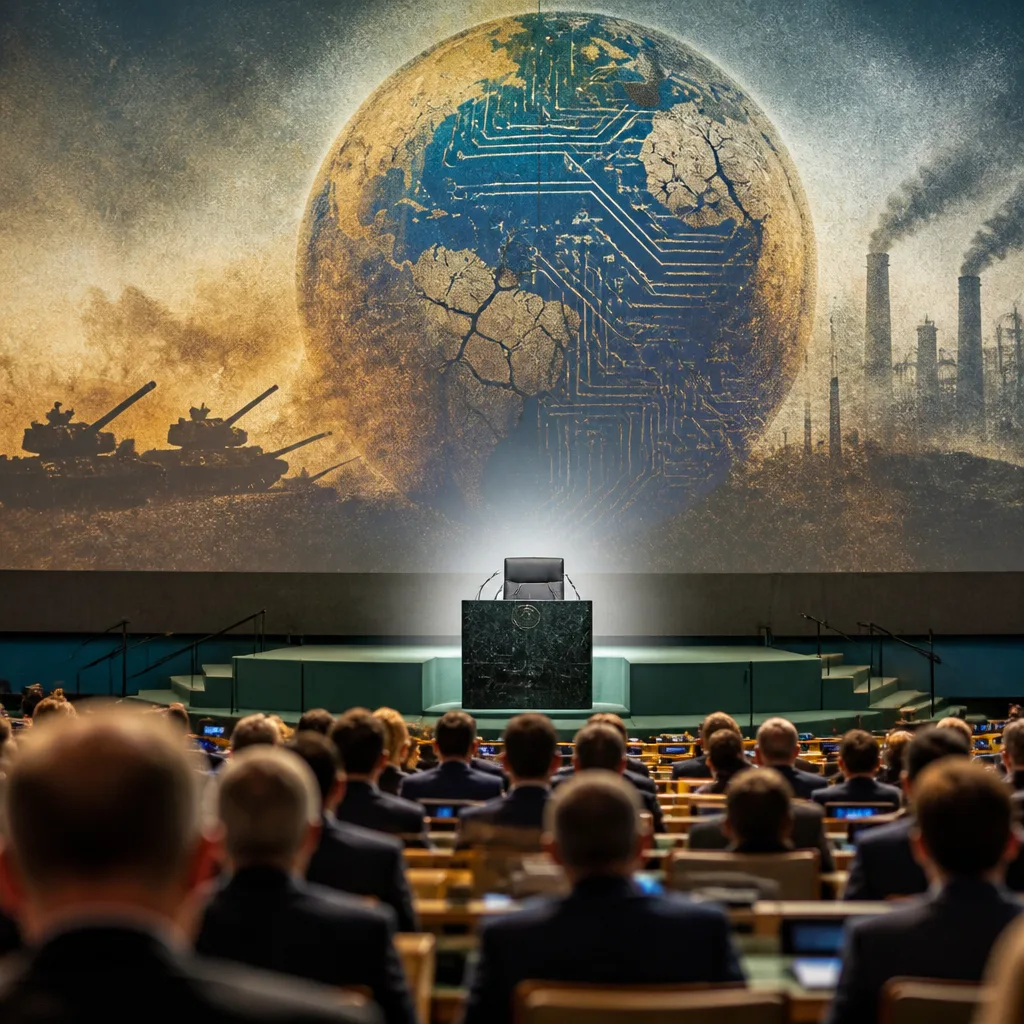
The outgoing secretary‑general of the United Nations delivered a stark appraisal of the international order in his final address to the General Assembly, telling world leaders that the major powers no longer possess the military, economic or technological instruments required to guarantee security or resolve the array of global crises.
Convergence of crises and fraying institutions
António Guterres framed his decade in office as a period in which multiple fault lines widened into what he described as "canyons" — a shift reflected in prolonged wars, human rights abuses, growing inequality and the accelerating effects of climate change. He warned that, at a moment of unprecedented overlapping threats, the mechanisms for collective action are under increasing strain.
Guterres highlighted several themes he said have defined the last 10 years: conflicts that have persisted with severe humanitarian consequences; civilians deliberately targeted; humanitarians killed; international law sidelined; and a dangerous rapid advance in artificial intelligence. He said these trends had exposed the limits of concentrated state power.
"At the very moment when humanity faces an unprecedented convergence of threats, our mechanisms for collective action are under growing strain."
On limits of power and calls for multilateral renewal
Without naming individual leaders or states, the secretary‑general urged a sober recognition by major powers that "their power isn't so super" and that military force, economic weight or technological prowess on their own cannot secure peace, stability or safety. He argued for a renewed and more representative United Nations as the only credible path to manage the intersecting challenges facing the planet.
Among the concrete policy areas he raised were governance of artificial intelligence, criticism of energy companies for environmental harm, and the long‑running question of Africa’s exclusion from permanent representation on the Security Council, which he called "stunning." He repeated his longstanding call for a new compact to regulate AI and for reforms that would make the UN more reflective of the contemporary global balance.
Humanitarian crises and specific conflicts
Guterres referred to the aftermath of the October 2023 attack by Hamas and the subsequent large‑scale violence in Gaza, describing what followed as "an onslaught on Palestinians in Gaza, with a scale of killing and destruction unlike anything I have witnessed in all my years as secretary general." His remarks placed the humanitarian catastrophe at the centre of his moral critique of current international practice.
He also condemned practices that weaponise hunger and criticised what he termed profiteering by energy companies who, he said, were treating the planet as "an open sewer." Such criticisms were woven into a broader plea for strengthened international law and for accountability where rights and lives are abused.
- Ten years in office: Guterres used his final address to catalogue a decade of intensifying crises.
- Limits of power: He said military, economic and technological might alone are insufficient to deliver security.
- Calls for reform: He urged a more representative UN and new global rules for technologies such as AI.
| Issue | Concern raised |
|---|---|
| Armed conflict | Extended wars with severe civilian harm |
| Humanitarian protection | Humanitarians killed; hunger weaponised |
| Global governance | Need for a more representative UN; African exclusion from permanent Security Council seats |
| Technology | AI advances outpacing regulation |
The speech blends a tone of reproach with cautious hope: the multilateral system, Guterres insisted, remains the only realistic architecture capable of addressing climate breakdown, armed conflict, mass displacement and the societal risks tied to rapid technological change. Yet he warned that without meaningful reform and renewed cooperation among states, especially the most powerful, the world will struggle to meet these threats.
As he steps down, Guterres’s remarks will add pressure to ongoing debates among member states over Security Council reform, global responses to humanitarian emergencies and the governance of emerging technologies. Whether his call for a new compact on AI and a reconfigured UN gains traction will depend on political will among capitals already divided by strategic competition and domestic pressures.
The address serves as both a summation of a decade of crises and a parting challenge to world leaders: rebuild multilateral institutions or face a future in which no single state, however powerful, can unilaterally secure peace, prosperity or safety for all.









