
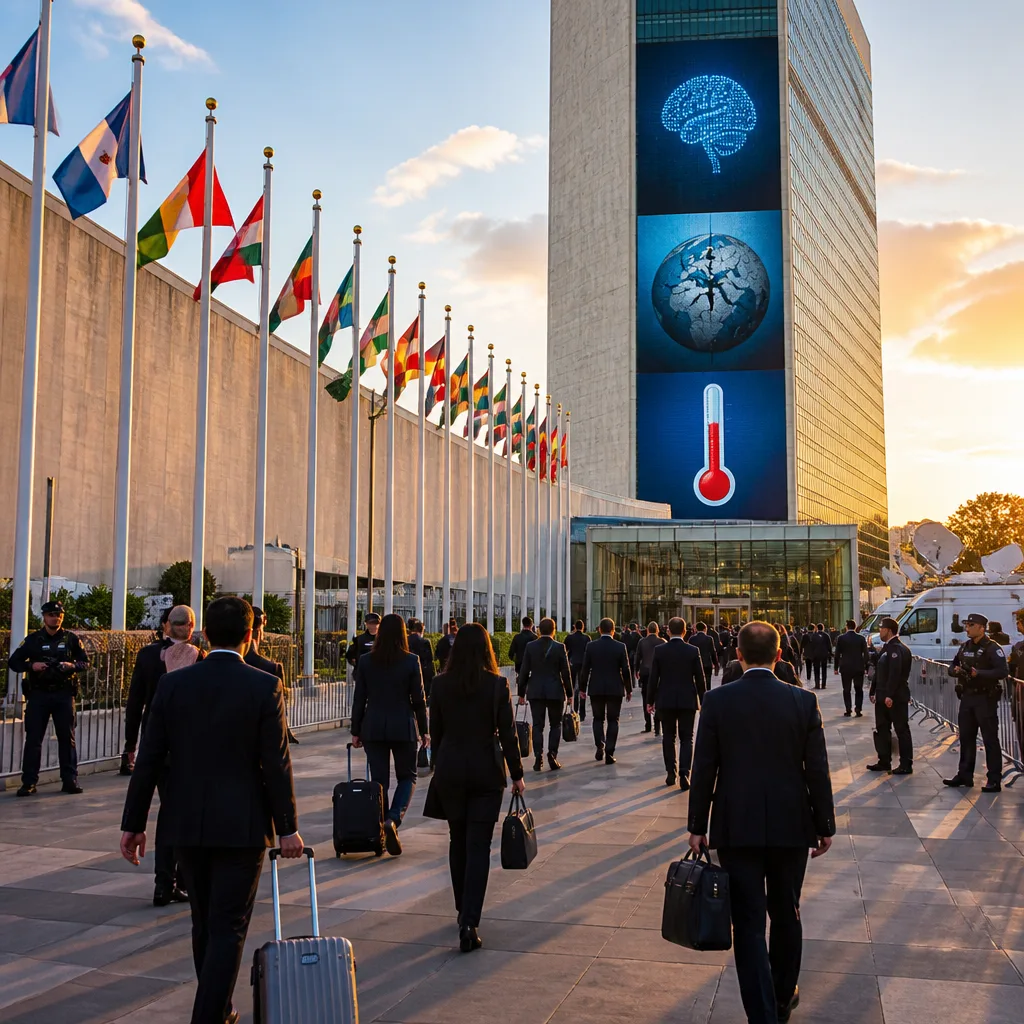
World leaders arrive in New York this week for the United Nations General Assembly facing a convergence of crises that will test the body's capacity to broker solutions and to adapt to a rapidly changing global order. The annual high-level week opens against a backdrop of multiple active conflicts, growing anxiety about artificial intelligence, accelerating climate impacts and disruptive economic shocks.
What leaders will confront
The agenda is crowded and urgent. Delegations will press for responses to several simultaneous conflicts — notably in Iran, Gaza, Ukraine, Sudan, Congo and Myanmar — even as they debate whether the UN can intervene effectively where regional and great-power politics constrain action.
- War and peace: Leaders must confront whether diplomacy can alter trajectories in theatres of intense violence.
- Artificial intelligence: New fears that runaway AI could pose systemic risks to humanity are rising up the agenda.
- Climate shocks: Increasingly severe weather and long-term warming remain central to the assembly’s discussions about survival and development.
- Economic disruption: Blocked shipping routes and fractured supply chains continue to push up costs and threaten growth in many countries.
Beyond individual crises, there is a persistent, overarching question about the UN’s own relevance and governance. The institution’s principal bodies still reflect the post‑Second World War balance of power: the five permanent members of the Security Council — the United States, Russia, China, Britain and France — retain veto authority that many argue is ill-suited to the 21st century.
Institutional reform and leadership change
Member states have agreed to a broad reform package aimed at updating the UN’s structures, including proposals that would affect the Security Council. Implementing these reforms, however, is politically complicated and faces entrenched resistance from states that would cede influence if veto power or membership were altered.
At the same time, attention will turn to the UN’s leadership. Secretary-General Antonio Guterres’ second five-year term ends on 31 December and, as yet, no clear successor has emerged. Behind-the-scenes jockeying and speculation about candidates are expected during the week, even if formal selection processes remain opaque and protracted.
"state of the world"
The General Assembly’s opening sequence — including the Secretary-General’s address and the high-level speeches that follow — is often as much about signalling as it is about substance. This year some 130 heads of state and government are expected to speak, a reminder of the UN's role as the foremost international forum despite its limits.
Key speakers and schedule highlights
Several headline appearances are already scheduled early in the week: the President of the United States and the French president will both speak on the first day following the Secretary-General’s opening remarks, while other notable addresses are set for the second day.
| Day | Named speakers |
|---|---|
| Tuesday | U.S. President; French President |
| Wednesday | President of Ukraine; President of Iran |
Those facing direct international scrutiny — including leaders presiding over contentious policies or military campaigns — will use the global platform to marshal support, justify actions or respond to criticism. The assembly also provides a stage for states and coalitions to push specific proposals on AI governance, climate finance, humanitarian access and supply‑chain resilience.
Outcomes and limits
Observers caution that, while the General Assembly can generate political momentum and moral pressure, durable solutions for many of the crises on the table require negotiation among powerful states and regional actors outside the general debate. Reform proposals that would rebalance global governance face particular obstacles because they impinge on the prerogatives of the most influential powers.
Still, the UN week will matter. It will be a barometer of international will: whether leaders can translate rhetoric into coordinated action on conflicts, AI safety, climate mitigation and economic recovery — or whether the mounting list of threats will expose the organisation’s constraints more starkly.
For capitals, the challenge this week will be to show that the UN remains not merely a forum for statements, but a space where collective decisions and commitments can be advanced in the face of converging global dangers.









