
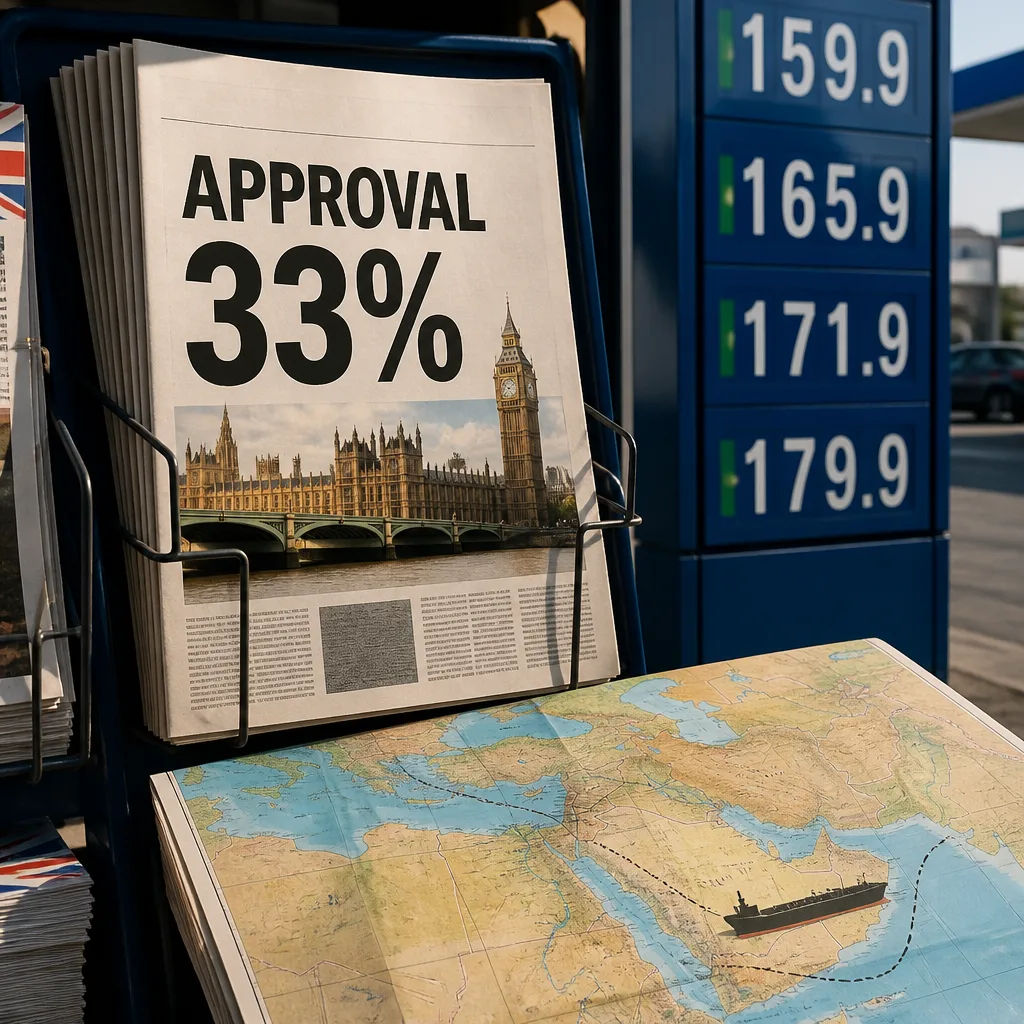
President Donald Trump’s approval rating has fallen to 33%, the lowest level of his current administration, according to a Reuters/Ipsos poll released on Monday. The survey attributes much of the decline to public unease over the war with Iran and the impact of higher gasoline prices on household budgets.
Public anxiety over a protracted conflict
The four-day poll found that 64% of Americans now disapprove of Mr Trump’s performance, leaving just a third in approval. Respondents expressed broad expectations that US involvement in the conflict with Iran will continue for an extended period rather than be resolved quickly.
About 80% of those questioned said they believed US involvement would be prolonged. That view crossed party lines: 87% of Democrats and 71% of Republicans anticipated a long-running engagement. Only 16% expected the fighting to be over within weeks.
“paying somewhat more for gasoline was worthwhile to prevent what he described as an evil country from obtaining nuclear weapons.”
The president has sought to defend the economic fallout from the conflict, arguing that higher petrol prices are an acceptable cost to prevent Iran acquiring nuclear capabilities. At a rally in New York last week, he framed the increased cost of fuel as a strategic price worth paying.
Economic pain and political consequences
Analysts and campaign strategists say rising energy costs could become a decisive issue in the run-up to the US congressional elections on 3 November. Higher gasoline prices are felt directly by households and can quickly alter political dynamics, particularly when control of narrow majorities is at stake in the House of Representatives.
While Mr Trump initially suggested the military engagement might be brief, the poll results indicate the public no longer expects a speedy resolution. The war has also disrupted oil flows through the Strait of Hormuz, a key transit for global crude, contributing to the spike in pump prices.
Partisan divides but limited enthusiasm
Support for the conflict is uneven even within the president’s own party. The poll found that roughly half of Republican voters consider the intervention worth the cost, leaving the remainder unconvinced. Across the wider electorate, only around one in five said the war justified the economic pain. The findings suggest limited public enthusiasm for a prolonged campaign.
- Approval: 33% approve, 64% disapprove
- Expect prolonged involvement: 80% overall
- Partisan split on war’s worth: ~50% of Republicans supportive
| Measure | Percentage |
|---|---|
| Overall approval | 33% |
| Overall disapproval | 64% |
| Expect prolonged involvement | 80% |
Political commentators note the timing of the poll increases its significance. With control of the House and slim margins in the Senate at risk, an erosion in presidential approval driven by foreign policy and domestic economic pressure can feed into voter turnout and campaign messaging across both parties.
The president’s defenders argue that firm action against Iran is necessary to deny Tehran nuclear capabilities, a proposition he reiterated publicly even as public tolerance for the economic consequences wavers. Opponents have seized on the economic pain to press a contrasting argument: that the war is inflicting avoidable harm at home and should not be sustained without clearer public consent.
As the midterm contest approaches, Republicans will have to weigh the electoral implications of a policy that divides their base. Democrats, sensing an opening, are likely to focus campaign energy on the economic squeeze felt by voters while highlighting the risks of a drawn-out military engagement.
The Reuters/Ipsos poll captures a moment of political strain for the White House, where foreign policy choices are colliding with domestic pocketbook issues. How that tension plays out over the coming weeks may shape not only the November results but also wider debates among US allies about strategy and burden-sharing in a volatile region.












