
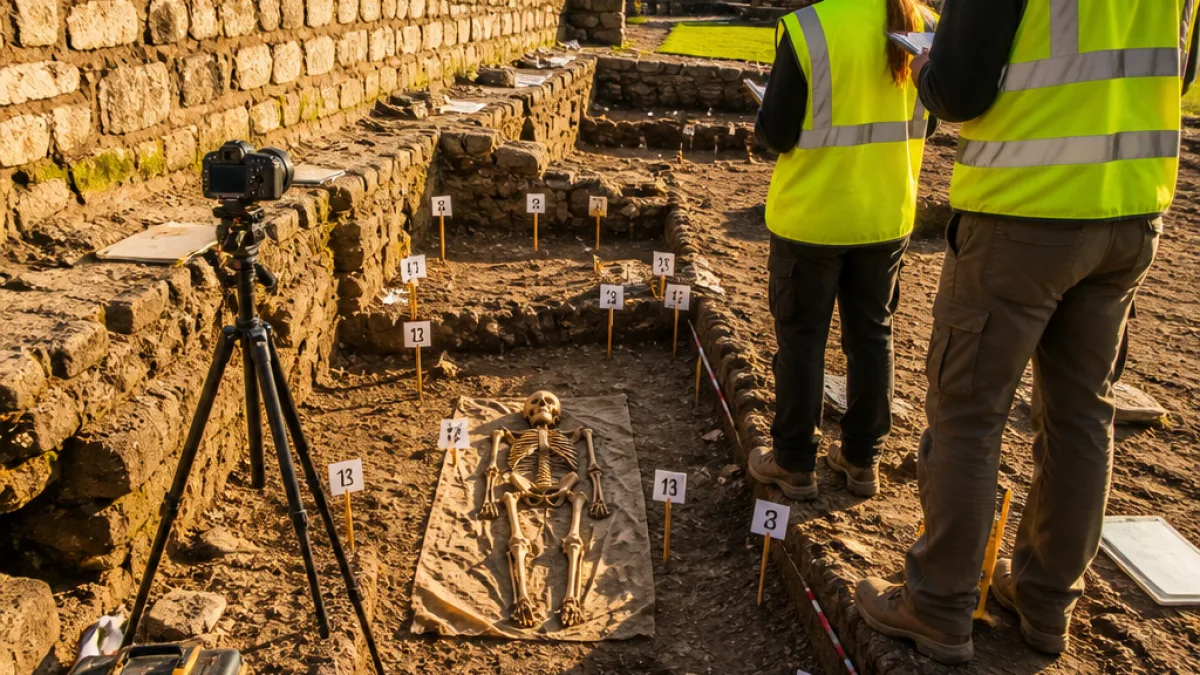
Archaeologists studying human remains uncovered at Stirling Castle say a skeleton dating to around 700 years ago shows catastrophic blunt-force trauma consistent with having been struck by a large projectile from a trebuchet. The analysis, published alongside the excavation findings, suggests the individual—referred to as Skeleton 150—may represent the earliest-known victim of this kind of siege weapon in the archaeological record.
Severe fractures point to high-energy impact
Forensic examination and scanning of the remains revealed more than 160 fractures sustained around the time of death. Of those, the researchers recorded 61 fractures to the skull and 57 to the ribs, alongside multiple injuries to other parts of the skeleton. The distribution and nature of the damage indicate a single, massive blunt-force event rather than repeated minor blows.
| Injury site | Number of fractures |
|---|---|
| Skull | 61 |
| Ribs | 57 |
| Other (combined) | Remaining fractures (part of >160 total) |
Investigators link the wounds to the sort of high-velocity impact produced by a large wooden sling or stone hurled by a trebuchet—an engine of siege warfare widely used during the later medieval period. The timing of the burial, the injuries, and the historical context of conflict around the castle have led the team to consider the possibility that the individual died during one of the sieges associated with the Scottish Wars of Independence.
Context at Stirling Castle and historical significance
Stirling Castle occupies a prominent place in Scotland’s medieval history and was the focal point of several military confrontations. The suggestion that the remains may represent a trebuchet victim adds a new, physical dimension to the archaeological story of those conflicts. If confirmed, the case would provide direct evidence of the destructive capability of large siege engines in Scotland at that time and supply rare human-scale data on how such weapons affected their targets.
The research note accompanying the find highlights both the scale of the injuries and their implications for interpreting siege archaeology. The authors point to the pattern of fractures as being unlike injuries caused by edged weapons or projectile wounds from arrows; instead, they argue the trauma matches what might be expected from a single, very powerful projectile strike.
"first known evidence of trebuchet trauma"
That phrase, lifted from the research discussion, underlines the potential importance of the discovery. It is unusual to be able to link skeletal trauma so explicitly to a specific class of siege technology, and doing so helps bridge material culture—such as remains of engines and documentary references—and the lived human cost of medieval warfare.
- Location: Stirling Castle excavations.
- Date: around 700 years ago (medieval period).
- Findings: >160 fractures; 61 skull, 57 ribs; consistent with a single massive blunt impact.
While the identification is compelling, the researchers are cautious. Establishing a direct causal link between the injuries and a trebuchet projectile requires careful taphonomic analysis, consideration of other potential causes of blunt-force trauma, and wider comparison with contemporaneous remains. Nevertheless, the discovery has already prompted interest from medieval historians and archaeologists working on warfare, siegecraft and the experience of combatants and non-combatants in the medieval period.
For Stirling, the find will resonate locally. The castle museum and interpretation programmes place great emphasis on the site’s turbulent past; tangible evidence of the human consequences of siege warfare may prompt new displays, educational material and public engagement. It also underlines how continuing archaeological work at such high-profile sites can still yield discoveries that change our understanding of the past.
Further work on the skeleton and associated stratigraphy is expected to refine the dating and circumstances of death. For now, Skeleton 150 stands as a stark reminder of the violence that once surrounded the castle and offers a rare window into the deadly mechanics of medieval siege warfare.









