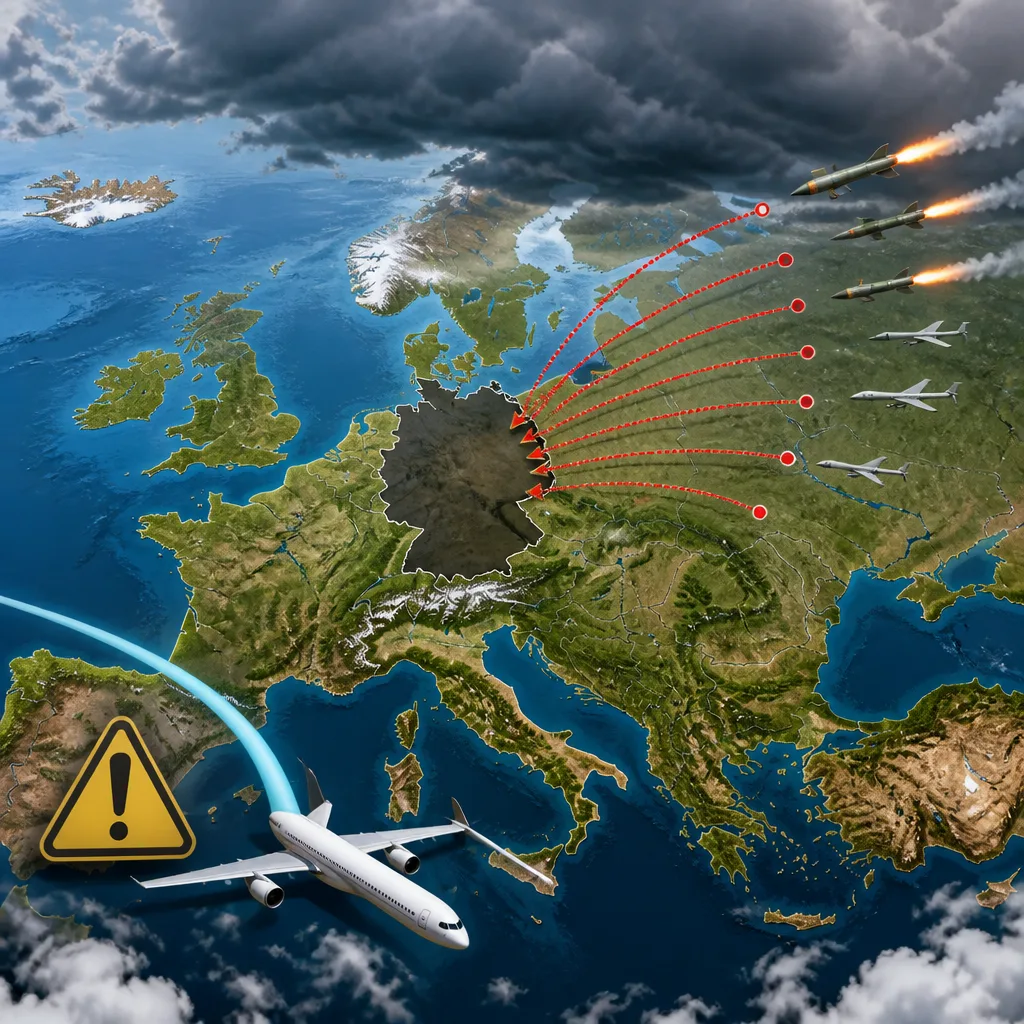
Russia has threatened direct strikes on Germany after Berlin accused Moscow of being connected to an alleged drone attack plot, according to a morning international briefing. The development forms part of a fast-moving diplomatic row that has also prompted warnings to the United Kingdom and renewed concerns about aviation safety across the region.
What has happened
The brief bulletin item reported several linked developments: Germany has said it has identified two suspects after accusing Russia of involvement in a drone plot; Russia has responded with threats of direct strikes on Germany; and Moscow has additionally warned the UK over unspecified attacks. Separately, Ukrainian president Volodymyr Zelensky has described Russian-controlled airspace as “completely unsafe,” urging airlines and passengers to exercise caution.
Implications and context
The exchange marks a notable escalation in rhetoric between a NATO member and Moscow. Public claims that another state's security services were involved in a planned attack on German soil, and an immediate threat of direct strikes in return, risk widening a bilateral dispute into a broader confrontation. NATO allies typically treat such assertions with gravity, particularly when they involve potential cross-border operations or threats to member territory.
There are several strands to watch:
- Diplomatic response: Berlin’s next steps will be decisive — whether to seek calm through private diplomacy, to escalate via public accusations and countermeasures, or to involve NATO institutions.
- Military posturing: Any credible threat of strikes raises questions about readiness, presence of forces and rules of engagement among allied militaries in Europe.
- Aviation safety: Zelensky’s warning that parts of Russian-controlled airspace are “completely unsafe” could affect airline routings, insurance costs and civilian travel across the region.
What is known and what remains unclear
The briefing notes stop short of providing operational detail: it does not identify the suspects named by Germany, nor does it specify the targets, timelines or legal rationale Moscow used to justify its threat. Likewise, the precise nature of the warning to the UK was not described. Those gaps leave significant uncertainty about the immediacy and credibility of the threats.
At present, the publicly available information comprises:
| Reported item | Public detail |
|---|---|
| Germany identifies suspects | Two suspects named by Berlin (no identities provided in briefing) |
| Russian response | Threats of direct strikes on Germany; warning issued to the UK |
| Aviation warning | Ukrainian president described Russian-controlled airspace as “completely unsafe” |
“Completely unsafe”
Possible consequences
Even absent immediate kinetic action, the episode could produce a cascade of diplomatic and security consequences. Allies may increase intelligence-sharing and defensive measures, airlines could continue to divert flights, and governments may review travel advisories. Public rhetoric of this kind also complicates crisis management: exaggerated or ambiguous threats can reduce space for quiet de‑escalation and make miscalculation more likely.
For Berlin, the reputational and political stakes are high. If German authorities believe foreign agents plotted an attack on their soil, they must balance transparency with protecting intelligence sources and methods. For Moscow, issuing threats could be intended as deterrence, signalling resolve or shaping domestic audiences; however, it risks international isolation if actions follow the rhetoric.
At this stage, key facts remain to be confirmed. Further reporting and official statements from the German, Russian and UK governments, as well as NATO and civil aviation authorities, will be required to assess whether the situation is confined to diplomatic posturing or whether it marks a more dangerous shift in European security dynamics.
WE NEWS will continue to monitor statements from Berlin, Moscow and allied capitals for clarification and any operational developments.