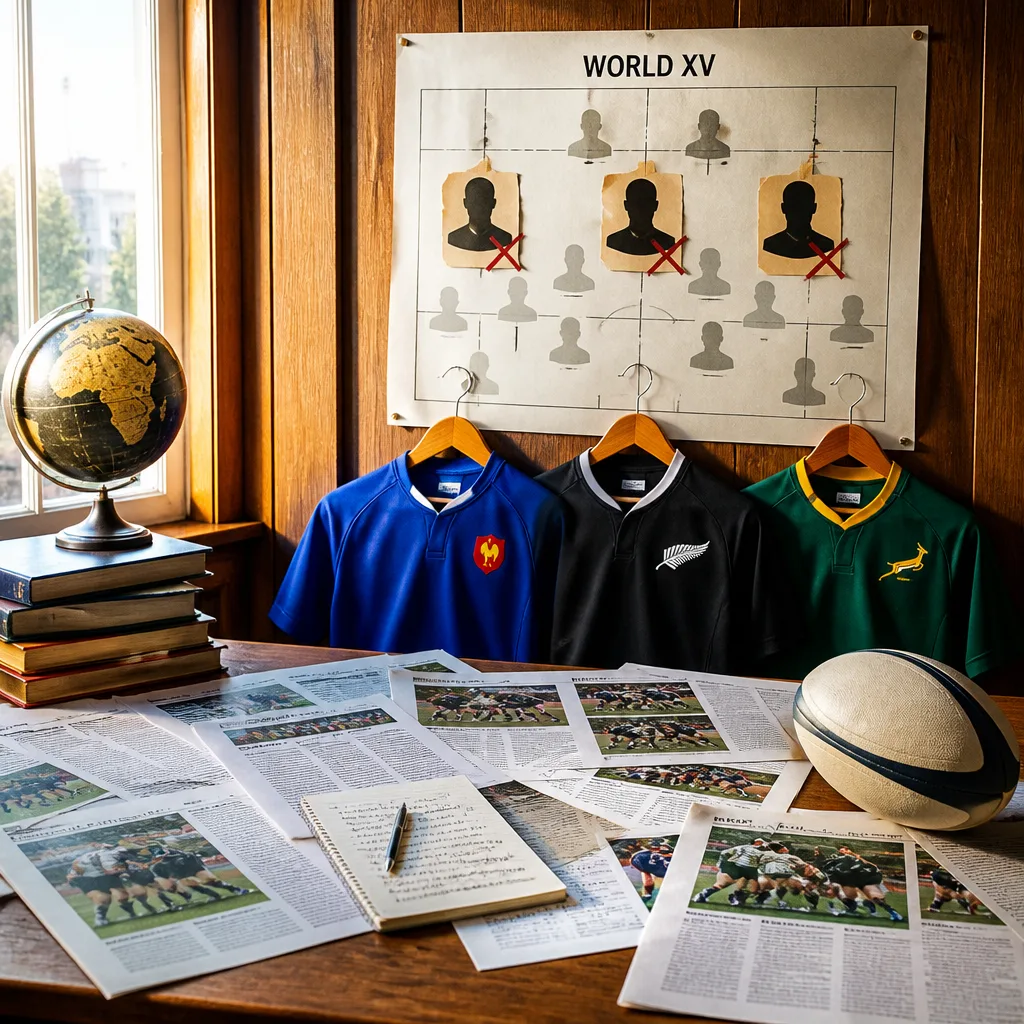
The latest update to Ruck’s informal World XV reflects a shift in how recent international performances are valued, with three changes at the backline end of the order. Thomas Ramos of France and Toulouse, Will Jordan of New Zealand and the Crusaders, and Jesse Kriel of South Africa and Canon Eagles have been elevated into the side. They replace Ireland’s Hugo Keenan, South Africa’s Cheslin Kolbe and New Zealand’s Quinn Tupaea respectively.
Selectors prioritise influence and finishing
Ruck’s assessment stresses the impact of tactical control, try-scoring and consistency. At full-back, Ramos is elevated on the basis of his playmaking and kicking influence; Ruck describes him as operating almost like "a second fly-half," combining distribution with a reliable goal-kicking game and assured positional play.
On the right wing, Jordan’s place is explained primarily through his recent form in New Zealand’s Nations Championship. Ruck highlights an outstanding try return — notably the milestone of being the first All Black to reach 50 Test tries — and the way his positional move has enhanced his finishing opportunities. For the outside centre/wing slot, Kriel’s consistent performances during South Africa’s Nations Championship campaign are cited as the reason for his inclusion.
- Thomas Ramos (France & Toulouse) replaces Hugo Keenan (Ireland & Leinster)
- Will Jordan (New Zealand & Crusaders) replaces Cheslin Kolbe (South Africa & Stormers)
- Jesse Kriel (South Africa & Canon Eagles) replaces Quinn Tupaea (New Zealand & Chiefs)
What the changes tell us
These alterations underline two competing selection logics. One rewards a player’s broader strategic influence on a match — as Ruck does with Ramos, emphasising his distribution and kicking — while the other values raw attacking output, the rationale given for Jordan’s elevation following a prolific try-scoring spell. Kriel’s selection is framed around dependable form across a campaign rather than a single headline statistic.
The piece also implicitly acknowledges the difficulty of definitively ranking players across different systems and roles. Ruck notes that some positions present multiple genuine candidates for the No.1 jersey and that global rugby’s evolution has made several roles harder to separate. That caveat matters: while such lists provoke debate, they do not replace formal selection processes used by national coaches.
| Position | In | Out |
|---|---|---|
| 15 (Full-back) | Thomas Ramos (France & Toulouse) | Hugo Keenan (Ireland & Leinster) |
| 14 (Right Wing) | Will Jordan (New Zealand & Crusaders) | Cheslin Kolbe (South Africa & Stormers) |
| 13 (Outside Centre/Back) | Jesse Kriel (South Africa & Canon Eagles) | Quinn Tupaea (New Zealand & Chiefs) |
Ruck’s note on Ramos highlights the increasing expectation that full-backs serve as second playmakers: distribution, tactical kicking and reliability from the tee are now key attributes alongside traditional defensive duties. For Jordan, Ruck points to a positional switch that has unlocked greater finishing returns; his try tally in the Nations Championship and historic 50-Test-try milestone are used as evidence for his case.
Selections such as these will feed discussion during the current international window, which Ruck terms intense, referencing the Rugby’s Greatest Rivalry series alongside ongoing fixtures. Lists like the World XV are a snapshot: useful for debating form and styles, but ultimately subjective and contingent on the selectors’ priorities.
Observers and supporters should expect further revisions as internationals continue and as players either consolidate or lose momentum. For now, Ramos, Jordan and Kriel have the selectors’ nod; those displaced remain world-class figures whose exclusion reflects the fine margins involved in assembling an unofficial global side.