
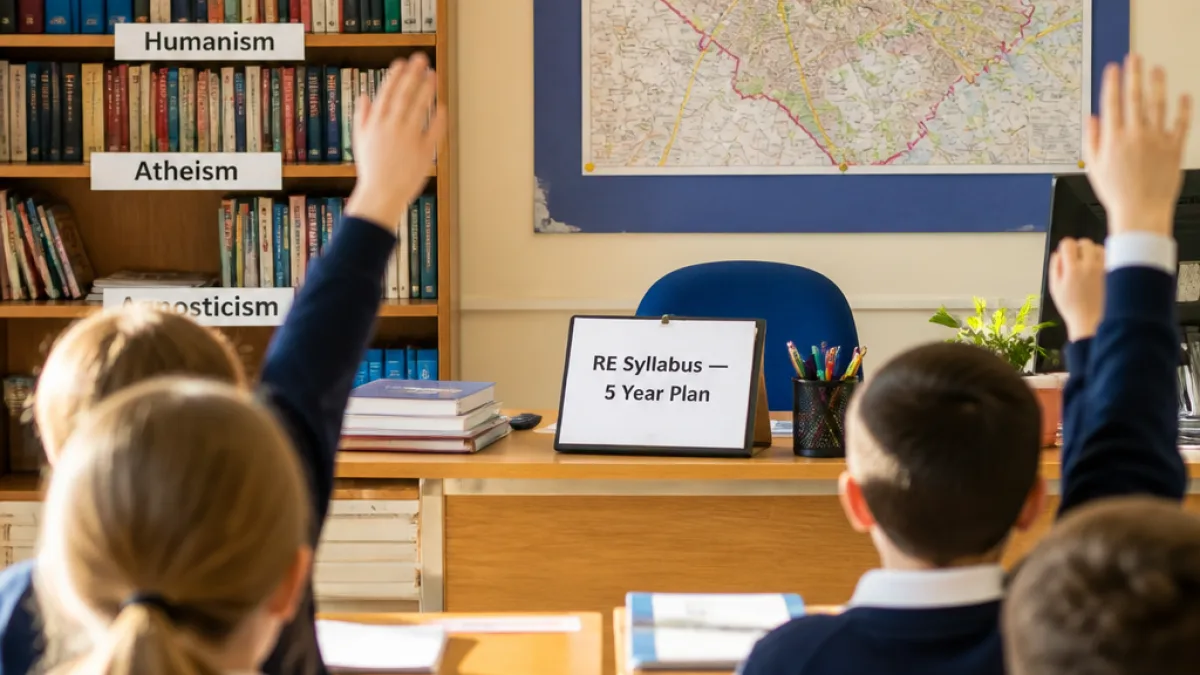
Proposal broadens RE to include humanism, atheism and agnosticism
Rotherham councillors are being asked to approve a new five-year Religious Education (RE) syllabus that places greater emphasis on non-religious worldviews, including humanism, atheism and agnosticism, a report from the borough's Standing Advisory Council for Religious Education (SACRE) recommends.
The document stresses that RE should help pupils to understand both religious and non-religious perspectives, and to develop the ability to evaluate evidence, think critically and respond to different beliefs with respect. The move brings Rotherham in line with neighbouring metropolitan authorities – Barnsley, Sheffield and Doncaster – which have already adopted a similarly broadened approach.
- Inclusion: explicit recognition of atheism, agnosticism and humanism in the curriculum.
- Skills focus: emphasis on critical thinking, evidence evaluation and respectful disagreement.
- Community cohesion: the report highlights the role of RE in bringing communities together through mutual understanding.
SACRE, the advisory body made up of a range of faith and non-faith representatives, has formalised details of the expansion and set them out in the report now before councillors. The body advises on what should be taught in maintained schools on religious education and collective worship.
Local context: shifting religious affiliation
The recommendation follows a review of the curriculum last year in which councillors were presented with census and Office for National Statistics data indicating a growth in non-religious worldviews locally. The last national census in 2021 showed substantial numbers of people in Rotherham reporting no religion.
| Reported belief (2021 census) | Number of residents |
|---|---|
| No religion | 105,820 |
| Christian | 130,150 |
| Muslim | 13,470 |
Those figures were cited to justify expanding the syllabus so that it reflects the beliefs and non-beliefs present in the borough and equips pupils to engage thoughtfully with differing convictions.
What SACRE says the syllabus should achieve
The report from SACRE outlines both aims and pedagogical approaches. It argues that RE should:
- Encourage pupils to form well-reasoned viewpoints while learning to disagree respectfully.
- Help pupils evaluate evidence and think critically about beliefs and worldviews.
- Foster responses based on imagination, empathy and respect.
RE "encourages pupils to develop their own well-reasoned viewpoints while learning to disagree respectfully, evaluate evidence, think critically and respond with imagination, empathy, and respect".
The report was prepared by a SACRE comprising interested groups from both faith and non-faith backgrounds. It formalises the changes discussed during the borough's curriculum review and makes a case for updating teaching materials and guidance for schools run by the council.
Reaction and next steps
Local reporting notes that those involved in the SACRE discussions agreed to expand recognition of atheism, agnosticism and humanism and increase references to non-religious worldviews throughout the syllabus. A former SACRE member who campaigned for inclusion said he welcomed a curriculum that would help pupils develop rational thinking and question beliefs rather than accept them unexamined.
Councillors will consider the SACRE report and the proposed five-year syllabus at an upcoming meeting. If adopted, the changes will apply to RE lessons in council-run schools across the borough and will require teachers and school leaders to incorporate the broadened content and the syllabus' stated focus on critical thinking and respectful engagement.
The proposal reflects a broader regional trend and raises practical questions for schools about training, resources and how best to teach sensitive and diverse worldviews in classrooms where pupils come from many different backgrounds.
Parents, faith and belief groups, and school staff in Rotherham will be watching the council's decision closely to see how the new syllabus is implemented and how it shapes religious education in the borough over the coming five years.











