Growing litter sizes in the UK pig herd are increasing demands on housing and management, while exposing shortcomings in the data gathered on finishing animals, industry specialists said at a meeting hosted by Ceva ahead of the British Pig & Poultry Fair.
More piglets, more space required
Analysis shared by Alan Stewart, senior pig lecturer at Harper Adams University, showed a clear rise in the number of piglets born alive and weaned per litter over the last decade. The university’s indoor production unit recorded an average of 13.4 piglets born alive per litter in 2014, rising to 16.5 by 2024. The number of piglets weaned per litter increased from 11.7 to 14.8 across the same period.
That growth translated into higher aggregate weaning weights: total litter weaning weight climbed from 96.2kg to 126.9kg, while average piglet weaning weight edged up from 8.2kg to 8.6kg. Though the per-pig weight rise was modest, the combined effect of more piglets created a notable increase in the space occupied at weaning.
| Metric | 2014 | 2024 |
|---|---|---|
| Born alive per litter (avg) | 13.4 | 16.5 |
| Weaned per litter (avg) | 11.7 | 14.8 |
| Total litter weaning weight | 96.2 kg | 126.9 kg |
| Average piglet weaning weight | 8.2 kg | 8.6 kg |
Using image-analysis technology, Stewart demonstrated practical examples of how occupancy changes with litter size. One image showed 13 piglets with a combined weight of 152.9kg occupying about 1.8 square metres when lying down. Another showed 16 piglets weighing 160.1kg needing almost 2 square metres when standing. The larger litters therefore required disproportionately more space despite only a small increase in total weight.
Implications for housing, welfare and productivity
Those figures prompted discussion about whether current housing systems are keeping pace with genetic and management-driven increases in litter size. Larger litters can intensify competition for udder access and resting space, with potential consequences for piglet mortality, uniformity and longer-term growth performance.
- Space allocation: Bigger litters need more pen area per litter, challenging farms designed to historical standards.
- Welfare concerns: Crowding can exacerbate stress and health risks, especially at critical early-life stages.
- Productivity trade-offs: While more pigs weaned increases output, management and infrastructure must adapt to preserve growth rates and reduce losses.
Data gaps on finishing pigs and the role of EID
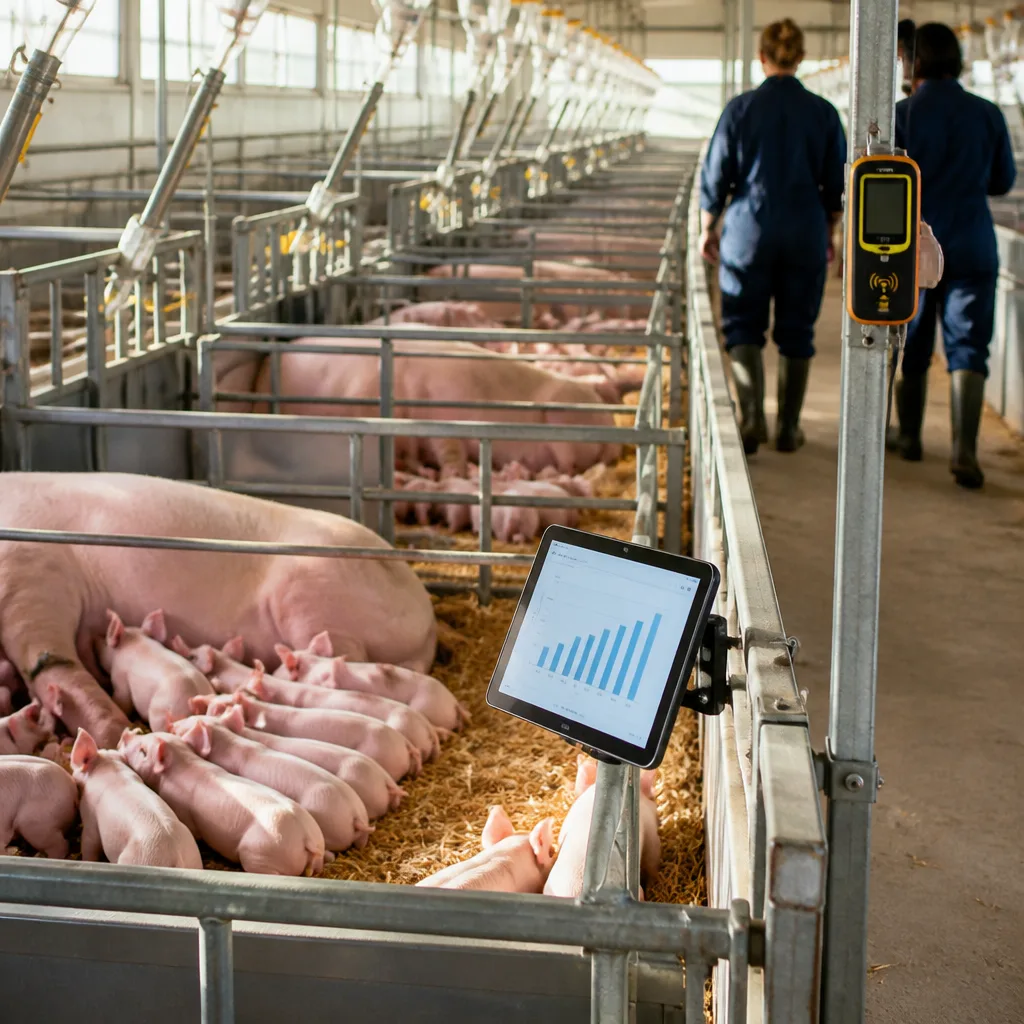
Dom Charman of CharmanAg highlighted that, although breeding herds often generate extensive datasets, finishing pigs commonly lack comparable individual-level records. That matters because finishing stock deliver the bulk of farm revenue and small differences in growth or health can materially affect margins.
Charman set out how electronic identification (EID) can bridge that information gap. When linked to live dashboards and EID-enabled weighing and sorting, individual-animal data exposes variation hidden by herd averages and enables targeted interventions. This can guide decisions on feeding, treatment and culling, and support health-monitoring programmes that tie farm-level management to abattoir assessments.
Ceva’s Lung Programme was cited as an example of how health-monitoring frameworks can use data to inform on-farm disease control and improve herd resilience. The discussion underlined a broader industry shift towards precision livestock farming tools as a way to manage the consequences of genetic gains and rising litter sizes.
Choices for producers and policy makers
Producers face choices about investing in additional space, redesigning pens, or adopting technologies such as EID to optimise management. For policy makers and advisory bodies, the evidence presented raises questions about whether current welfare and housing guidance fully reflects recent changes in biological productivity.
As litter sizes continue to evolve, the industry will need to balance the economic benefits of higher output with the capital and operational costs of adapting infrastructure and the ethical imperative to maintain high welfare standards.