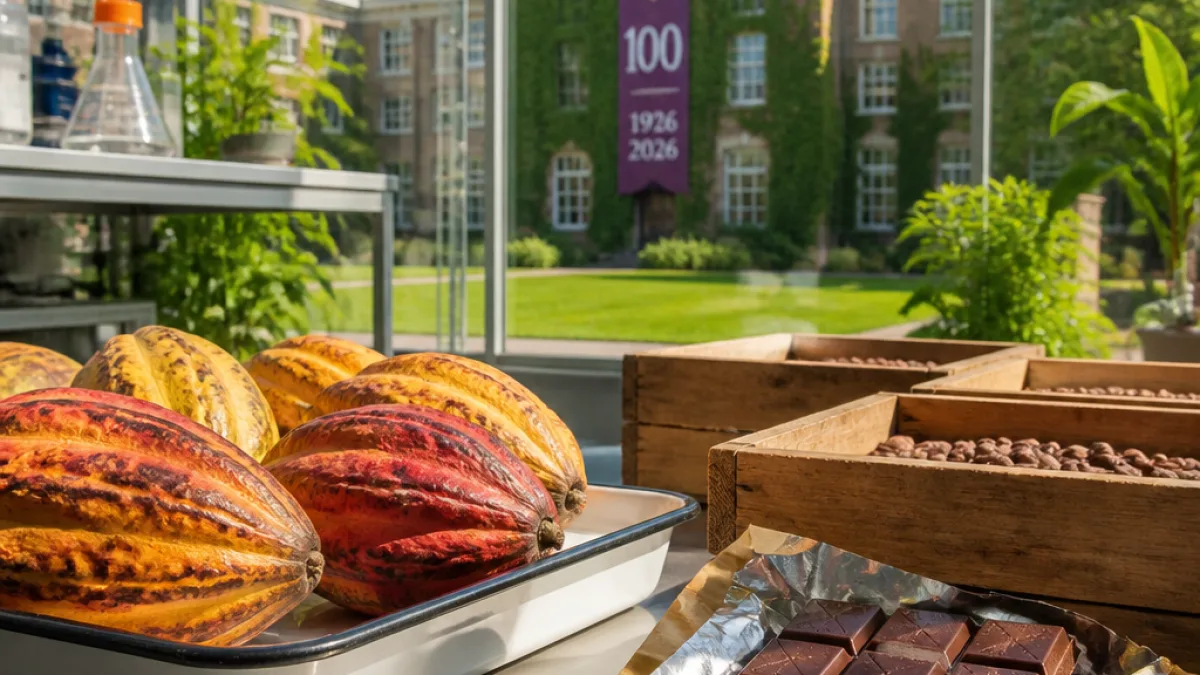
Scientists at the University of Reading have produced what the university describes as a chocolate bar made from cocoa beans grown, fermented and processed entirely in Berkshire, marking a rare example of a British bar created from locally cultivated cocoa. The project, timed to the university’s centenary celebrations, demonstrates both the possibilities of glasshouse and collection-based cultivation and the fragility of global food supplies on which the UK confectionery industry depends.
From pod to bar in Reading
The bar was made using beans harvested from cocoa plants kept in the university’s international collection. A masters student at Reading led the work, carrying out the harvesting, fermentation and processing in the university food department. The student, who was responsible for the hands-on production, said the experience allowed her to follow the whole chocolate-making process without leaving Reading.
“It has been amazing to follow the entire chocolate-making process, from pod to bean to bar, without leaving Reading,”
She added that the experience underlined the delicate nature of global cocoa supplies, pointing to the sensitivity of cocoa trees to temperature and rainfall changes and the pressures climate change places on producing countries. The university highlighted that varieties in its collection originate from more than 300 sources, an asset that could prove useful if harderier varieties are needed in future.
Local effort, global context
The UK is a major chocolate consumer with an industry valued at about £10.4bn, but it currently relies on imported cocoa. The Reading project therefore stands more as a research and demonstration exercise than a route to domestic self-sufficiency. Researchers say the work emphasises why protecting diverse cocoa varieties and supporting farmers overseas will be important as climate shifts affect traditional growing regions.
Those involved in the Reading trial also described sensory findings from the raw beans. Before processing, the beans were found to be coated in a white pulp with a flavour likened to lychee, a taste profile not familiar to many British consumers. The finished chocolate was described as having a rich and complex flavour characteristic, reflecting the mix of varieties used.
- Institution: University of Reading
- Project purpose: Demonstrate pod-to-bar chocolate production in Reading and highlight crop diversity
- Context: UK chocolate market worth approx. £10.4bn but reliant on imports
| Item | Detail |
|---|---|
| University anniversary | 100 years |
| Varieties in collection | 300+ |
| UK chocolate market value | £10.4bn |
For Reading residents, the project underlines the role of the university in practical agricultural and food science research. The work draws attention to local expertise in plant collections and food processing, and it may feed into public engagement and education activities at the campus and in the wider community. It also offers a tangible demonstration of how research can make complex supply issues accessible: a chocolate bar is a simple way to talk about biodiversity, climate risk and global trade.
While a single locally produced bar will not shift the economics of the chocolate business, the initiative highlights the kinds of research that could be relevant to farmers, industry and policymakers should the need arise to breed or select cocoa varieties able to withstand a warming climate. The university’s collection and the skills in its food department put Reading on the map as a place where such exploratory, hands-on experiments can be carried through from plant to product.
Those interested in tasting or learning more will likely see the project used as a showcase in university outreach over the coming months as Reading continues its centenary programming.