
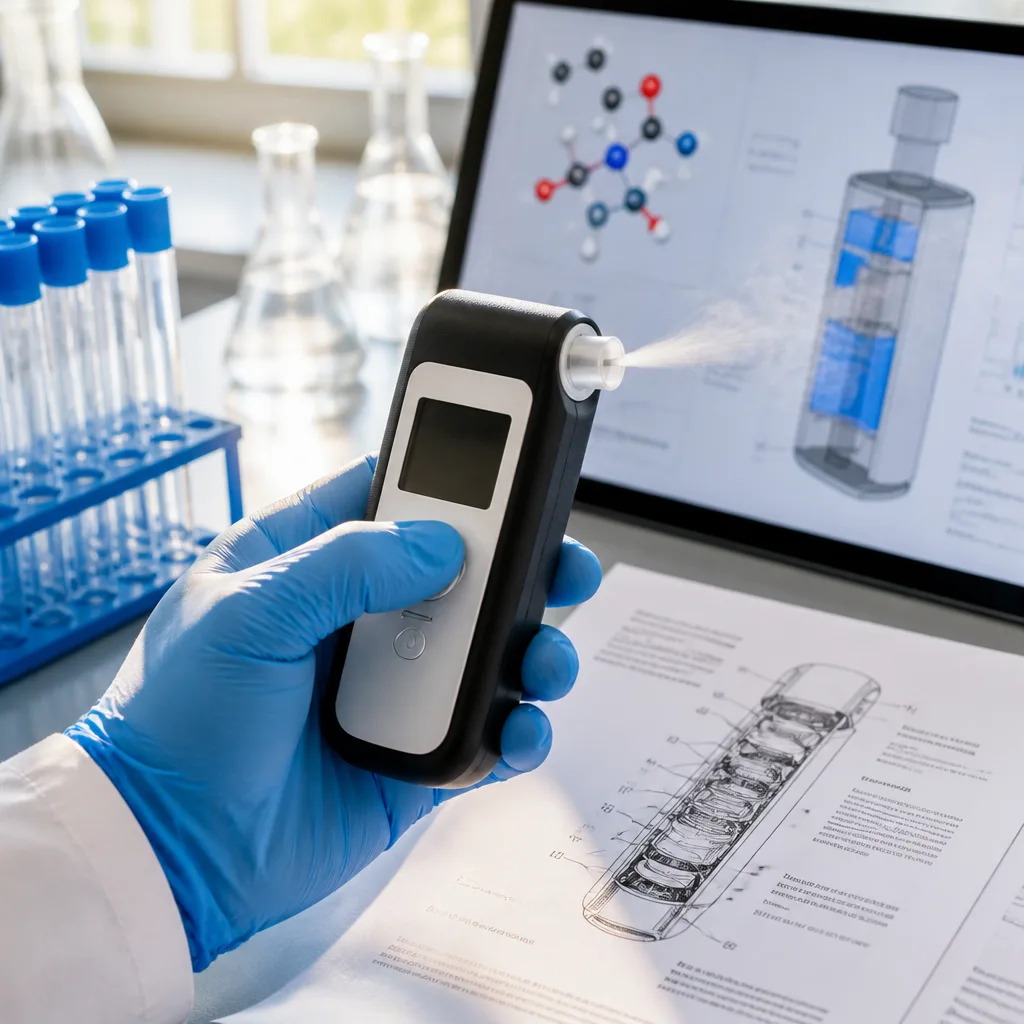
Nian Sun, a distinguished professor of electrical and computer engineering at Northeastern University, has been awarded a patent for a handheld breath sensor designed to identify viral particles in exhaled air.
From explosives to pathogens
The device evolved from technology originally developed to detect airborne traces of illegal drugs and explosives. The acceleration of diagnostic innovation during the COVID‑19 pandemic prompted Sun and colleagues to refocus the platform on biological targets, notably viral proteins such as the coronavirus spike protein.
The patented system uses a synthetic material known as a molecularly imprinted polymer (MIP). An MIP is manufactured around a target molecule to create complementary cavities that selectively capture that target, a technique researchers say holds promise for sensitive detection outside conventional laboratory settings.
Speed and user experience
Sun describes the test as non‑invasive and offering results almost immediately, comparing its convenience to that of a Breathalyser. He said the handheld device provided a useful alternative to slower polymerase chain reaction (PCR) diagnostics during the pandemic, which required swabbing and laboratory analysis. In his comments to Northeastern Global News he highlighted the difference in user experience:
"It's even faster than a swab test and much more user‑friendly."
The university’s account notes that swab‑based tests during the pandemic could take at least 15 minutes to yield a result under some circumstances, a point Sun used to underline the sensor’s potential advantage in speed and ease of use.
Patent protection, not yet a clinical device
The United States Patent and Trademark Office has issued legal protection for the gas sensor and associated methods, recognising the novelty of the approach. However, Sun acknowledges that the technology still requires further testing before it can be used as a clinical diagnostic.
The university’s release also records that other scientists have observed the promise of MIP‑based sensing while noting the gap between laboratory demonstrations and commercial development.
- Origin: Technology adapted from chemical detection (drugs/explosives) to pathogen sensing.
- Core material: Molecularly imprinted polymer (MIP) that captures target molecules.
- Regulatory milestone: Patent issued by the US Patent and Trademark Office.
Below is a brief summary of the device’s claimed attributes as reported by Northeastern:
| Attribute | Reported detail |
|---|---|
| Detection target | Viral particles (example: coronavirus spike protein) |
| Sample matrix | Exhaled breath |
| Primary sensing material | Molecularly imprinted polymer (MIP) |
| Current status | Patent issued; requires further testing before clinical use |
Context and implications
Rapid, non‑invasive diagnostics are an active area of research because they promise to reduce logistical burdens posed by laboratory testing and uncomfortable sampling. Breath‑based approaches appeal because they simplify collection and could accelerate triage in settings such as airports, clinics or workplaces.
But there is a distinction between proof‑of‑concept and a validated clinical tool. Regulatory approval for diagnostic devices typically requires robust clinical studies demonstrating sensitivity, specificity and real‑world performance across diverse populations and viral loads. The university statement is clear that such work remains to be done for Sun’s sensor.
Meanwhile, the patent establishes a legal foundation that could support further development, licensing or commercial partnerships if subsequent testing proves the technology’s clinical utility. Observers who study MIP materials have long flagged their potential for selective recognition; translating that chemistry into reliable, manufacturable devices is the next challenge.
The prospect of near‑instant breath testing is appealing, but the path from a patented concept to a product used by clinicians and the public involves technical validation, regulatory scrutiny and commercial scaling. The patent is an important milestone, but it is one step among many before the device could change routine diagnostic practice.









