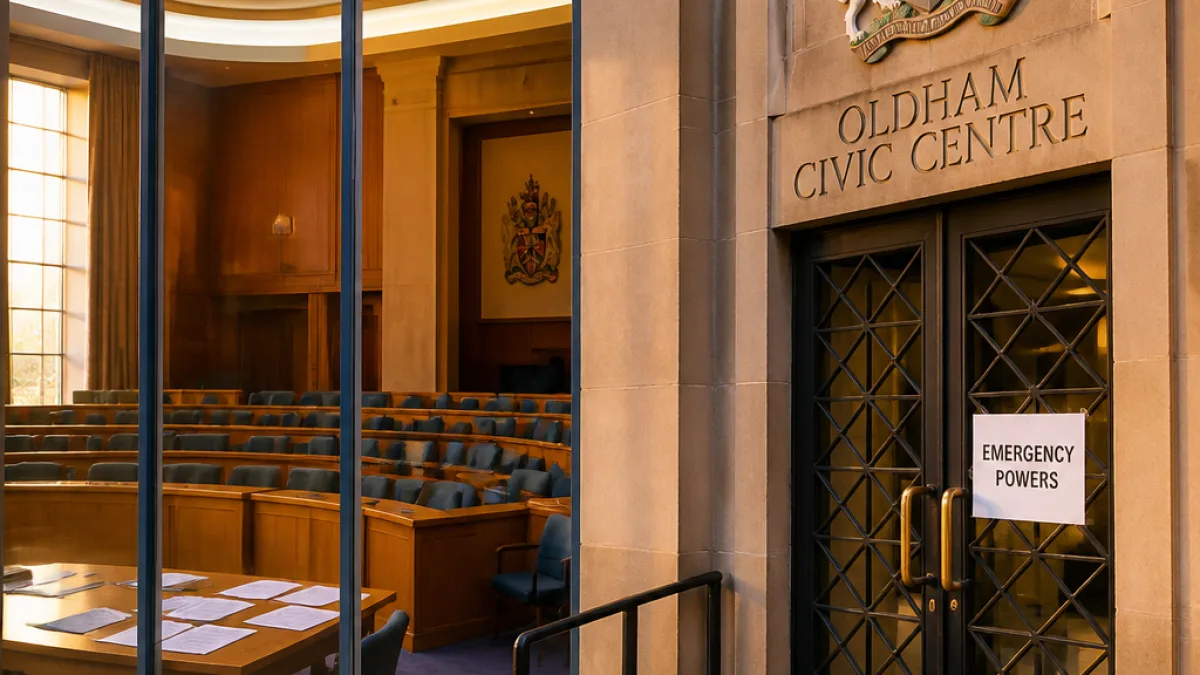
Oldham’s local authority has been publicly described by its senior officers as operating outside legal requirements after months of political deadlock following the 2026 local elections. The turmoil centres on the council’s inability to form a proper cabinet and to appoint an elected member to oversee children’s services, two conditions the council constitution and UK law expect to be in place.
Officers using emergency powers to keep services running
With no party holding a third of seats on the chamber, and deep divisions between councillors, officers have been resorting to emergency powers to keep essential functions moving. That has prompted officials to warn that the council is now breaching its own rules and, potentially, the law.
The crisis follows a messy result at this year’s elections in which Labour lost multiple seats and the Reform party made significant gains. No clear majority emerged and the arithmetic in the council chamber has left no obvious route to stable leadership. Meetings have been marked by loud exchanges and public blame between councillors, according to those following proceedings.
- Revenue budget: £368m — the scale of finances the council must manage without clear political direction.
- Leadership gap: No appointed leader or established cabinet since May 2026.
- Statutory role vacant: No elected councillor in charge of children’s services.
The consequences are concrete. The council’s constitution requires a leader and cabinet to be in place; the absence of these decision-makers means officers — whose role is to administer policy set by elected members — are making choices normally reserved for politicians. That departure from normal practice is what has led senior officials to conclude the authority is breaking the law.
“You never know what the electorate is going to do. It could produce something which makes the maths more viable but I do not t”
The comment above comes from Stuart Wilks‑Heeg, Professor of Politics at the University of Liverpool, who said he had not seen a situation like Oldham’s in his experience. He suggested there is potential for resolution at the next scheduled ballot but warned the outcome is unpredictable.
What the deadlock means for residents
For residents, the immediate worry is clarity and accountability. A council without a leader or cabinet leaves questions over who is responsible for setting policy direction and for handling difficult decisions, particularly on services that affect families and vulnerable people.
Children’s services are singled out in the council’s own statements as needing an elected member to oversee them. The lack of that statutory appointment raises particular concern given the sensitivity and legal requirements attached to safeguarding and children’s welfare.
While the use of emergency powers may prevent an abrupt collapse of services, it is a stopgap. Officers implementing urgent measures are not elected and are not intended to carry the political mandate required to make long‑term strategic choices about the borough’s future.
Paths to resolution
Local sources and academic comment point to two possible routes to resolve the impasse: either a negotiated cross‑party arrangement that installs a leader and cabinet acceptable to enough councillors, or a fresh electoral test. The next scheduled elections are in May 2027, and there is a possibility of an all‑out poll which would put every seat up for grabs — but there is no guarantee that would deliver a majority or clear mandate.
| Item | Detail |
|---|---|
| Council revenue budget | £368m |
| Next scheduled elections | May 2027 (possible all‑out poll) |
In the meantime, the borough carries on under an unusual arrangement where senior officers make high‑level decisions to “keep the lights on”. That arrangement is proving contentious because it steps into territory normally filled by elected politicians, and now a legal question hangs over the council’s conduct.
Oldham residents watching the rows at the town hall should be in no doubt of the practical stakes: policy direction, oversight of vital services and financial stewardship of a £368m budget are all at risk while councillors remain unable to form a working administration.
There is public hope that the forthcoming year will produce a solution, but as one academic commentator warned, the electorate can be unpredictable — and the current situation underlines how fragile local governance can become when political divisions harden rather than heal.