
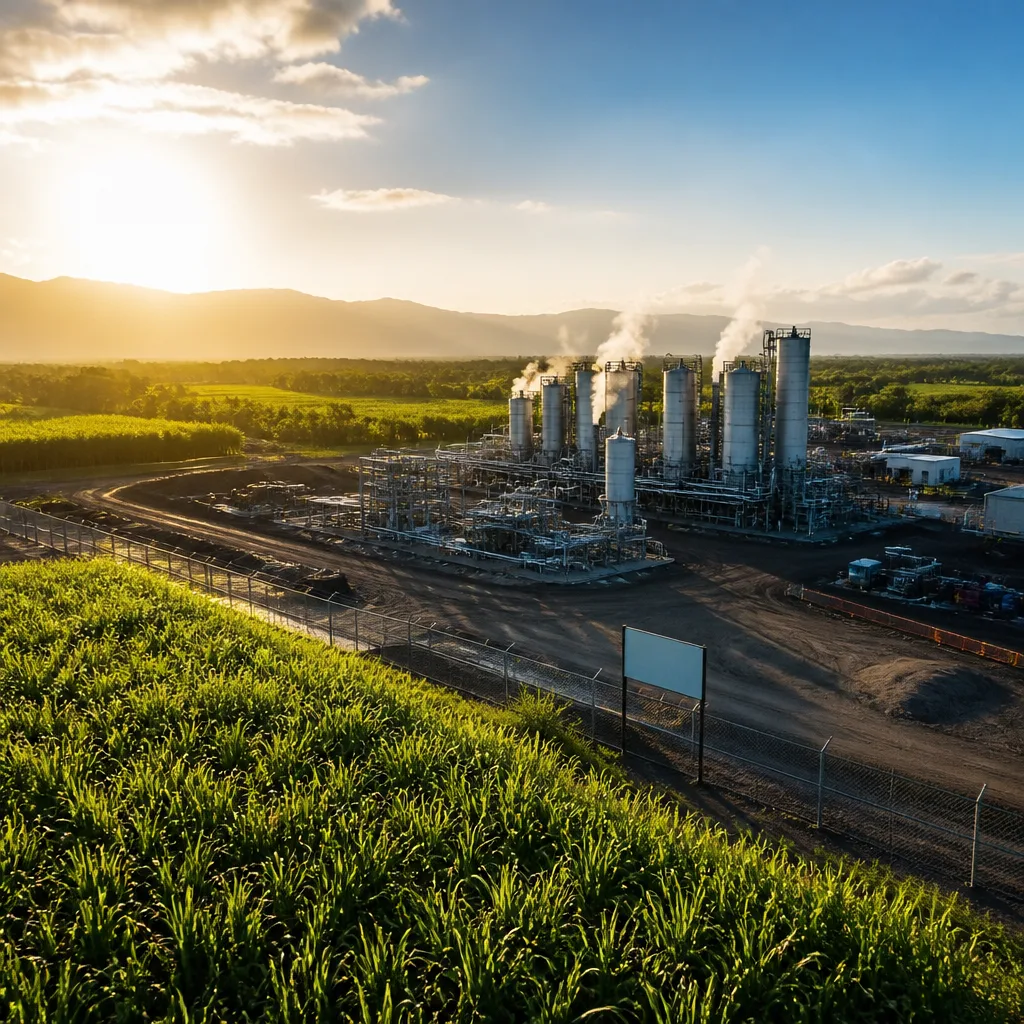
Nextchem has been appointed to supply licensing, a Process Design Package (PDP) and engineering services for the syngas element of Project Lion, a renewable fuels initiative in North Queensland, Australia. The work will use Nextchem’s proprietary NX Circular™ Gasification technology to convert local sugarcane residues into purified chemical-grade syngas, which will then feed third-party synthesis routes to produce sustainable aviation fuel (SAF) and renewable diesel.
Technology and output
The contract, awarded by SKY Renewables Burdekin Pty Ltd and carried out through Nextchem’s subsidiary MyRechemical, covers licensing and the engineering design package for the gasification stage of the plant. It is conditional on a formal Notice to Proceed for most elements, with the exception of some engineering services.
When scaled up, Project Lion is modelled to produce as much as 125,000 tonnes of sustainable aviation fuel per year from agricultural residues — specifically sugarcane tops and trash that would otherwise often be burned in the field. Turning those residues into syngas is intended to supply downstream conversion processes operated by third parties.
| Item | Detail |
|---|---|
| Feedstock | Sugarcane residues (tops and trash) |
| Technology | NX Circular™ Gasification (Nextchem) |
| Potential annual SAF output | 125,000 tonnes |
Why it matters
This award highlights two intersecting trends in decarbonisation: the use of waste and residue biomass as feedstock for low-carbon fuels, and the deployment of modular gasification technology to produce a chemical intermediate — syngas — that can be converted into multiple fuel products. By valorising agricultural residues, the project aims to avoid open-field burning and create a local feedstock supply chain for low‑carbon aviation fuels.
- Resource efficiency: uses locally available residual biomass rather than purpose-grown crops.
- Flexibility: syngas can be routed to different conversion technologies for SAF or renewable diesel.
- Scale potential: the quoted output is significant for the SAF market, where supply constraints are a major barrier to uptake.
“This award confirms the strategic relevance of Nextchem’s proprietary technologies in enabling the development of sustainable fuels from renewable and residual feedstocks,” said Fabio Fritelli, Managing Director of Nextchem.
The contract also underlines Australia’s growing role in the development of sustainable fuel projects. North Queensland’s Burdekin region is a dense sugar-growing area where tops and trash are an abundant by-product of harvesting. Projects that convert such residues into higher-value, lower-carbon products have the potential to both reduce emissions and boost rural economic activity.
Commercial and technical context
Nextchem’s package focuses on the syngas stage — the complex thermochemical step that breaks down biomass into a mixture of hydrogen, carbon monoxide and other gases. The purified syngas is then intended to be processed by third-party technologies to make finished fuels, meaning the project brings together multiple specialist suppliers across the value chain.
The award is contingent on a Notice to Proceed for most project elements. That condition is typical for large industrial projects and means the commercial relationship will be fully confirmed once the project developer completes its internal approvals and financing milestones.
For the UK and other markets watching the SAF sector, Project Lion is a reminder that feedstock diversity — including agricultural residues — is likely to be part of the route to scaling SAF production. Delivering projects at scale, however, will require co‑ordination between technology licensors, engineering firms, financiers and fuel conversion providers, and will be sensitive to local logistics and regulatory support for low‑carbon fuels.
Nextchem’s engagement in Australia adds to a growing global pipeline of projects seeking to convert waste biomass into low‑carbon fuels, and will be one to watch as it progresses through permitting and construction milestones.









