
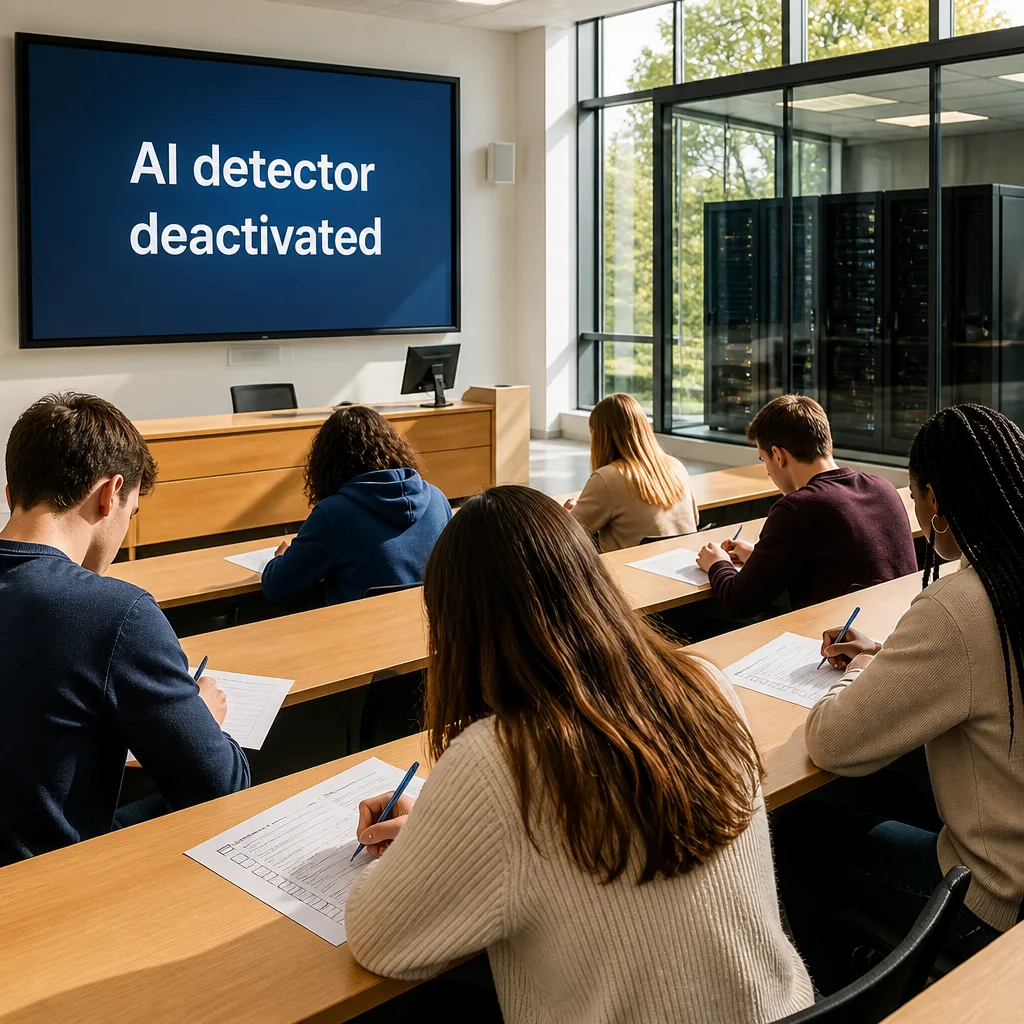
Nanyang Technological University (NTU) has announced it will stop using its institutional artificial intelligence detector from 2027, saying the technology is "fundamentally unreliable" and cannot be used as evidence of academic misconduct.
Move away from automated surveillance
The university will deactivate the detector on 31 December and will no longer treat AI probability scores as proof in disciplinary cases, according to an email to faculty members signed by associate vice-provost for education transformation Tan Seng Chee. NTU said the tools lack "empirical validity" and cannot reliably distinguish between unauthorised AI use and responsible, curriculum-sanctioned use.
"[The tools] lacked 'empirical validity' and could not distinguish between unauthorised AI use and responsible use of the technology as part of the curriculum."
Instead of continuing with automated detection, NTU will prioritise assessment approaches that document how students develop and complete their work. The university plans to introduce standardised disclosures of AI use and emphasise assessment design that captures students' processes and reasoning.
Reasons and consequences
NTU has flagged a number of practical and fairness concerns about AI detectors that informed the decision. Its internal guidance warns detectors can produce both false positives and false negatives, be evaded by small edits to text and potentially disadvantage students whose writing reflects non-native language patterns.
Faculty were instructed that automated AI flags or scores should not be used as evidence in alleged violations. The university also noted that ambiguous detection reports can create unnecessary administrative burdens and harm teacher–student relations.
The move comes as NTU expands access to sanctioned institutional AI tools for staff and students. University leaders argued that running detection software alongside approved AI use risks sending mixed messages about acceptable practice.
Context within higher education
NTU's change follows a dispute in 2025 involving three students who were accused of improper AI use and contested the allegations, raising concerns about due process. The episode is part of a wider debate among universities globally about whether existing AI-detection tools are robust enough for high-stakes judgements.
- Deactivation date: 31 December (end of this semester)
- Policy change: AI-probability scores will no longer be presented as evidence of misconduct
- New emphasis: Documentation of student process and standardised AI-use disclosures
Universities and vendors have struggled to create detectors that reliably discriminate between human and machine output. NTU's decision highlights the limits of current commercial and experimental tools and the potential harms when such tools are used in disciplinary contexts.
| Aspect | NTU position |
|---|---|
| Use of AI detectors | To be deactivated; not admissible as evidence |
| Sanctioned AI access | Expanded for faculty and students |
| Alternative approach | Assessment redesign and standardised disclosures |
What this means for students and staff
For students, NTU's shift reduces the risk that an automated score alone could lead to accusations of misconduct. For staff, it calls for greater emphasis on designing assessments that reveal how work was produced, rather than relying on opaque algorithmic verdicts.
NTU's own guidance acknowledges technical limits: detectors may be bypassed by minor text changes and may misclassify writers whose style diverges from models used to train detection software. Those practical failings, the university said, created unfair outcomes and administrative strain.
As universities wrestle with how to integrate AI into teaching and assessment, NTU's approach emphasises process transparency and academic judgement over automated policing — a stance likely to influence other institutions weighing the costs and benefits of detection technology.









