
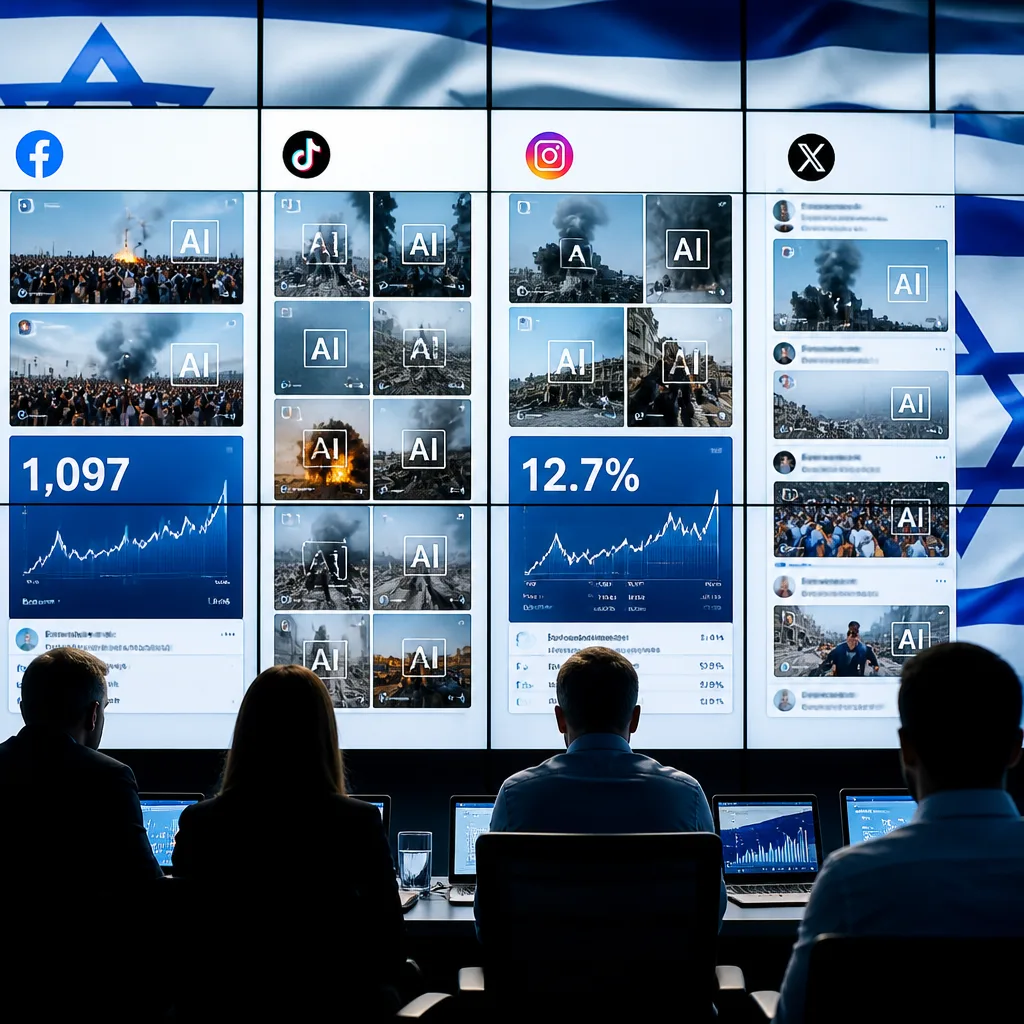
The Open University has recorded 1,097 items of election-related content created with the assistance of artificial intelligence, accounting for 12.7% of political posts uploaded since 28 July, the institution said.
Scale and provenance of AI use
The monitoring project, titled "This is AI", scans the social media accounts of political parties and candidates to identify use of AI in photos, videos, audio clips and text. It examines posts on Facebook, TikTok, Instagram and X. The initiative tracks both content evidently generated by AI and material that appears to have been edited using AI tools.
The data gathered so far indicates a concentrated pattern of use. The party identified as publishing the largest share of AI-assisted material is Likud, whose politicians are responsible for roughly 70% of the flagged items.
| Measure | Value |
|---|---|
| Total AI-assisted posts identified | 1,097 |
| Share of monitored political content | 12.7% |
| Leading party's share of AI posts | ~70% (Likud) |
Method and purpose of the project
Project leaders say the aim is to improve public transparency about how AI is being deployed in an electoral setting. The monitoring process uses several checks to determine whether AI tools were used, including:
- whether the account holder explicitly declared AI use as required by the Central Elections Committee;
- whether the platform has labelled the content as AI-generated;
- and whether the material carries a watermark from an AI system.
If those visible indicators are absent, the project applies further analysis to reach a conclusion about AI involvement.
“We want to create public transparency tools to help the public deal with the entry of AI into the electoral system, and also to help maintain the integrity of the elections,” Prof. Anat Ben‑David of the Open University, who leads the project, told Calcalist.
Context and concerns
Project organisers say this is the first election in Israel where AI has been used at scale in political campaigning in the ways the researchers have documented. They emphasise that detecting AI is not an exercise in technological alarmism. Instead, the work is framed as a response to a new form of electoral communication whose origins and methods are not yet familiar to many voters.
Prof. Ben‑David told reporters the intention is to help citizens answer a basic question when they consume political material: Is it AI? The project does not, at this stage, make normative judgments about whether AI use is inherently wrong. Its stated priorities are transparency and preserving election integrity by cataloguing and classifying the presence of synthetic content.
Implications for regulation and oversight
The findings touch on a growing policy debate. Regulators and election authorities in many countries are grappling with how to require disclosure, label synthetic media and impose penalties where manipulation undermines democratic processes. The Open University project demonstrates both the technical challenge of detecting AI and the practical importance of clear labelling rules.
For campaign watchers, the distribution of AI use — heavily weighted towards one party in the data so far — will prompt further scrutiny of how different political organisations are adopting new tools. For voters, the immediate consequence is a need for greater awareness of how social media content may be produced or altered.
The project continues to monitor uploads and will update its public database as it analyses more material. Its organisers say they expect the techniques and volume of AI-assisted content to evolve during the campaign, reinforcing the need for ongoing surveillance and public guidance.












