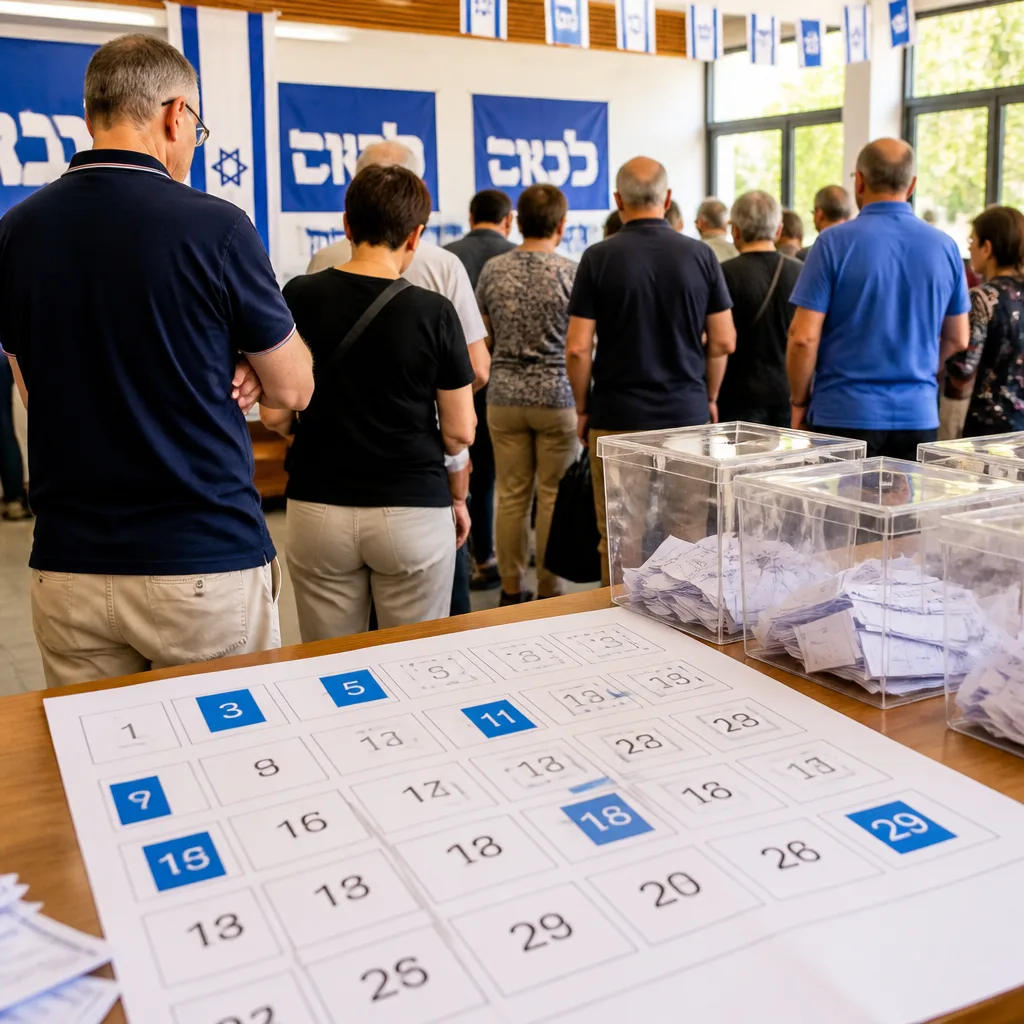
Polling stations across Israel opened on Monday for the 140,000 registered members of the Likud party to cast ballots in a primary that could reshape the governing party’s parliamentary slate and provide an early signal about its direction ahead of the general election on 27 October.
Netanyahu’s expanded influence
Changes adopted last month by the Likud Central Committee have given Prime Minister Benjamin Netanyahu greater control over the party list. Under the decision, he may place eight personally chosen figures into reserved positions among the top 29 places on the list. Those slots are the 3rd, 5th, 9th, 11th, 15th, 18th, 26th and 29th positions.
The move, which passed despite rare public dissent within the party, has narrowed the number of open spots available to candidates competing in the primary and intensified the contest as incumbents and newcomers vie for electable positions. One senior party critic, MK David Bitan, publicly argued the change would demote sitting lawmakers in favour of handpicked figures who would be beholden to the premier.
What the primary will tell observers
Analysts and party insiders will watch the results for two distinct signals. First, the vote will indicate whether Likud’s membership continues to drift to the right and consolidate further under Netanyahu’s leadership. Second, it may reveal whether an internal push for moderation has gained traction by elevating candidates seen as less directly tied to the prime minister.
Public opinion polling has suggested a decline in Likud’s standing since the last Knesset. Surveys cited ahead of the vote have consistently placed the party at roughly 22–24 seats in October’s projections, down from the party’s current 32 seats in the Knesset. With the number of winnable slots reduced, many incumbent MKs face an uncertain prospect of returning to parliament.
- Membership voting: 140,000 Likud members eligible to vote in the primary.
- Reserved slots under Netanyahu’s control: 3, 5, 9, 11, 15, 18, 26, 29.
- Poll projections: Likud polling at about 22–24 seats ahead of the 27 October election, down from 32 today.
| Item | Number |
|---|---|
| Registered Likud voters | 140,000 |
| Current Knesset seats held by Likud | 32 |
| Polling projection (approx.) | 22–24 |
Practical and political consequences
The outcome will determine which candidates secure the limited open slots and who may need to rely on Netanyahu’s reserved placements to enter the Knesset. That dynamic may strengthen the premier’s ability to shape the parliamentary faction and, by extension, the next coalition if the pro-Netanyahu bloc succeeds in October.
For challengers and long-serving members, the contest is an immediate test of local and national support. Many newcomers have entered the race, seeking to capitalise on the reduced slate and the public’s shifting preferences. The primary is also taking place against a backdrop of heightened scrutiny of the party’s internal democratic processes, with critics arguing the new arrangement concentrates power at the top.
Party officials went ahead with the membership vote after attempts to cancel the primary were reportedly defeated. Apart from the reserved slots and his own position at the head of the list, Netanyahu’s ability to choose several high positions marks an unprecedented degree of formal influence over Likud’s parliamentary roster, according to the party’s recent motion.
As ballots are counted and results begin to emerge, political operatives will be analysing who benefited from grassroots support and who will instead depend on reservation by the leader. The primary result will not only shape the Likud list but may also set the tone for coalition bargaining and policy priorities if the party remains the largest in the next Knesset.
Whatever the immediate arithmetic, the contest underscores how internal party rules and leadership decisions can have outsized effects on electoral outcomes and the composition of government.