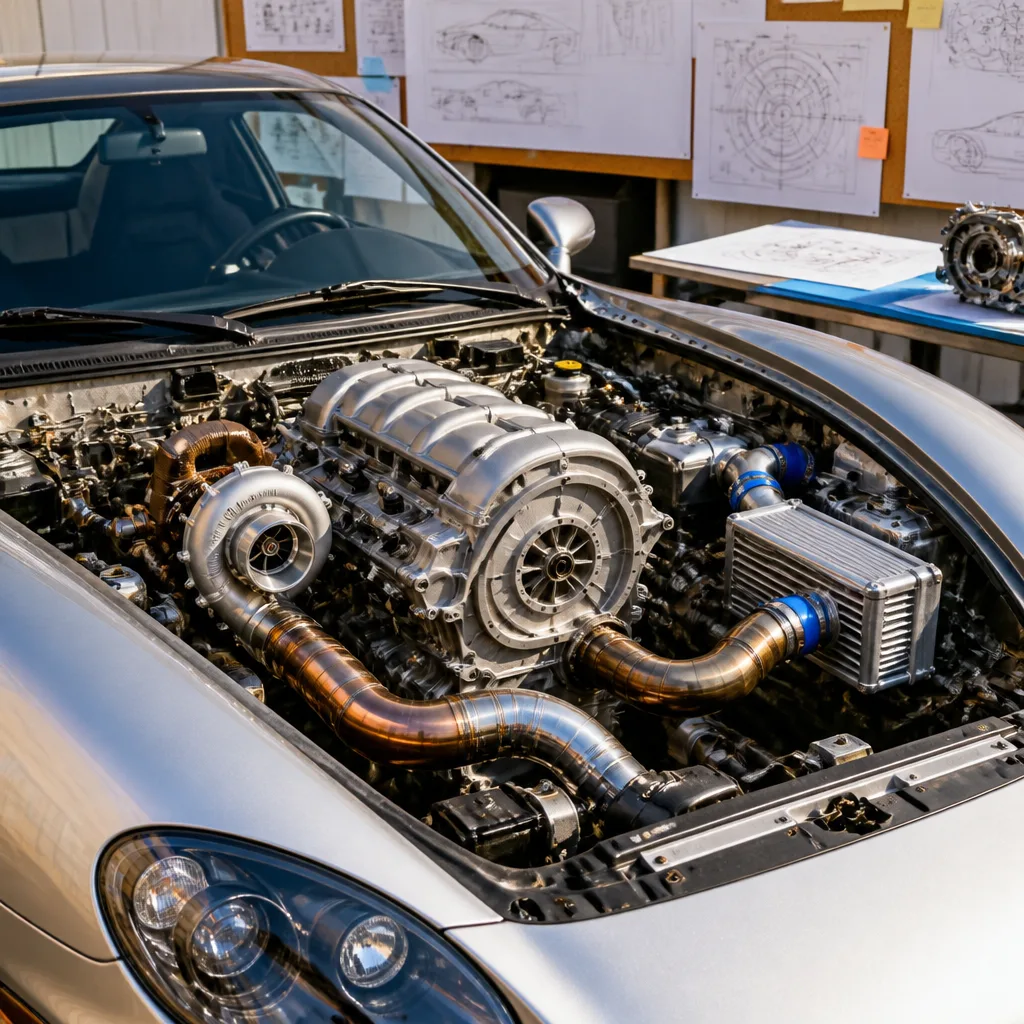
Mazda has filed a patent that proposes a bespoke exhaust gas recirculation (EGR) arrangement for Wankel rotary engines, underlining the company's continued engineering interest in the unconventional power unit. The filing, lodged with the US Patent and Trademark Office at the beginning of the year and unearthed by CarBuzz, describes a dual-path approach that separates hot and cooler exhaust flows from the rotary’s different ports to improve both performance and emissions control.
How the system works
The patent lays out a concept that uses the characteristically uneven exhaust flows of a Wankel engine to split duties between boosting and recirculation. In the proposed design:
- hot exhaust leaving a side port is channelled into a turbocharger to raise power and torque; and
- cooler exhaust emerging from the peripheral port is routed through an additional cooler using engine coolant, then fed back into the combustion process to lower operating temperatures and reduce the formation of oxides of nitrogen (NOx).
This arrangement aims to shrink the space and complexity normally needed for EGR cooling. The patent explains that because only the relatively cool peripheral-port exhaust is treated by the EGR cooler, the sizing and packaging of that cooler can be much more compact and positioned adjacent to the engine — a practical consideration in performance‑oriented cars where space is at a premium.
Emissions and packaging trade-offs
The core claim in the filing is pragmatic: channel the hot exhaust to a turbo, use the cooler exhaust for EGR, and keep the cooling hardware small enough to fit close to the engine bay. That has two immediate effects. First, using the side‑port flow for turbocharging preserves a route to higher power and torque figures — useful if Mazda intends the layout for a sports car. Second, recirculating cooled peripheral-port gases targets NOx reduction without the need for a bulky, high-capacity cooler.
The patent also notes a practicality for normal driving: when EGR is not required, the system routes exhaust directly to a second catalytic converter instead of sending it back into the combustion chamber.
“We have to caution that a patent doesn't equal production intent, or even that the technology can ever be put into production.”
The filing itself includes the standard caveat that a granted patent does not guarantee the concept will reach showrooms. Patents often represent exploratory work or proof‑of‑concepts that may never make it into a production vehicle.
What this could mean for a rotary revival
The inclusion of a turbocharger in Mazda’s drawings suggests the setup would be intended for an application where the rotary engine drives the wheels, rather than a range‑extender or auxiliary generator role. Mazda's last model to deliver rotary power directly to the wheels was the RX‑8, which left production in 2012. The RX‑8 used a naturally aspirated 1.3‑litre twin‑rotor Wankel, known as Renesis II, with output figures described in the patent’s context between 143kW/198Nm and 173kW/216Nm depending on specification.
If Mazda is testing ways to reconcile the rotary’s packaging and power density with modern emissions constraints, this twin-path EGR/turbo concept is a sensible engineering direction. It addresses two familiar Wankel weaknesses — thermal management and NOx formation — while retaining the engine’s potential for high specific power.
Limits and next steps
Important caveats remain. A patent filing simply evidences research activity; it does not reveal whether Mazda has solved production durability, emissions certification, cold‑start control or real‑world fuel consumption — all areas where rotaries have historically struggled. The company will also have to demonstrate compliance with increasingly tight emissions standards should it wish to fit such engines in road cars sold across global markets.
Still, the patent is an explicit technical sketch of how Mazda engineers might attempt to keep the Wankel relevant in a turbocharged, emissions‑constrained age. Whether it leads to a new rotary‑powered sports car, or is another inventive dead end, will depend on how these ideas perform beyond the drawing board.
| Item | Detail |
|---|---|
| Patent filed | With US Patent and Trademark Office, early in the year |
| Discoverer | CarBuzz |
| Key technical idea | Split exhaust flow: hot side‑port to turbo; peripheral‑port cooled and recirculated for EGR |
| Previous rotary road car | RX‑8 (production ended 2012); Renesis II 1.3L twin‑rotor outputs ~143–173kW |