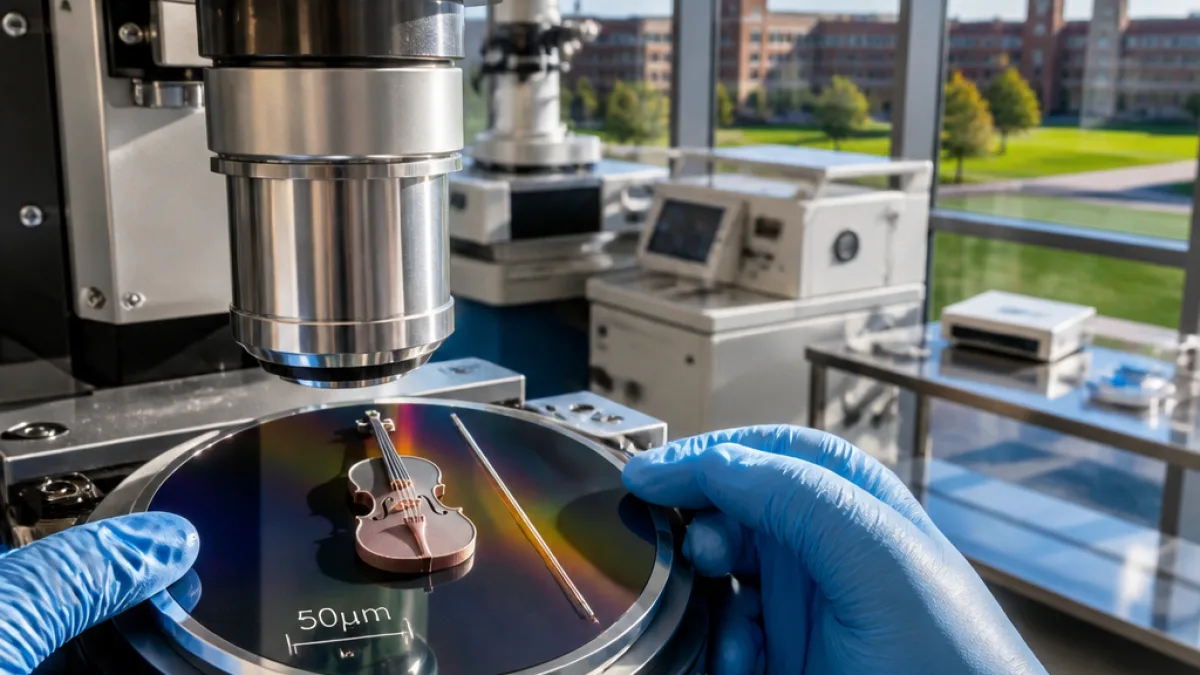
Physicists at Loughborough University have announced the creation of what they believe is the world’s smallest violin, a platinum instrument measuring just 35 microns in length and 13 microns across. The miniature object, produced as part of tests on a newly installed nanolithography system, has been recognised by the World Record Academy, the university said in a statement.
Technical demonstration with wider research aims
The tiny violin was fabricated to demonstrate the capabilities of the university’s advanced nanolithography suite, a collection of tools designed to let researchers build and examine structures at the nanoscale. In its press release the university said the system will back a range of projects aimed at discovering new materials and techniques for developing the next generation of computing devices.
To place the instrument’s size in context, a micron is one millionth of a metre. The university compared the violin’s dimensions with everyday microscopic measures: a human hair typically ranges from 17 to 180 microns in diameter, while microscopic creatures called tardigrades measure roughly 50 to 1,200 microns.
- Material used: platinum
- Length: 35 microns
- Width: 13 microns
- Purpose: demonstration of a new nanolithography system for materials research
“Though creating the world’s smallest violin may seem like fun and games, a lot of what we’ve learned in the process has actually laid the groundwork for the research we’re now undertaking,” said Professor Kelly Morrison, Head of the Physics department and an expert in experimental physics.
The university described the project as partly playful — a nod to a common pop-culture phrase — but said the exercise yielded valuable practical knowledge. According to the press release, the nanolithography facility allows experiments that probe materials by applying light, magnetism or electricity and observing how those materials respond.
Local impact and future research directions
For Loughborough, the installation of a high-spec nanolithography system represents a boost to the university’s scientific infrastructure. The university said understanding how materials behave at very small scales is a prerequisite for applying that knowledge in practical technologies, from improving computing efficiency to exploring new methods of harvesting energy.
The record-setting violin is presented as an early output of a set-up intended to support multiple research projects. The university has not specified which specific projects will start immediately, but the statement emphasised the system’s role in enabling experimental designs that combine different physical probes to access fundamental material behaviour.
| Item | Measure |
|---|---|
| Violin length | 35 microns |
| Violin width | 13 microns |
| Human hair (typical) | 17–180 microns |
| Tardigrade size (typical) | 50–1,200 microns |
Local stakeholders, including students and research partners, are likely to take an interest in how the facility will be used going forward. The university has framed the nanolithography system as a platform that will enable teams to design experiments and then apply emergent findings to device development and energy-related research.
While the world record for the smallest violin draws attention because of its novelty, the university stresses the instrument’s real value lies in what the process taught researchers about the capabilities of the equipment and how that will shape future investigations.
As the university moves from demonstration pieces to applied projects, the coming months and years will show how the facility influences both academic work and any potential collaborations with industry partners in computing and energy.