New networked AV system aims to make teaching more flexible across campus
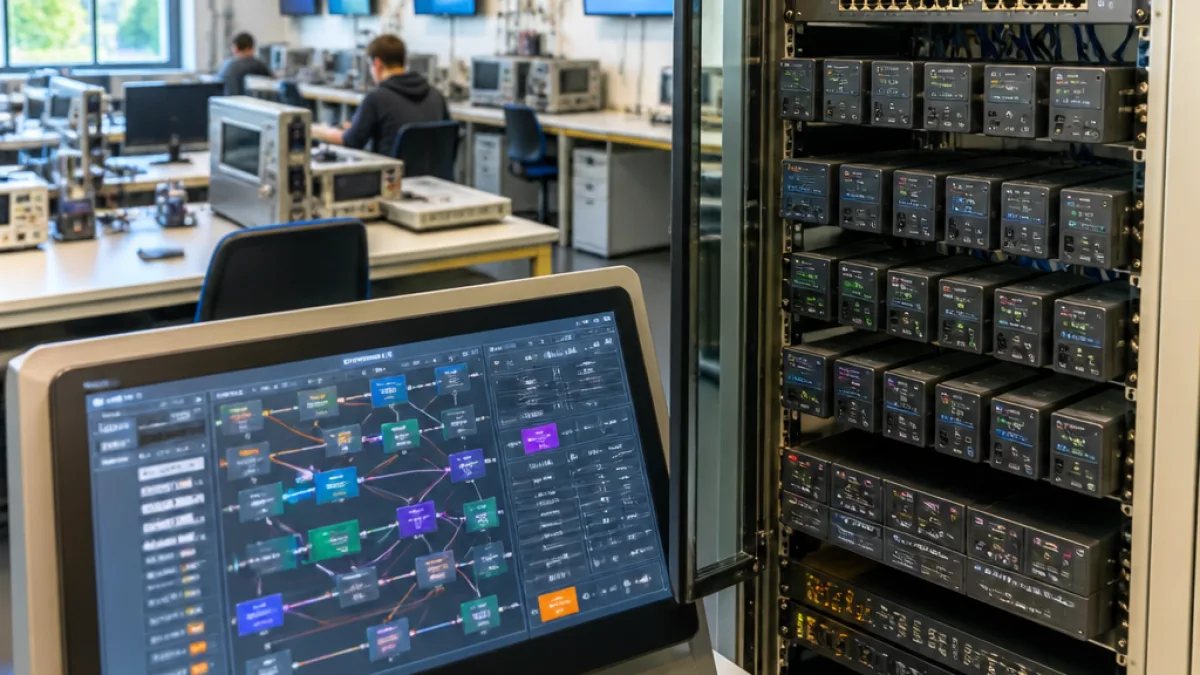
Loughborough University has completed a major upgrade of its STEM teaching facilities by installing an open AV over IP (AVoIP) infrastructure designed to route content between teaching spaces, centralise management and provide a scalable platform for future needs.
The deployment replaces an older point-to-point AV setup that integrators and university staff found restrictive as teaching methods evolved. The new system is built around 93 PlexusAV P-AVN-4 transceivers and the vendor’s Visual Array Management Platform (VAMP), allowing the AV team to monitor and manage devices from a single interface.
Project partners included AV integrator GVAV, onemedia and PlexusAV. The upgrade followed collaborative workshops and proof-of-concept testing to assess the university’s requirements and to evaluate alternative approaches such as HDBaseT and Dante.
- Devices deployed: 93 PlexusAV P-AVN-4 transceivers
- Management: Visual Array Management Platform (VAMP)
- Network: designed to operate over the existing 1Gb network
- Codec support: H.264, H.265, IPMX and JPEG XS
One of the aims of the new configuration is to allow content to be moved between rooms rather than being confined to individual teaching spaces. That change is intended to give academics greater flexibility in how they present and share materials, particularly important in practical and multi-space STEM teaching.
"Technology is the key enabler for us. It’s all about supporting the academics’ need for flexibility – presenting in different ways in a seamless, engaging and inclusive environment."
The quotation above is from Aaron Turlington-Smith, AV manager at Loughborough University, who highlighted the pedagogical purpose behind the technical upgrade. Centralised monitoring via VAMP is already giving the university’s AV team improved visibility across the system, with Turlington-Smith reporting reduced reactive maintenance requirements.
Balancing bandwidth, latency and sustainability
The technical design takes account of bandwidth limitations in parts of the university’s existing network. To manage that, the system supports both high-compression and low-compression workflows: high-compression streams (H.264/H.265) can connect multiple teaching spaces over the 1Gb network, while low-compression JPEG XS streams are used where low latency within a single room is required.
| Codec | Primary use |
|---|---|
| H.264 / H.265 | High-compression streams for multi-room connectivity |
| IPMX | Open standard support / interoperability |
| JPEG XS | Low-latency, low-compression streams within rooms |
GVAV’s technical project manager, Scott Meikle, said the infrastructure was designed around open standards to give the university greater visibility and flexibility and to allow the system to evolve over time. Those design priorities reflect an intent to retain some existing network infrastructure and AV equipment rather than replacing everything.
Sustainability was also a consideration in the specification. PlexusAV’s Eco Mode reduces transceiver power consumption outside teaching hours, a feature the university has enabled across the deployment.
For campus users, the practical outcomes expected from the upgrade are clearer access to teaching content across rooms, fewer interruptions from equipment faults as monitoring improves, and a platform that can be adapted as teaching methods change. For the AV team, centralised control should reduce time spent on reactive maintenance and make longer-term planning easier.
While the project was technical in nature, its aim is plainly educational: to create a more adaptable and inclusive teaching environment for STEM subjects at one of the region’s major universities. Local students and staff can expect to see the benefits in timetabled practicals and cross-room teaching activities as the system beds in.